
“KORU stock” is a common search phrase, but KORU is not a company. It is the Direxion Daily MSCI South Korea Bull 3X ETF, a leveraged fund designed to seek three times the daily performance of the MSCI Korea 25/50 Index before fees and expenses. The word “daily” is the part traders cannot afford to skip.
KORU can offer a direct way to express a short-term bullish view on major South Korean equities. It can also produce fast losses, volatility drag and returns that look nothing like three times the Korean market over a month or year.
What Is KORU Stock?
KORU’s full name is Direxion Daily MSCI South Korea Bull 3X ETF. It began trading in April 2013 and is listed on NYSE Arca. Although people often call exchange-traded funds “stocks” in everyday searches, buying an ETF share is different from buying shares in one operating business.
KORU follows the MSCI Korea 25/50 Index. Direxion says that benchmark covers large- and mid-cap South Korean companies and represents about 85% of the country’s free-float-adjusted market value. Its largest weights include major semiconductor and electronics names such as SK Hynix and Samsung Electronics, so the global AI-memory cycle can have an outsized effect on KORU.
For a broader introduction to South Korea’s equity market, Tapbit Learn’s KOSPI index guide explains how exports, semiconductors, the won and global risk sentiment interact.
How Does KORU’s Daily 3x Leverage Work?
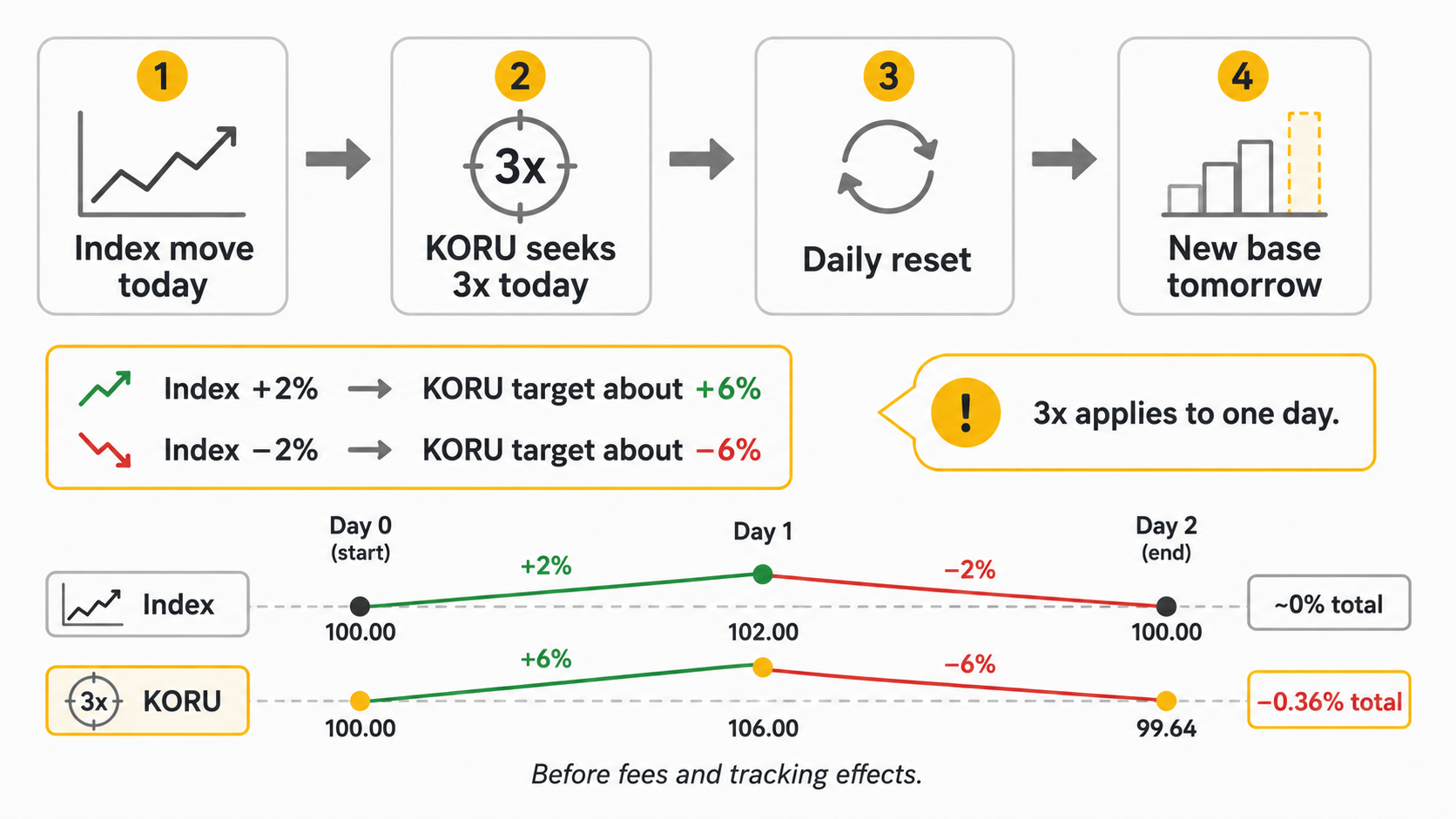
KORU seeks approximately 300% of its benchmark’s movement for one trading day. If the index gains 2% during a session, KORU seeks roughly 6% before fees, financing costs and tracking differences. If the index loses 2%, KORU seeks roughly a 6% loss.
This is an objective, not a guarantee. The fund can use swaps and other derivatives to create leveraged exposure, and real-world results may differ because of expenses, market conditions and imperfect tracking.
Why KORU Resets Every Day
At the end of each session, the fund rebalances so that the next session begins with a new 3x daily target. Gains and losses therefore compound from a changing base. This feature helps KORU maintain its daily objective, but it also makes longer holding periods path-dependent.
Imagine the index starts at 100, rises 10% to 110, then falls 9.09% back to 100. A simple unleveraged index finishes flat. A theoretical daily 3x product rises 30%, then falls about 27.27% from its new higher base. It ends below where it started. The market went on a round trip; the leveraged product paid for the journey.
Trending Markets vs Choppy Markets
A smooth, strongly rising Korean market can allow favorable compounding. A volatile sideways market can do the opposite. Repeated gains and losses may erode value even when the benchmark’s final level changes little. That is why Direxion states that KORU should not be expected to deliver three times the benchmark’s cumulative return for periods longer than one day.
What Does KORU Hold and Track?
KORU’s benchmark includes Korean semiconductor, electronics, automotive, financial and industrial companies. The exact weights change, so traders should check the current Direxion fund page rather than relying on an old list.
Semiconductor concentration matters. Strong HBM demand, Nvidia-related AI spending and improving memory prices can support Korean chip leaders. Export weakness, a softer chip cycle or a sharp risk-off move can pressure several large index weights at the same time.
KORU also differs from an unleveraged Korea ETF. An unleveraged fund such as EWY aims to follow Korean equities without a daily 3x target. KORU is built for amplified tactical exposure and requires more active monitoring.
KORU Stock Split History
| Effective Trading Date | Split | Share Count | Approximate Per-Share Price Effect |
|---|---|---|---|
| February 10, 2025 | 1-for-10 reverse split | Every 10 shares became 1 | About 10 times higher |
| July 15, 2026 | 20-for-1 forward split | Every 1 share became 20 | About one-twentieth |
A split changes the number of slices, not the size of the pie. In the 2025 reverse split, ten shares became one and the per-share price adjusted higher. In the 2026 forward split, one share became twenty and the per-share price adjusted lower. The total market value of a position was not changed by either split alone, apart from possible fractional-share treatment.
Splits can make historical charts confusing. Traders should use split-adjusted price data; otherwise the July 2026 forward split may look like an enormous crash that never happened.
Main Risks of KORU
- Amplified downside: A modest index decline can become a much larger daily KORU loss.
- Daily-reset risk: Multi-day performance depends on the sequence of returns.
- Concentration risk: Large Korean chip companies have heavy benchmark influence.
- Country and currency risk: Korean policy, geopolitics, exports and USD/KRW can affect sentiment.
- Fund-structure risk: Swaps, financing costs, expenses, liquidity and tracking differences can reduce returns.
Tapbit’s ETF contract risk guide explains why daily-reset products need different risk controls from normal long-term holdings.
How KORU-USDT Futures Work on Tapbit
Tapbit users can follow KORU-linked price action through the KORU-USDT perpetual futures market. The contract provides price exposure. It does not give the trader KORU ETF shares, voting rights or ETF distributions.
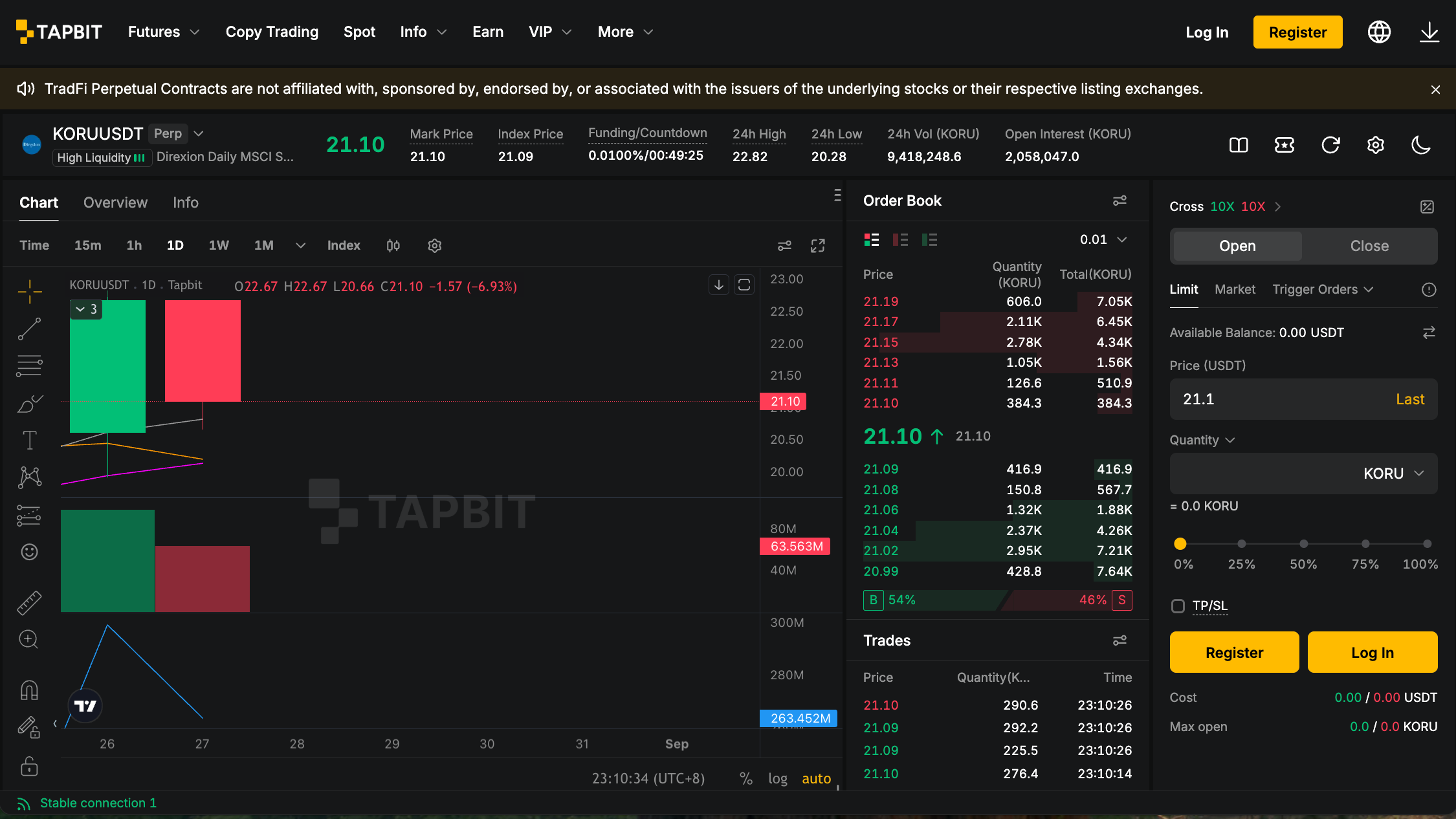
There are two leverage layers to understand: KORU already targets 3x daily benchmark exposure, and futures margin can amplify the contract position again. Before trading, check the mark price, funding rate, margin mode, liquidation price and position size. New users can create an account and review the contract specifications before placing an order.
Bottom Line
KORU is a daily 3x South Korea ETF, not a normal company stock and not a promise of three times Korea’s long-term return. Its splits changed the share count and displayed price, not the position’s underlying value. The biggest lesson is simple: with KORU, the path matters as much as the destination.
FAQ
Is KORU a stock or an ETF?
KORU is a leveraged ETF. It tracks a South Korean equity benchmark and seeks 300% of its daily return before fees and expenses.
What was the KORU stock split in 2026?
KORU completed a 20-for-1 forward split. Shares began trading on a split-adjusted basis on July 15, 2026.
Why does KORU not return exactly three times the Korean market over a month?
The 3x target resets daily. Compounding, volatility, expenses and tracking differences can cause multi-day returns to diverge from three times the benchmark’s cumulative move.
Does KORU-USDT give traders KORU ETF shares?
No. KORU-USDT is a perpetual derivative that provides price exposure without ownership of ETF shares.


