
What Is the KOSPI Index?
What is KOSPI index? The KOSPI index is South Korea's main stock market benchmark. Its full name is the Korea Composite Stock Price Index. It measures the performance of common stocks listed on the Korea Exchange's main market and is often used as a quick signal for the health of South Korea's equity market.
In simple terms, the KOSPI index works like a scoreboard for large and widely traded Korean companies. When major Korean stocks rise, the index usually rises. When those stocks fall, the index usually falls. Because South Korea is home to globally important semiconductor, electronics, battery, auto, shipbuilding, and internet companies, KOSPI is not only a local market signal. It can also reflect global demand for technology, exports, and risk assets.
The index uses a market-capitalization-weighted method. That means larger companies usually have more influence than smaller companies. A move in a major chip or electronics company can affect the index more than a move in a small local stock.
KOSPI is useful for crypto and global macro readers because it sits at the intersection of Asian equities, technology supply chains, U.S. rate expectations, and global investor appetite. When Korean tech shares rally, it may point to stronger enthusiasm for AI, semiconductors, and growth assets. When KOSPI drops sharply, it can signal pressure in the broader risk environment.
How Many Stocks Are in the KOSPI Index?
The KOSPI index includes hundreds of common stocks from the Korea Exchange's main board. The exact number can change because companies list, delist, merge, or move between market segments. That is why KOSPI should be understood as a broad market benchmark rather than a fixed basket with one permanent company count.
This is different from indexes with a fixed number in the name, such as the S&P 500, which is designed around roughly 500 large U.S. companies. KOSPI is broader in structure and reflects the eligible common stocks on the main Korean market.
The base date for KOSPI is commonly referenced as January 4, 1980, with a base value of 100. If the index trades far above 100 today, that does not mean individual stocks rose by the same amount. It simply means the overall market value represented by the index has grown over time.
| Feature | KOSPI Index |
|---|---|
| Full name | Korea Composite Stock Price Index |
| Market | South Korea |
| Exchange | Korea Exchange main board |
| Weighting | Market capitalization weighted |
| Base date | January 4, 1980 |
| Common use | Korea equity benchmark and Asian risk signal |
KOSPI vs S&P 500: What Is the Difference?
The KOSPI index and the S&P 500 are both stock market benchmarks, but they measure different markets.
The S&P 500 tracks large U.S. companies across sectors such as technology, healthcare, finance, consumer goods, and energy. It is often used as the main benchmark for U.S. stocks. Tapbit Learn's S&P 500 index guide explains how that index works.
KOSPI tracks South Korean listed stocks. Its movements can be more sensitive to Korean exports, the Korean won, memory chips, Asian manufacturing cycles, and regional investor sentiment. Large technology and electronics companies can have a major impact on daily index direction.
For global traders, the comparison is useful because both indexes can reflect risk appetite. If the S&P 500 is strong while KOSPI is weak, the pressure may be more regional. If both are weak, investors may be reducing risk globally. If KOSPI rallies with Nasdaq-linked technology shares, it may point to renewed confidence in the AI and semiconductor cycle.
Why Is KOSPI Moving or Crashing?
KOSPI can move for several reasons, and the biggest driver is not always domestic news. Common catalysts include:
- Semiconductor demand: Memory chips and AI-related hardware are central to Korea's market narrative.
- Currency moves: A weaker or stronger Korean won can affect exporters and foreign investor flows.
- U.S. interest rates: Higher rates can pressure growth stocks; lower rate expectations can support them.
- China and global trade: Korea is deeply connected to global supply chains.
- Foreign fund flows: International investors can move KOSPI sharply when risk appetite changes.
When people ask why KOSPI is crashing, they are often trying to identify whether the move is company-specific, sector-specific, or macro-driven. A single weak earnings report from a large chip company may pressure the index, but a broad drop across banks, technology, autos, and exporters usually points to wider risk reduction.
Why Chips, AI Stocks and Korea's Market Rally Matter
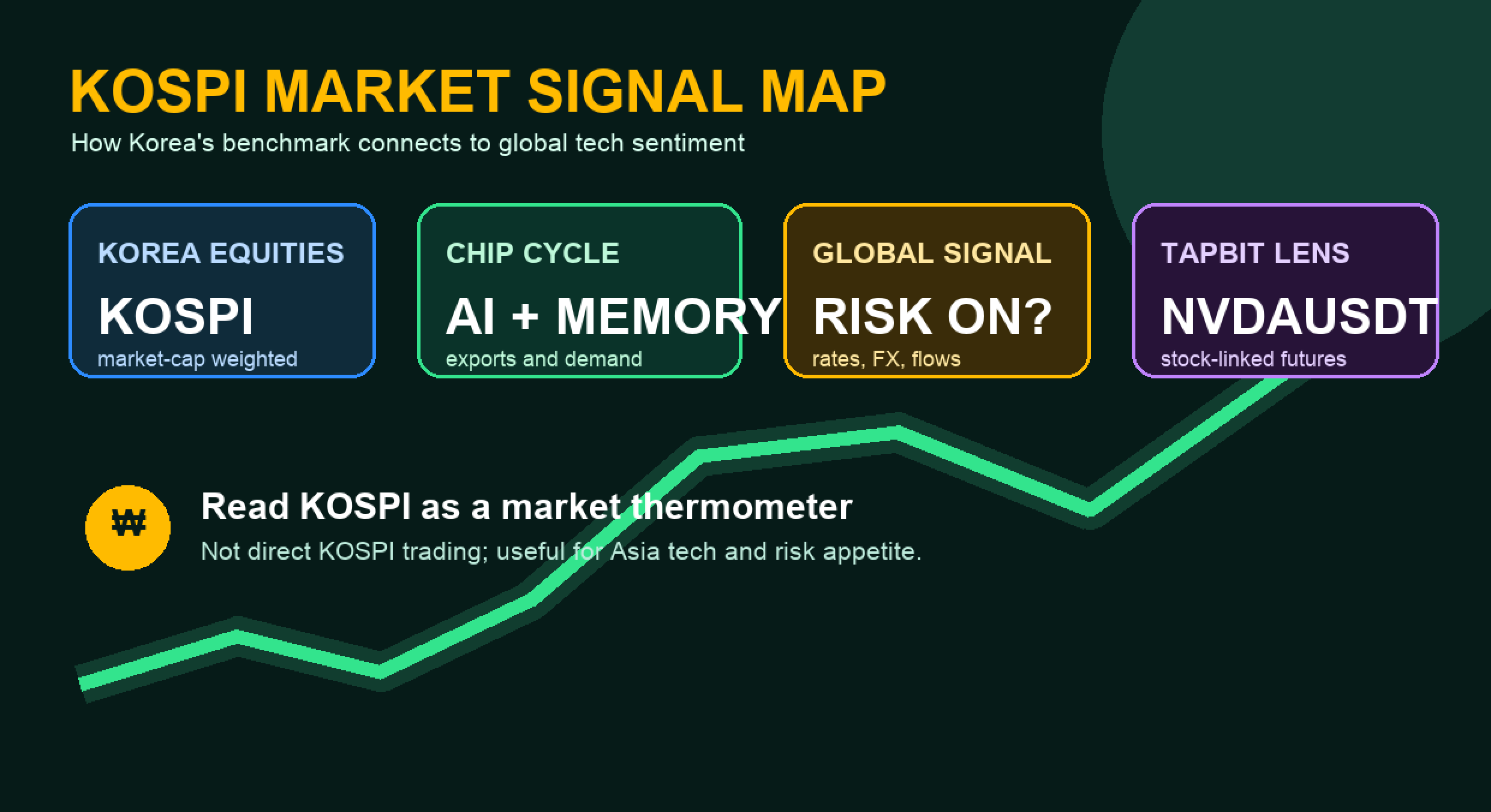
KOSPI has become especially important in the AI era because South Korea is a major player in memory chips, advanced electronics, and global technology supply chains. When AI infrastructure spending increases, investors often look at Korean semiconductor companies as part of the broader hardware cycle.
This is where the index becomes useful even for traders who do not trade Korean equities directly. A strong KOSPI move may confirm that AI and chip optimism is spreading beyond U.S. megacaps. A weak KOSPI move may suggest that optimism is narrowing or that investors are taking profits after a strong rally.
Crypto traders may also watch KOSPI as part of the global risk picture. Crypto does not trade like a stock index, but Bitcoin, Ethereum, and large-cap altcoins often respond to the same broad forces: liquidity, risk appetite, rates, technology enthusiasm, and global investor confidence. Tapbit Learn's crypto vs stocks article gives more context on how these markets differ.
How Global Traders Can Track Stock-Linked Products on Tapbit
Tapbit does not present KOSPI as a direct index product. However, users who follow global technology sentiment can explore stock-linked futures such as NVDAUSDT. NVIDIA is not a Korean stock, but it is closely tied to the AI and semiconductor theme that often influences KOSPI sentiment.
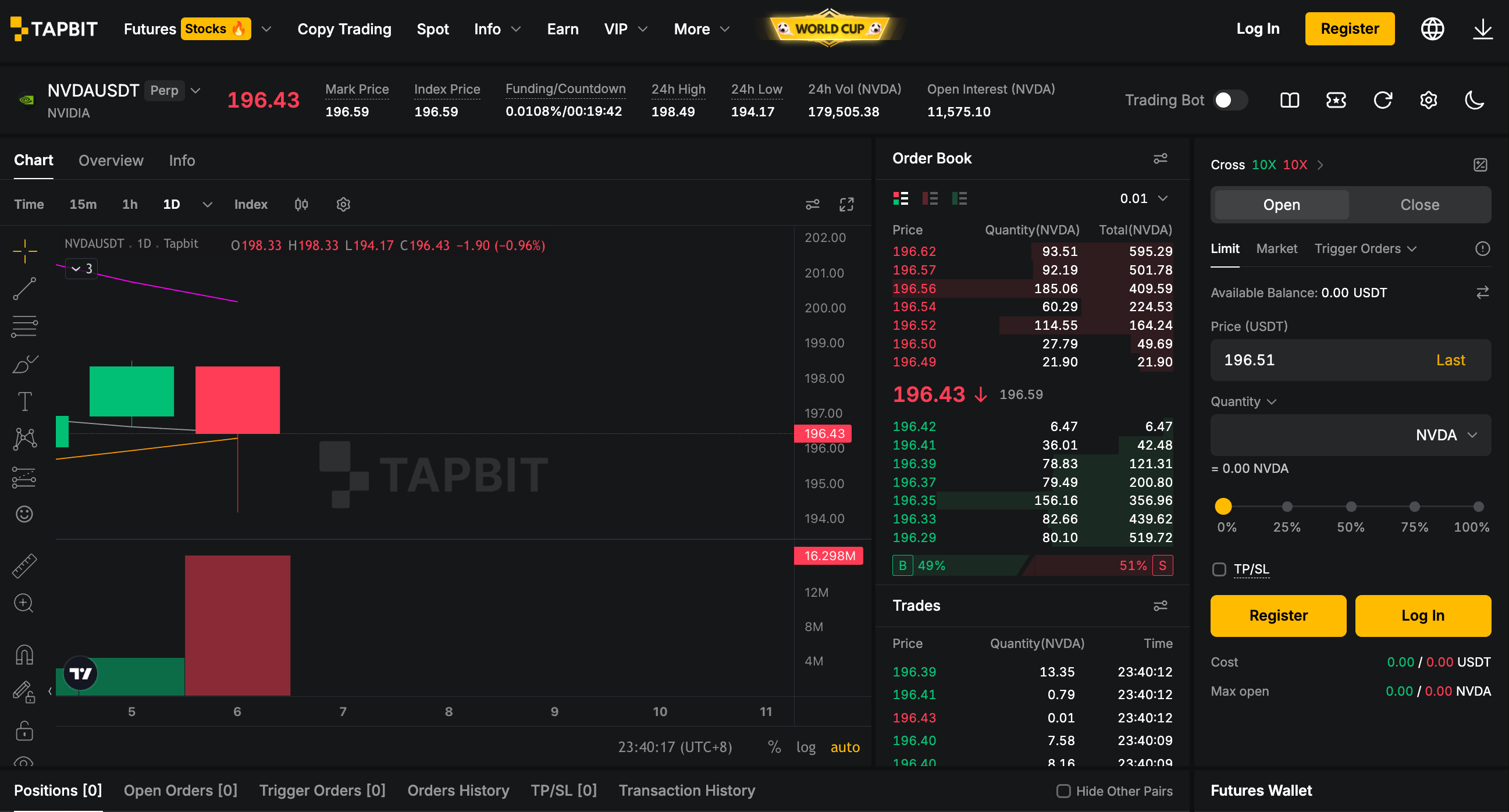
To explore stock-linked futures on Tapbit:
- Open the Tapbit futures page for a supported stock-linked pair, such as NVDAUSDT.
- Check the last price, 24H change, trading volume, and order book.
- Choose margin, leverage, and order type based on your plan.
- Set TP/SL before opening a long or short position.
These products are derivatives. They do not give direct ownership of the underlying stock, index, or company shares, and they do not provide shareholder rights or dividends. New users can create an account and review Tapbit's fee structure before trading.
What to Check Before Trading Stock-Linked Derivatives
Before trading any stock-linked derivative, check what the product tracks, when the underlying market is open, and whether overnight or holiday gaps could affect pricing. A U.S. stock-linked future may react to U.S. market hours, while KOSPI itself follows Korea's trading calendar. Those schedules do not always overlap.
Also check liquidity. A product may show a tradable price, but spreads and depth matter. Wider spreads can increase trading costs, especially during volatile sessions.
The main takeaway is that what is KOSPI index is more than a definition question. KOSPI is a Korea equity benchmark, a semiconductor-cycle signal, and a useful reference point for global risk sentiment. For Tapbit users, it can help frame the wider market environment around technology-linked and stock-linked derivatives.
FAQ
What does KOSPI stand for?
KOSPI stands for Korea Composite Stock Price Index.
Is KOSPI the same as KOSPI 200?
No. KOSPI is the broader benchmark, while KOSPI 200 tracks 200 large Korean stocks and is often used for derivatives and institutional products.
What companies drive the KOSPI index?
Large Korean companies in technology, semiconductors, electronics, autos, finance, and industrial sectors often have the biggest influence.
Can I trade KOSPI directly on Tapbit?
Tapbit does not present KOSPI as a direct index product. Users can follow supported stock-linked futures, such as NVDAUSDT, to track related global tech sentiment.
Why do global investors watch KOSPI?
They watch KOSPI because South Korea is important to semiconductors, exports, Asian equities, and global risk appetite.


