

XRP exchange-traded funds may hold roughly $1.4 billion in assets, but that does not guarantee an immediate return to the token’s record high. ETF assets show that regulated investment products have attracted meaningful capital; they do not remove selling pressure, change XRP’s circulating supply overnight, or force every new dollar into the spot market at once. Based on the supplied Tapbit snapshot, XRP traded near $1.43, leaving it about 57% below its historical peak.
Traders can follow the live market through the XRP/USDT spot market on Tapbit. The key question is not whether ETF demand exists, but whether it can outpace profit-taking, broader crypto weakness, and the large amount of XRP already available to trade.
XRP ETF Demand Is Significant, but It Is Not the Whole Market
Spot XRP ETFs have created a new route for investors who prefer brokerage accounts over crypto wallets. Public fund filings show that several products hold XRP directly, while market trackers aggregate their net assets and flows. The exact total changes with XRP’s price, subscriptions, redemptions, and the products included in each tracker, so the $1.4 billion figure should be treated as a point-in-time estimate rather than a fixed balance.
That scale is still important. It suggests that XRP has gained a more established place in regulated investment portfolios. Yet XRP’s total market value and daily global trading activity are far larger than the ETF segment alone. A fund category can grow rapidly without controlling the token’s overall price discovery.
AUM Is Not the Same as Fresh ETF Inflows
Assets under management, or AUM, measure the current value of assets inside a fund. AUM can rise because investors add money, because XRP’s price increases, or both. It can also fall during a price decline even when the number of XRP tokens held by the funds barely changes.
This distinction matters when headlines describe $1.4 billion in ETF assets as $1.4 billion of new buying. Cumulative net inflows measure subscriptions minus redemptions; AUM includes the market value of the position. The two numbers answer different questions. Bitwise’s public filing, for example, reports the quantity and fair value of XRP held by its trust, showing how fund value moves with the underlying token.
Why Is XRP Still 57% Below Its High?
The first reason is supply. XRP has a large circulating supply, and additional tokens can enter the market through scheduled escrow releases and other distributions. ETF accumulation can absorb part of that supply, but it must compete with sales from existing holders, market makers, traders, and entities managing treasury or escrow positions.
The second reason is that an all-time high reflects a specific market regime. XRP’s previous peak occurred during an unusually speculative crypto cycle. Returning to that level requires more than institutional access: it needs sustained liquidity, improving risk appetite, and enough demand to support a much larger market capitalization.
A third factor is capital rotation. Bitcoin, Ethereum, Solana, AI-related tokens, and stablecoin strategies all compete for the same marginal investment dollar. Even when an XRP-specific catalyst is positive, investors may prefer other assets if their momentum, yield opportunities, or narratives appear stronger.
What the Supplied XRP/USDT Chart Shows
The provided daily chart shows XRP rebounding sharply from the area around $1.03 and briefly trading above $1.50 before settling near $1.43. The move was accompanied by a large increase in volume, which suggests that the breakout attracted real participation. At the same time, the pullback after the initial spike shows that sellers remain active above the recent trading range.
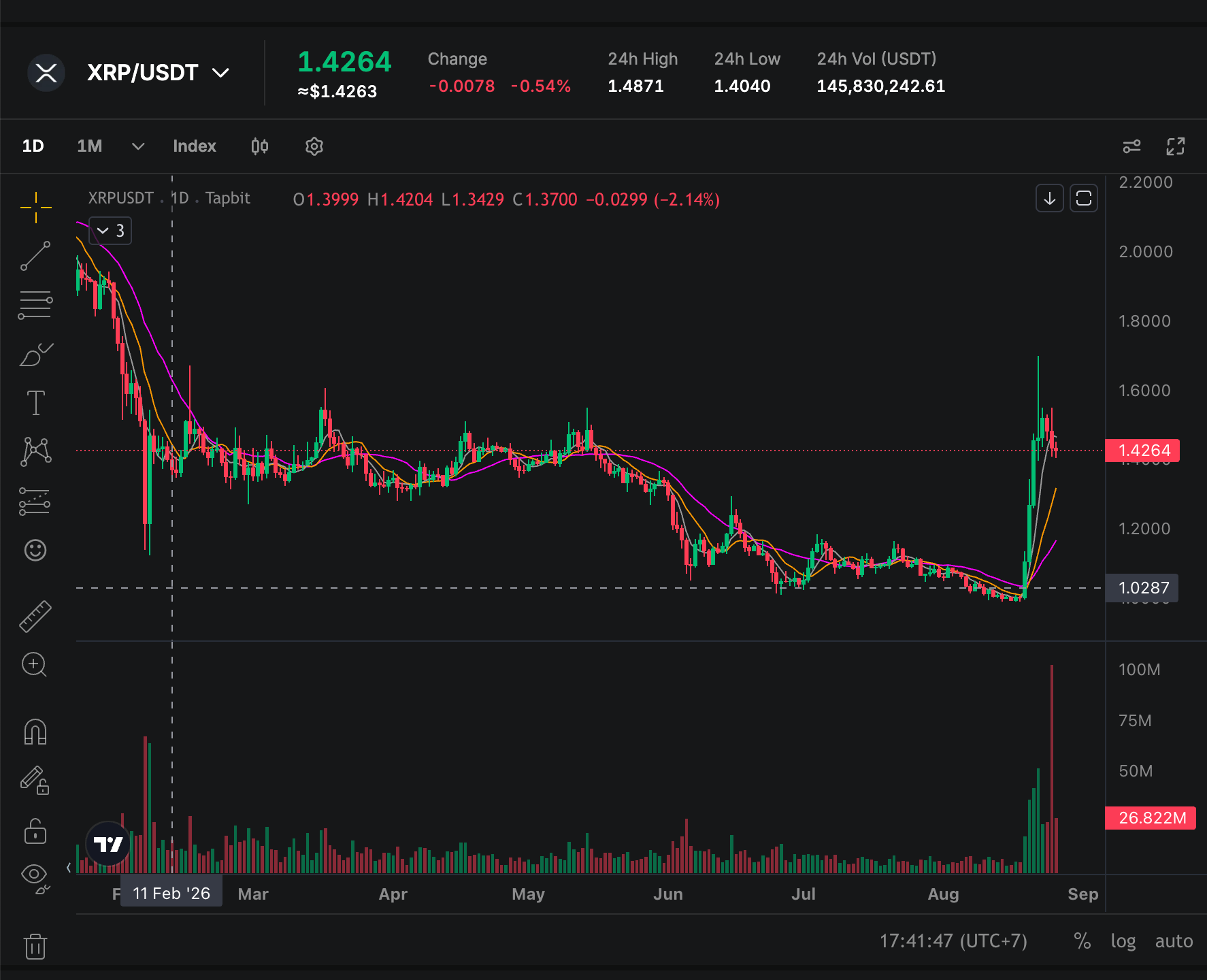
From a technical perspective, the old consolidation zone around $1.35-$1.40 is an important short-term test. Holding above it would indicate that buyers are defending the breakout. A loss of that zone could expose the market to a deeper retracement toward $1.20, while a renewed push through roughly $1.50-$1.60 would strengthen the case for trend continuation. These are observation zones rather than guaranteed targets.
Can ETF Holdings Create a Supply Squeeze?
A supply squeeze is possible only if funds keep receiving net inflows while available exchange liquidity contracts. Spot ETFs can contribute because creations generally require the acquisition or delivery of underlying XRP. Persistent accumulation can reduce the quantity readily available for other buyers, especially during a broad market rally.
But the mechanism is not automatic. Authorized participants can create and redeem shares, investors can take profits, and off-exchange liquidity can respond to higher prices. XRP’s supply is also much larger than the inventory of the current ETF group. The bullish argument therefore depends on the direction and durability of flows, not the headline AUM number by itself.
What Could Move XRP Closer to Its Record High?
| Driver | Why It Could Help | What Could Limit It |
|---|---|---|
| Sustained ETF inflows | Creates recurring spot demand and broader access | Redemptions or falling prices can reduce AUM |
| Stronger crypto market | Improves liquidity and risk appetite across altcoins | Bitcoin dominance may absorb most new capital |
| XRPL adoption | Can support utility-based demand and network activity | Usage growth may not translate directly into token buying |
| Clearer regulation | Could reduce uncertainty for institutions and payment firms | Policy changes can be slow or jurisdiction-specific |
| Break above resistance | May attract momentum traders and short covering | Failed breakouts can trigger rapid reversals |
What Investors Should Watch Next
ETF flow direction is more useful than a single AUM headline. Investors should compare daily creations and redemptions, the number of XRP held, ETF trading volume, and changes in NAV. XRP ETF trackers can help distinguish fund flows from price-driven changes in asset value.
Outside the funds, the most relevant signals include exchange balances, XRP Ledger activity, escrow-related supply, derivatives open interest, funding rates, and the broader direction of Bitcoin. A rally driven mainly by leverage may be less durable than one supported by spot volume and steady fund accumulation.
Conclusion
XRP ETFs holding around $1.4 billion in assets is a meaningful sign of institutional access, but it does not by itself explain or control XRP’s price. The token remains roughly 57% below its high because ETF demand is only one force in a much larger market shaped by supply, capital rotation, macro liquidity, and holder behavior. A sustained move higher would require continuing net inflows, healthy spot demand, and a successful break through the resistance created by previous sellers.
FAQ
Do XRP ETFs buy actual XRP?
Spot products generally hold XRP directly, while futures or leveraged products can use derivatives. Investors should check each fund’s prospectus and holdings before assuming the exposure is identical.
Why can XRP ETF AUM rise when inflows are small?
AUM reflects both investor flows and changes in XRP’s market price. If XRP appreciates, the value of existing fund holdings rises even without large new subscriptions.
Can XRP ETFs push the token back to its all-time high?
They can add demand, but a new high would also require favorable market liquidity, manageable selling pressure, and sustained interest outside the ETF channel.
What price levels matter after the recent XRP rebound?
Based on the supplied chart, traders may watch approximately $1.35-$1.40 as near-term support and $1.50-$1.60 as the next resistance zone.
Is holding an XRP ETF the same as owning XRP?
No. ETF shareholders own fund shares and do not directly control the underlying XRP or its private keys. Direct spot holders own the token itself and are responsible for custody.


