

Nvidia earnings delivered another large set of numbers. Q2 FY2027 revenue reached $96.2 billion, Data Center revenue climbed to $89.0 billion and the company guided Q3 revenue to $108.0 billion, plus or minus 2%. These are reported results for the quarter ended July 26, 2026, not pre-earnings estimates.
The first stock reaction was hesitant, then turned strongly positive as management described a longer AI-spending runway. Reuters reported that NVDA rose about 4.2% in extended trading after the call and later gained 6.7% to $223.71 before the August 27 open. These measurement windows should not be mixed with the latest regular-session close.
Nvidia Earnings at a Glance
| Metric | Q2 FY2027 | Change or Comparison |
|---|---|---|
| Revenue | $96.221 billion | +18% Q/Q; +106% Y/Y |
| Data Center revenue | $89.0 billion | +18% Q/Q; +117% Y/Y |
| GAAP gross margin | 75.0% | +0.1 point Q/Q |
| GAAP diluted EPS | $2.46 | +128% Y/Y |
| Non-GAAP diluted EPS | $2.22 | Above cited $2.10 consensus |
| Q3 revenue outlook | $108.0 billion ±2% | Above cited $104.19 billion consensus |
Reuters cited an average analyst estimate of about $92.17 billion for Q2 revenue. Nvidia beat that figure by roughly $4 billion. The company also reported GAAP net income of $59.7 billion, up 126% year over year.
This article updates Tapbit Learn’s pre-earnings Nvidia scenario analysis. The earlier numbers were expectations; the figures above come from Nvidia’s official release.
Data Center Revenue Is Still the Main Nvidia Story
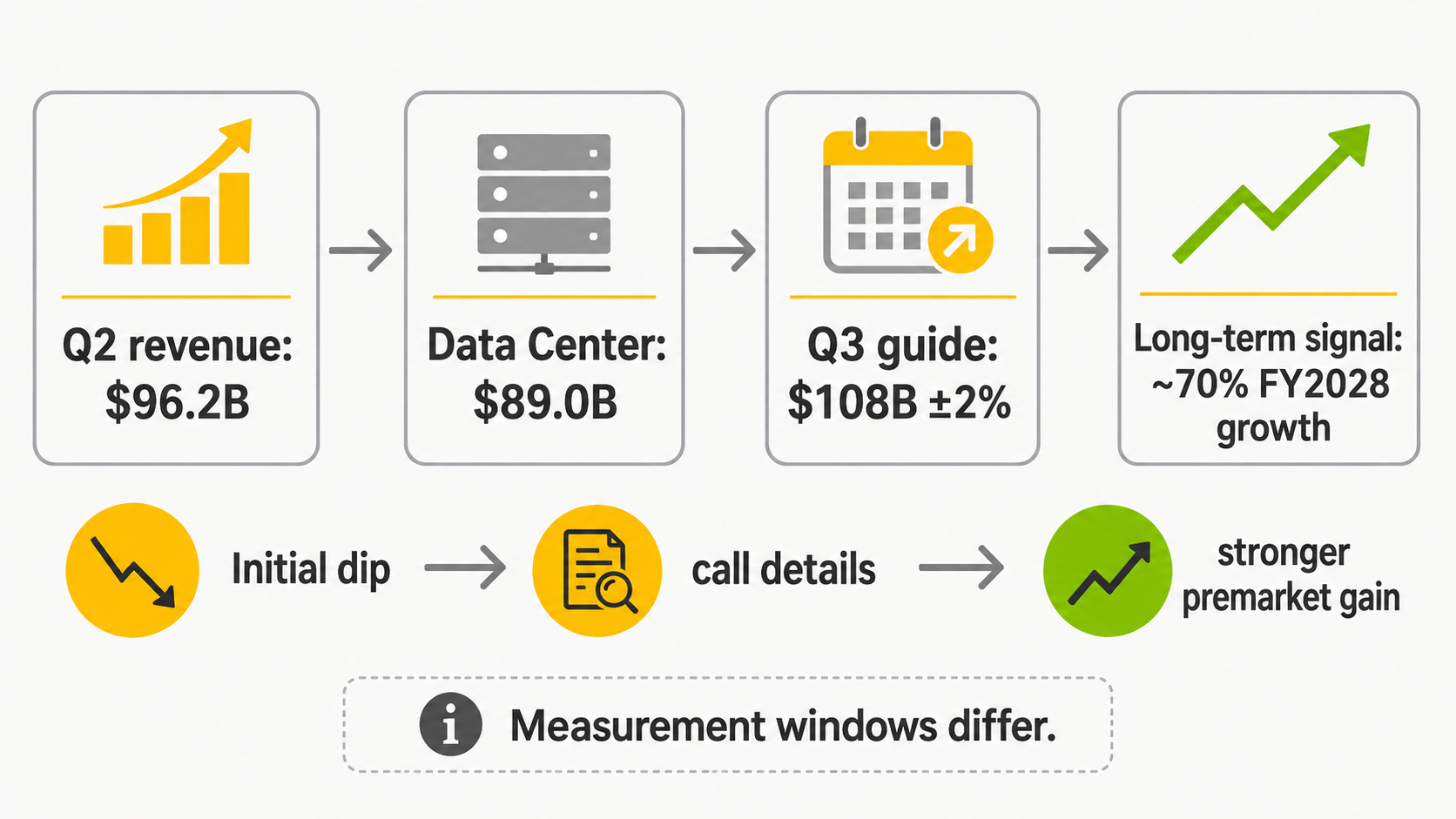
Data Center generated about 92% of Nvidia’s total quarterly revenue. That concentration shows why cloud spending, AI labs and the next infrastructure cycle matter far more than a normal PC-chip cycle.
Management said the Vera Rubin platform is in full production, with systems running at major cloud partners. Nvidia also highlighted demand from AI labs, enterprises, sovereign projects and infrastructure builders. That wider customer mix is important because investors have worried that a few hyperscalers account for too much of the AI boom.
The results also connect directly to South Korea. Nvidia announced or highlighted partnerships with SK Telecom, Naver and SK Hynix. Continued AI-factory investment supports demand for high-bandwidth memory and other components supplied by Korean technology companies.
Why Nvidia’s Q3 Guidance Beat Expectations
Nvidia expects Q3 revenue of $108 billion, plus or minus 2%. The midpoint is above the roughly $104.19 billion analyst consensus cited by Reuters and implies another quarter of substantial sequential growth.
The guidance reflects demand for accelerated computing, networking, AI software and systems. It also excludes any Data Center compute revenue from China. That exclusion makes the forecast easier to interpret: near-term growth does not depend on a China sales recovery, but any future China revenue remains an uncertain source of upside or risk.
Export rules, licensing decisions and local Chinese competition can change quickly. Traders should not treat excluded China revenue as permanently lost or automatically available later.
Gross Margins, Supply and Component Costs
Nvidia reported a 75.0% GAAP and non-GAAP gross margin in Q2. For Q3, it expects both measures near 74.0%, plus or minus 50 basis points.
Revenue can grow rapidly while margins soften. Memory prices, advanced packaging, networking components and the cost of moving to a new system architecture can all pressure profitability. Reuters reported that management expects component costs and supply constraints to remain a challenge and sees margins moving lower before improving.
That is not automatically bearish. A company may accept a lower percentage margin while producing far more total profit. Investors will watch whether operating income and cash flow continue growing fast enough to justify the trade-off.
The 70% Fiscal 2028 Growth Signal
The most powerful part of the earnings call was longer-term guidance. Nvidia said it expects revenue to grow roughly 70% in the fiscal year ending January 2028. Reuters said that was well above the market’s earlier expectation for growth around 44%.
Management’s argument is that AI has moved beyond experiments. Models are producing useful work, new AI labs are scaling and physical AI is beginning to add demand. Nvidia also sees an expanding role for enterprise, sovereign and industrial customers.
This remains a forecast, not a contract with the future. Customers could delay projects, financing conditions could tighten and competitors could win workloads. Still, the projection told investors that Nvidia does not see the current boom ending after one more quarter.
Why NVDA Rose After an Initial Dip
Nvidia shares initially moved lower after the release even though the company beat major estimates. Expectations were extremely high, and investors needed more than a normal quarterly beat.
The call changed the reaction. Details about the fiscal 2028 outlook, demand beyond hyperscalers and Rubin production gave the market a stronger reason to look past margin and supply concerns. The stock moved higher in extended trading, then strengthened further before the next regular session.
The lesson is familiar: earnings reactions depend on the gap between results and expectations, not whether the numbers look large in isolation. Tapbit Learn’s NVDA stock analysis explains why guidance and AI demand usually matter more than a single headline.
Main Risks After Nvidia Earnings
- China and export controls: Nvidia excluded China Data Center compute revenue from the Q3 outlook.
- Supply and costs: Memory, packaging and component constraints can pressure margins.
- Customer financing: Large AI projects require capital, power and long payback periods.
- Competition: AMD, cloud custom chips and other accelerators can win workloads.
- Execution: Vera Rubin production must scale reliably across complex systems.
- Valuation: Strong expectations can make the stock sensitive to any slower signal.
The reported Hugging Face acquisition is a separate same-day event. Because neither company had confirmed a completed transaction, it should not be treated as part of reported Q2 operations.
How to Follow NVDA-USDT Futures on Tapbit
Tapbit offers the NVDA-USDT perpetual futures contract. It provides Nvidia-linked price exposure but not Nvidia shares, voting rights or direct dividends.
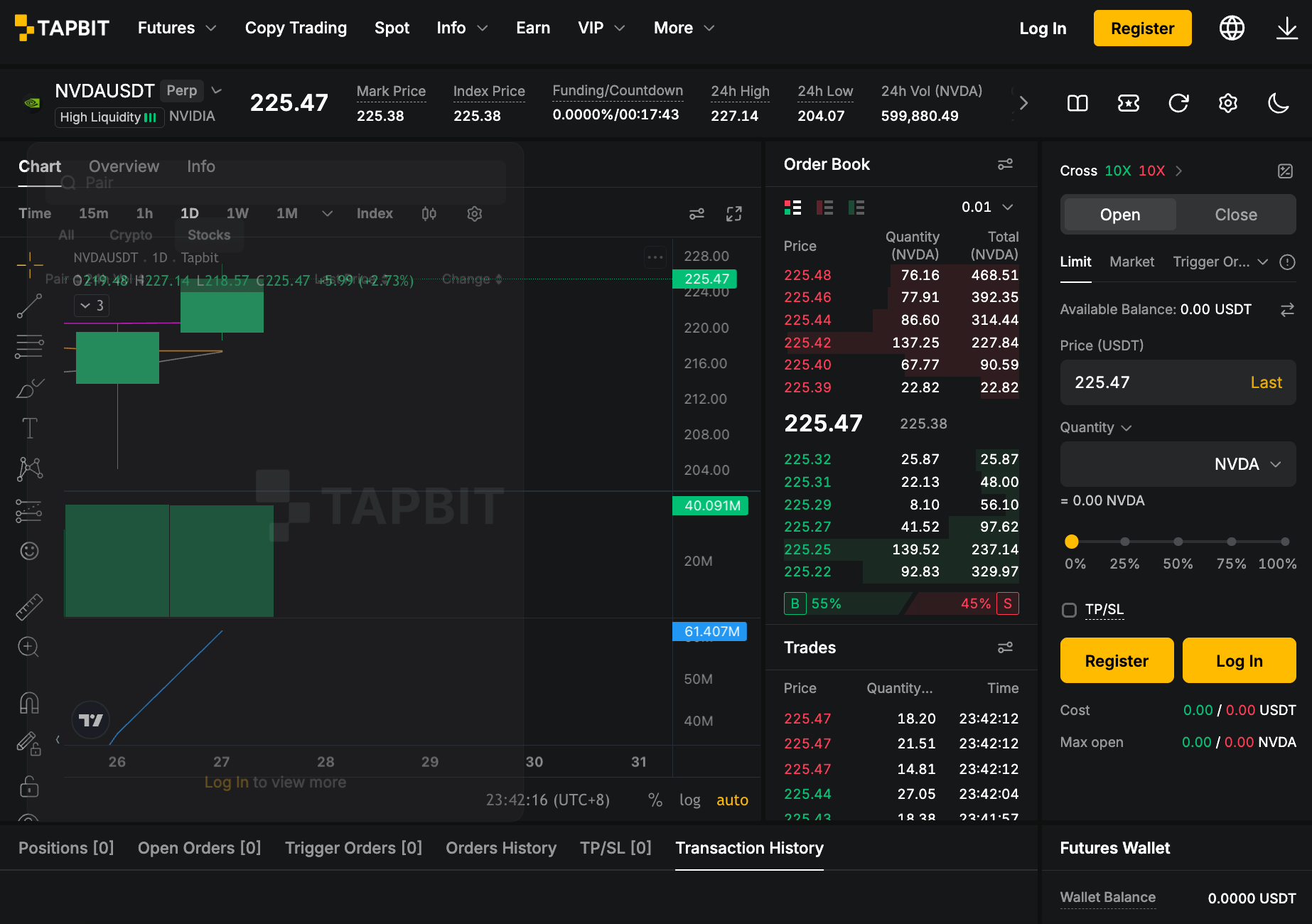
Earnings can create fast moves across after-hours, premarket and regular sessions. Check the contract’s mark price, index price, funding rate, margin mode and liquidation level. Users can create an account and review Tapbit Learn’s NVDA-USDT futures guide before trading.
Bottom Line
Nvidia beat key Q2 expectations and guided Q3 revenue above consensus. The bigger catalyst was management’s view that AI infrastructure spending can support roughly 70% fiscal 2028 growth. The report strengthens the bull case, but China, margins, supply and execution still determine whether those expectations become reality.
FAQ
What was Nvidia’s Q2 FY2027 revenue?
Nvidia reported revenue of $96.221 billion, up 106% from a year earlier.
How much was Nvidia Data Center revenue?
Data Center revenue reached $89.0 billion, up 117% year over year.
What is Nvidia’s Q3 revenue guidance?
The company expects $108.0 billion, plus or minus 2%, and assumes no China Data Center compute revenue.
Why did NVDA rise after earnings?
Investors responded to the above-consensus Q3 guide and management’s much stronger long-term AI-growth outlook after an initially hesitant reaction.


