
What Does Oil Penny Stocks Mean?
You searched it. Here's the direct answer.
Oil penny stocks are low-priced shares of small companies in the oil and gas industry. They typically trade below $5 per share. They are not tokens. They are not crypto. They are traditional equity stocks — just very cheap ones tied to the energy sector.
Break it into two parts.
"Oil" means the industry: crude oil exploration, shale production, offshore drilling, oilfield services, and natural gas.
"Penny stocks" means the price category. The U.S. Securities and Exchange Commission (SEC) officially defines penny stocks as shares trading below $5 per share under Rule 3a51-1. That is the regulatory line.
Put them together:
|
Oil penny stocks = shares of small oil and gas companies priced under $5 per share. |
That is the definition. Simple, but there is a lot underneath it.
Is a $2 Oil Stock a Penny Stock? What About $10?
This question comes up constantly. Here are two direct answers.
A $2 oil stock? Yes — usually. It sits well under the SEC's $5 threshold. It almost certainly qualifies as a penny stock.
A $10 oil stock? No. Under U.S. rules, $10 falls above the penny stock boundary. The definition does not apply.
But here is the critical thing most people miss.
Price alone does not measure risk.
A $4.99 stock listed on NYSE can be more transparent and liquid than a $0.50 OTC stock with no audited financials. Before you judge any stock by its share price, check four things:
• Market capitalization — how large is the company?
• Daily trading volume — can you actually exit the position?
• Exchange listing — NYSE / NASDAQ or OTC Pink Sheets?
• Financial disclosure — does the company publish audited reports?
Low price does not equal low risk. That is the most important rule in this space.
What Are the Main Types of Oil Penny Stocks?
Oil penny stocks are not a single category. They cover several types of small energy companies.
Upstream (Exploration & Production)
These companies find and extract crude oil and natural gas. They are the most sensitive to WTI price swings.
Oilfield Services
They supply drilling rigs, equipment, and labor. They do well when major oil companies increase capital spending.
Offshore Drillers
They operate in deep-water environments. High cost structure, high volatility.
Shale Producers
They focus on U.S. onshore basins like the Permian or Bakken. Very sensitive to domestic energy policy.
Midstream / Transport
They move oil from wellheads to refineries. Generally less volatile than pure exploration names.
One practical note: specific tickers change constantly. A stock can jump above $5 after one strong earnings report — and fall back below on the next bad quarter. Always use real-time data before treating any ticker as a penny stock.
Why Are Oil Penny Stocks So Risky? The Amplifier Effect
Here is the core mechanic. This explains both the excitement and the danger.
Oil penny stocks act as a price amplifier for WTI crude.
A 5% increase in WTI crude oil price can trigger a 20% to 30% jump in a micro-cap driller's share price. Why? Because rising oil prices can flip a heavily indebted small company from near-bankruptcy to profitability almost overnight — dramatically changing the estimated value of its underground reserves.
The reverse is equally true.
WTI drops 5%? That same company can lose 25% in a single session. No floor. No warning.
Why so extreme? Small oil companies typically carry:
• Thin or negative profit margins
• Heavy debt loads relative to assets
• Limited cash reserves to weather downturns
• Extreme sensitivity to commodity price cycles
They move fast. In both directions. This is not a bug — it is the fundamental nature of the product.
The Fraud Risk FINRA Keeps Warning About
Oil penny stocks have a serious fraud problem. Regulators have been warning about it for years — and the problem is getting worse.
FINRA's 2025 Annual Regulatory Oversight Report confirmed that pump-and-dump schemes targeting small-cap stocks have continued to evolve, now occurring months after company IPOs and often hitting the same issuer multiple times.
Here is how the scheme works.
Step 1 — Pump
Fraudsters buy a large position in a low-priced, thinly traded stock. They then promote it heavily through encrypted messaging apps, social media investment clubs, email newsletters, and online ads. The stock price rises.
Step 2 — Dump
Once enough outside investors have bought in and pushed the price up, the fraudsters sell all their shares at the inflated price. The stock crashes. Everyone else is left holding nearly worthless shares.
Red flags to watch for:
• Unsolicited tips in Telegram or Discord investment groups
• Claims of "guaranteed returns" or "can't miss" opportunities
• Sudden volume spike with no company news
• Companies with no audited financials or SEC filings
If you see any of these, the right move is to walk away.
How Oil Penny Stocks Connect to Crypto
Oil penny stocks are not crypto. But there are three real connections that crypto traders should understand.
Connection 1: Both Are Speculative Risk Assets
When market risk appetite rises, capital flows into altcoins, meme coins, and small-cap energy stocks simultaneously. When risk-off sentiment hits, both categories sell off together. The correlation is not perfect — but it is real during major macro events.
Connection 2: Energy Prices Directly Affect Bitcoin Mining Costs
The EIA estimates that U.S. cryptocurrency mining electricity consumption represents approximately 0.6% to 2.3% of total U.S. electricity usage. Oil and gas price swings flow directly into power generation costs — which flow directly into miner profitability margins.
Connection 3: Oil Infrastructure Is Intersecting with Mining
Some energy companies are now using excess natural gas from oilfields to power Bitcoin mining rigs on-site. The two industries are increasingly sharing infrastructure and economic logic.
These three connections are why crypto traders who watch energy markets are not wasting their time.
Oil Penny Stocks vs Tapbit OIL(WTI)-USDT: Key Differences
Oil penny stocks = company risk. You are betting on a specific small company's ability to survive, produce oil, service its debt, and avoid fraud or bankruptcy.
Tapbit OIL(WTI)-USDT = price risk. You are tracking WTI crude oil price movement directly through a crypto futures contract, with no exposure to any single company's balance sheet.
|
|
Oil Penny Stocks |
Tapbit OIL(WTI)-USDT |
|
What you get |
Shares of a small oil company |
A futures position on WTI price |
|
Main risk source |
Company failure, fraud, dilution |
Leverage, margin, liquidation |
|
Traditional broker needed |
Yes |
No |
|
Tracks WTI crude? |
Indirectly, amplified |
Directly |
|
Contract expiry |
N/A (equity) |
Perpetual — no rollover |
|
Transparency |
Varies (often limited for OTC) |
On-chain, real-time |
For crypto traders who want direct WTI crude oil price exposure, you can trade OIL(WTI) futures on Tapbit — without a traditional brokerage account and without managing contract rollovers.
How to Trade OIL(WTI)-USDT on Tapbit — 4 Steps
1. Create your account. Start trading by registering on Tapbit and completing identity verification.
2. Deposit USDT. Transfer USDT into your futures wallet. This is your collateral for trading.
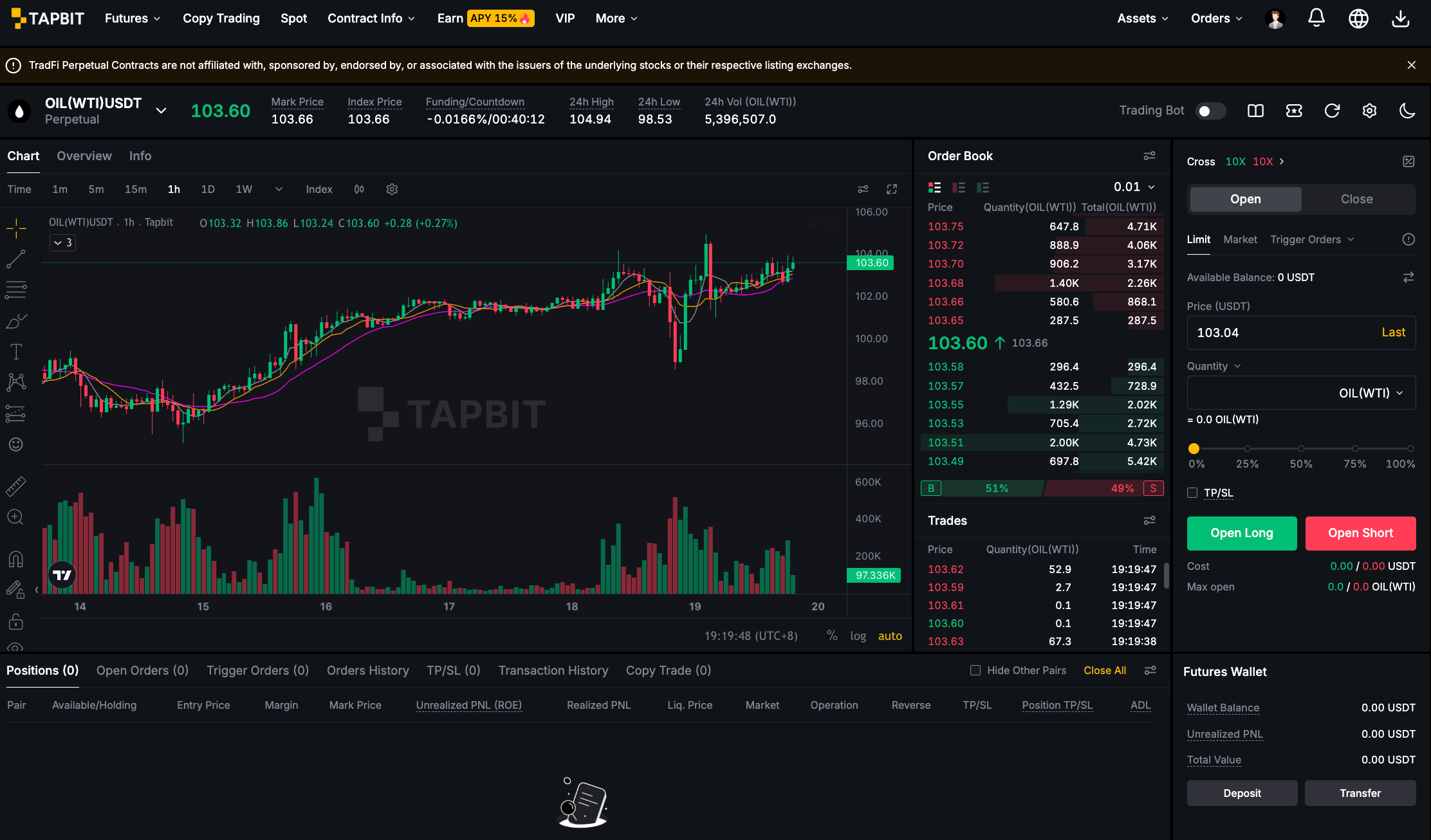
3. Open the OIL(WTI)-USDT contract. Navigate to Futures → search OIL(WTI)-USDT → open the contract trading page. You can view market data first to check current WTI price trends and sentiment.
4. Set your direction and risk controls. Select Long if you expect WTI to rise. Select Short if you expect it to fall. Set your position size, stop-loss, and take-profit levels before confirming.
Before entering any position, review Tapbit's fee structure to understand trading costs. Tapbit also maintains publicly auditable proof of reserves, so you can verify at any time that your funds are fully backed.
|
⚠️ Risk Notice: OIL(WTI)-USDT is a leveraged perpetual futures product. Leverage amplifies both profits and losses. Always understand your liquidation price before entering a trade. |
Should You Buy Oil Penny Stocks? An Honest Answer
Not for most people.
Oil penny stocks layer two separate risks on top of each other: commodity risk (will WTI prices move the right way?) and company risk (will this specific company survive?). Managing both simultaneously requires significant research and experience.
Low share price is not the same as good value. A $2 oil stock can go to zero. A $10 oil stock can double. The number on the screen tells you almost nothing on its own.
The better questions to ask before buying any oil penny stock:
• Do I understand this company's financials and debt level?
• Do I understand the current oil price cycle?
• Do I know my maximum acceptable loss?
• Have I verified the company's SEC filings and trading volume?
If the answer to any of these is "not yet," starting with a more transparent instrument — like Tapbit's OIL(WTI)-USDT futures — may be a cleaner way to learn how oil prices actually move before adding company-specific and fraud risk to the equation.
Summary
Oil penny stocks are low-priced, high-risk shares of small energy companies. They amplify WTI crude oil price moves — dramatically — in both directions. They carry significant fraud risk that FINRA has flagged repeatedly and continues to monitor. And while oil penny stocks are not crypto, energy markets and crypto markets are more interconnected than most people realize.
For crypto traders who want direct crude oil price exposure without navigating OTC markets, shell company risk, or traditional brokerage requirements, Tapbit's OIL(WTI)-USDT perpetual futures offer a more direct and transparent alternative to oil penny stocks — with real-time pricing, no rollover complexity, and verifiable fund security.
Trade carefully. Research everything. Risk only what you can afford to lose.
This article is for educational purposes only and does not constitute financial or investment advice. All trading involves risk, including the potential loss of principal.
FAQ
Q1: What does oil penny stocks mean?
Oil penny stocks are low-priced shares of small companies in the oil, gas, or energy sector. They typically trade below $5 per share under the SEC's official definition. They are traditional equity stocks — not tokens, not crypto, not oil futures.
Q2: Is a $2 stock a penny stock?
Yes. A $2 oil stock sits well under the SEC's $5 threshold and generally qualifies as a penny stock. But always check the company's market cap, trading volume, and exchange listing — not just the share price.
Q3: Is a $10 stock a penny stock?
No. Under U.S. rules, $10 is above the penny stock threshold. It does not qualify. However, a $10 stock can still be highly volatile depending on the company's financial health and liquidity.
Q4: What are some types of oil penny stocks?
They include upstream exploration and production companies, offshore drillers, shale producers, oilfield service firms, and small natural gas producers. Specific tickers change frequently — always verify with real-time data.
Q5: Why are oil penny stocks so risky?
They combine commodity risk and company risk simultaneously. They are often thinly traded, carry heavy debt, and are frequent targets of pump-and-dump fraud. FINRA's 2025 report confirmed that manipulation schemes in this category continue to grow, particularly via social media platforms.
Q6: Can I trade oil price exposure on Tapbit without buying penny stocks?
Yes. Tapbit offers OIL(WTI)-USDT perpetual futures — a direct, crypto-native way to trade WTI crude oil price movement. There is no traditional brokerage required, no contract rollover, and no exposure to individual oil company risk.


