

What AI Stocks Are and How They Differ From Tech Stocks
AI stocks are publicly traded shares of companies that have meaningful exposure to artificial intelligence. That exposure may come from building AI chips, operating cloud AI infrastructure, selling AI software, or using AI to improve core products.
Not every technology company is an AI stock. A company that casually mentions AI in marketing materials is different from a company whose revenue, capital spending, or product roadmap is directly tied to AI demand.
AI stocks also differ from private AI startups. Companies such as private model labs may be important to the AI ecosystem, but they are not AI stocks unless they are publicly listed.
For crypto readers, the simplest definition is this: AI stocks are equity-market exposure to AI, while AI crypto tokens are blockchain-market exposure to AI-related networks or protocols.
The Main Types of AI Stocks
AI is not one single industry. It is a value chain.
| AI Stock Type | What It Provides |
|---|---|
| Chipmakers | GPUs, memory, and processors for AI training and inference |
| Cloud platforms | Compute infrastructure for AI developers and enterprises |
| Software firms | AI tools, enterprise automation, analytics, and copilots |
| Data-center infrastructure | Power, cooling, networking, and hardware support |
| Robotics and automation | AI-driven manufacturing, logistics, and physical systems |
Nvidia is often treated as the clearest AI stock because its GPUs are central to model training and data-center AI workloads. Microsoft, Alphabet, Amazon, Meta, Palantir, Broadcom, AMD, and other companies may also appear in AI-stock discussions depending on the angle.
Tapbit Learn's NVDA stock analysis gives more context on why chipmakers have become a major AI-market signal.
Why AI Stocks Attract Market Attention in 2026
AI stocks attract attention because the market sees artificial intelligence as a multi-year infrastructure cycle.
Large companies are spending heavily on chips, data centers, cloud capacity, and AI software. Investors watch whether that spending turns into revenue growth, productivity gains, and stronger margins.
AI stocks also matter because they can become market leaders. When a small number of AI-linked companies drive index performance, traders across crypto and traditional markets pay attention.
In 2026, this connection has become even more visible. When AI stocks rally strongly, capital may rotate toward equities and away from crypto for a period. When AI stocks fall, AI crypto narratives can also weaken as traders reduce exposure to speculative growth themes.
For another example of an AI-linked equity narrative, Tapbit's PLTR stock guide covers how data platforms fit into the broader AI trade.
AI Stocks vs AI Crypto Tokens
AI stocks and AI crypto tokens may share a theme, but they are not the same asset type.
AI stocks represent ownership in a company. Shareholders are exposed to revenue, earnings, product execution, regulation, competition, and valuation.
AI crypto tokens usually represent network utility, governance, staking incentives, access rights, or speculation around decentralized infrastructure. Token holders do not own a company just because the project uses AI.
The difference is important:
- AI stock: company equity, financial statements, earnings reports.
- AI token: blockchain asset, tokenomics, network usage, liquidity, governance.
- AI ETF: basket of listed equities, not crypto tokens.
Crypto traders should avoid assuming that a strong AI-stock rally automatically means every AI token will rise. Some AI tokens may benefit from narrative spillover, but token performance still depends on liquidity, supply, utility, exchange support, and market sentiment.
Tapbit's top AI crypto projects 2026 article is useful for comparing the token side of the theme.
How AI Stock Trends Can Spill Into Crypto Markets
AI stocks can influence crypto in three main ways.
First, they shape the narrative. If Nvidia, Microsoft, or Palantir reports strong demand, traders may become more interested in AI tokens, DePIN projects, and compute-related crypto assets.
Second, they affect risk appetite. AI stocks are often treated as high-growth assets. When they rise, speculative appetite may improve. When they fall sharply, traders may reduce exposure across AI tokens and other high-beta assets.
Third, AI infrastructure connects to crypto infrastructure. DePIN and decentralized compute projects often use language similar to AI infrastructure: GPUs, data, models, bandwidth, and distributed networks. Tapbit's article on top crypto gainers today shows how AI and infrastructure narratives can drive short-term crypto attention.
Risks of AI Stocks That Also Apply to AI Crypto
AI stocks carry real risks even when the long-term theme is strong.
Valuation risk is the most obvious. If investors price in years of growth, even a solid earnings report can disappoint if it does not beat expectations by enough.
Competition risk matters too. Chipmakers compete with each other, cloud platforms build their own chips, and software companies face rapid product cycles.
Regulation is another factor. AI policy, data privacy, export controls, and intellectual-property rules can all affect public AI companies.
Many of these risks also apply to AI crypto tokens. A strong narrative can push prices higher, but tokens without real demand, clear utility, or sustainable liquidity can fall quickly when hype cools.
How to Track AI-Linked TradFi Products on Tapbit
Tapbit may offer stock-linked TradFi perpetual futures for selected AI-related names. These are derivatives, not direct stock ownership.
AI-Linked TradFi Futures Steps
- Open a supported pair such as NVDA futures or PLTR futures.
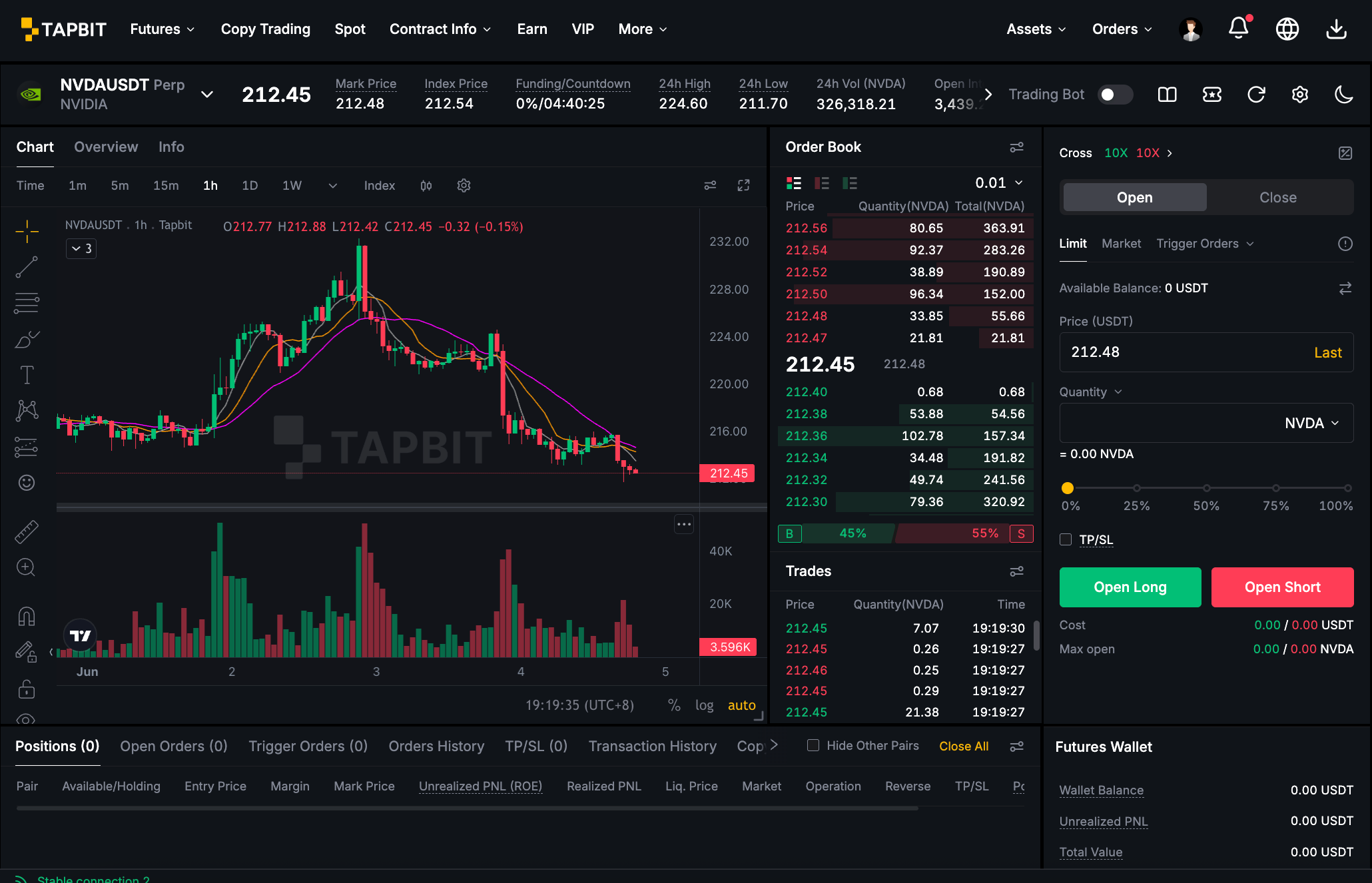
- Confirm the product is a stock-linked perpetual futures contract, not shares of the company.
- Check last price, 24H change, volume, funding, and order-book depth.
- Set margin, leverage, order type, and TP/SL before opening a position.
You can also use the Tapbit price page to compare broader crypto market conditions before trading AI-linked narratives. New users can create a Tapbit account to access supported products and market tools.
FAQ
Are AI stocks the same as tech stocks?
No. AI stocks are a subset of tech or infrastructure companies with meaningful AI exposure. Not every tech company has enough AI-related revenue or strategy to qualify.
Is Nvidia an AI stock?
Yes. Nvidia is widely viewed as an AI stock because its GPUs are central to AI model training, data centers, and inference workloads.
Are AI stocks the same as AI crypto tokens?
No. AI stocks are company shares. AI crypto tokens are blockchain assets tied to networks, protocols, governance, or utility.
Can AI stocks affect AI crypto tokens?
Yes, indirectly. Strong AI equity performance can support the AI narrative, while a correction in AI stocks can weaken appetite for AI crypto assets.
Are AI stocks risky?
Yes. They can be volatile because valuations are high, competition is intense, and investor expectations are demanding.
Can I trade AI stocks directly on Tapbit?
Tapbit may offer selected stock-linked TradFi perpetual futures, but these are derivatives, not direct ownership of shares.


