
MRAM stock became a breakout search query in South Korea as investors turned their attention to Everspin Technologies. Shares were quoted near $14.94, placing the small-cap memory company in a very different valuation and liquidity category from large suppliers such as Micron or SK Hynix.
Everspin is the Nasdaq-listed company behind ticker MRAM. It develops magnetoresistive random-access memory, a nonvolatile technology designed to retain data without power while offering high endurance and fast access.
What Is MRAM Stock?
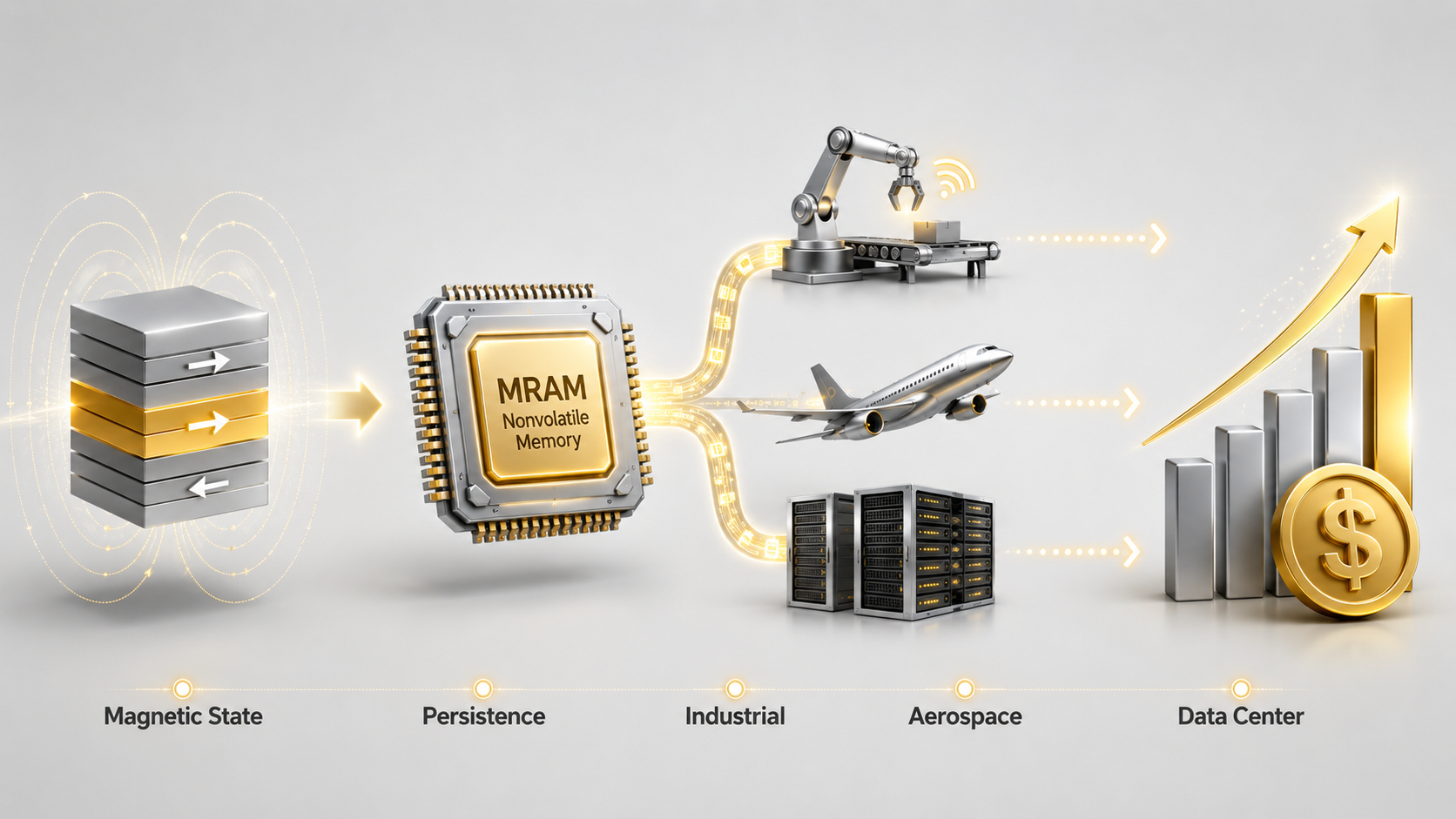
MRAM is the ticker for Everspin Technologies. The company sells Toggle MRAM and spin-transfer-torque MRAM products for industrial automation, transportation, data centers, aerospace and other applications where data persistence and reliability matter.
The ticker can be confusing because MRAM is also the name of the underlying memory technology. Investors buying the stock are purchasing equity exposure to Everspin, not ownership of the entire MRAM technology market.
Why Is MRAM Stock Trending?
Three factors have supported interest:
- A Q2 earnings event on August 5.
- A previously announced $40 million agreement supporting U.S. defense-industrial MRAM capabilities.
- Inclusion in the Russell 2000, which can increase passive-fund ownership and visibility.
The Korea Trends breakout is a freshness signal, not proof that fundamentals changed overnight. Search spikes can bring momentum traders into a stock with limited liquidity, increasing volatility.
What Do the Latest Financial Signals Show?
Everspin reported Q1 2026 revenue of $14.9 million, compared with $13.1 million a year earlier. MRAM product sales reached $14.1 million and gross margin was 52.7%. The company reported a small GAAP net loss but positive non-GAAP income.
For Q2, management had guided to revenue between $15.5 million and $16.5 million before the final results became available. The published article should replace this guidance with the filed Q2 figures and management commentary.
What Would Turn the Rally Into a Durable Repricing?
For a small-cap semiconductor company, a durable rerating requires more than one earnings headline or a burst of search interest. The first requirement is evidence that product revenue is expanding across multiple customers rather than depending on a single program. Design wins are encouraging, but investors should track when those programs enter production, how much revenue they generate and whether follow-on orders appear.
The second requirement is better operating leverage. Specialized memory can command attractive pricing because reliability and persistence matter in industrial, aerospace and defense systems. Even so, higher revenue must translate into stable or improving gross margin after manufacturing, qualification and engineering costs. If expenses rise as quickly as sales, the business may grow without creating proportionate earnings value.
Customer concentration is especially important. A large contract can validate the technology while making quarterly results more volatile. The market is more likely to assign a higher valuation when Everspin adds customers across aerospace, defense, industrial automation and embedded systems. A broader base reduces the risk that one delayed program changes the entire annual outlook.
Finally, the chart should confirm the fundamental story. A healthy breakout usually holds above its prior base, attracts sustained volume and avoids immediate reversal after the news cycle fades. If the stock rises on thin liquidity and then loses the breakout area, momentum may have moved faster than the underlying business. Investors should therefore compare price strength with order visibility, margin progress and management guidance rather than assuming that scarcity alone justifies any valuation.
Why Defense and Aerospace Demand Matter
Mission-critical customers value persistence, endurance and reliability more than the lowest cost per bit. That gives specialized memory products a role in environments where conventional storage can face power-loss or durability limitations.
The $40 million agreement is meaningful relative to Everspin’s size. Investors should still distinguish a multi-period contract or engineering program from recognized quarterly product revenue.
MRAM vs DRAM and NAND
- MRAM: nonvolatile, fast and durable, but more expensive and smaller in market scale.
- DRAM: fast working memory that loses data when power is removed.
- NAND: nonvolatile storage with high density but different endurance and latency characteristics.
MRAM does not need to replace DRAM or NAND to create value. Its opportunity is strongest in specialized applications where persistence and reliability justify the price.
Is MRAM Stock Overvalued?
A small company can rerate quickly when a contract or design win changes future revenue expectations. It can also fall quickly when the market prices several years of growth into a limited current revenue base.
Investors should compare the stock’s market capitalization with product revenue, gross margin, cash, contract timing and recurring customer demand. Momentum alone does not show whether the valuation is sustainable.
MRAM Stock Technical Outlook
The $14–$15 area is the current reference zone. Holding above the post-earnings support area would indicate that buyers are accepting the higher range. A break below the recent breakout base with rising volume would suggest the search-driven momentum is fading.
Bull Case
Q2 results confirm product growth, the defense agreement contributes on schedule and the stock holds above its breakout area.
Base Case
Revenue grows gradually while MRAM consolidates as investors wait for contract recognition and new design wins.
Bear Case
Revenue or guidance disappoints, liquidity declines and the stock returns below the breakout base.
MRAM is part of the wider semiconductor stocks universe, but its specialized market differs from mainstream AI memory. Readers can also review the broader AI stocks theme without assuming every memory company has the same demand drivers.
Can You Trade MRAM on Tapbit?
Tapbit support for an MRAM-linked product has not been confirmed. Do not assume that a similarly named memory contract provides Everspin exposure. Users can create an account and check the current product list, but the exact ticker and underlying asset must be verified before trading.
FAQ
What company is MRAM stock?
MRAM is the Nasdaq ticker for Everspin Technologies.
What does Everspin make?
It develops persistent magnetoresistive random-access memory products and related technology.
Is MRAM the same as Micron?
No. Everspin is a specialized MRAM company, while Micron is a much larger DRAM and NAND supplier.
Is MRAM available on Tapbit?
Support remains unconfirmed and should be checked before publication.


