

What Is PLTR Stock?
You saw PLTR on a crypto platform. Now you're wondering: is it a token? A coin? A DeFi project?
None of the above.
PLTR is the stock ticker for Palantir Technologies Inc. — a U.S.-based AI and data analytics company founded in 2003. It trades on the Nasdaq. It's a real company with real government and enterprise clients.
Palantir builds software for big, complex decisions. Its three core platforms are:
- Gotham — used by U.S. military and intelligence agencies
- Foundry — used by large enterprises for data operations
- AIP (Artificial Intelligence Platform) — Palantir's newest product, driving rapid commercial growth
PLTR went public in 2020 via direct listing. Today it's one of the most-watched AI stocks on Wall Street — and increasingly, in crypto markets too.
Bottom line: PLTR stock means shares of Palantir Technologies. It's an AI equity, not a digital asset.
What Does PLTR Stock Mean in Crypto?
So why does PLTR keep showing up in crypto spaces? There are three reasons.
Reason 1: Tokenized Stock (RWA)
Tokenized PLTR products let crypto users gain price exposure to Palantir shares — without opening a brokerage account.
| Product | Platform | Mechanism | Key Feature |
|---|---|---|---|
| PLTRx | Kraken xStocks | Backed 1:1 by real PLTR shares via custodian | 24/5 trading, no shareholder rights |
| PLTRon | Ondo / BingX | Chainlink oracle tracks live price, USDT settlement | 24/7 P2P transfers, MetaMask compatible |
These are Real World Assets (RWA) — a fast-growing crypto category that brings traditional financial instruments onto the blockchain.
Important: holding tokenized PLTR is not the same as owning real Palantir shares. No voting rights. No dividends. Price exposure only.
Reason 2: AI Narrative Crossover
Palantir is a leading AI stock. Crypto markets care about AI. When AI sentiment shifts — up or down — both AI tokens and AI stocks like PLTR tend to move together. Crypto traders watch PLTR to gauge broader AI market momentum. You can view market data across crypto and tokenized assets on Tapbit to track real-time sentiment shifts.
Reason 3: PLTR Perpetual Futures on Crypto Platforms
Beyond tokenized products, platforms like Tapbit offer PLTR-USDT perpetual futures — derivative contracts settled in USDT. No real shares involved. Leverage available. Trade long or short, 24/7.
Compared to tokenized products, PLTR futures on Tapbit work differently across four key areas:
Leverage: Tokenized stock usually carries none. Tapbit futures support leverage, letting you control a larger position with less capital — and more risk.
Settlement: Tokenized products settle in USDT or crypto. Tapbit futures are always USDT-settled, keeping things simple.
Direction: Tokenized PLTR is long-only — you profit only if the price goes up. Tapbit futures let you go long or short, so you can trade both directions.
Trading hours: Tokenized products trade 24/5 or 24/7 depending on platform. Tapbit futures run 24/7 without interruption.
For active crypto traders, PLTR-USDT futures offer more flexibility than tokenized products.
Is PLTR a Good Stock to Buy or Trade in 2026?
Is PLTR a good stock to buy? That's the most-searched question about this ticker. Here's the honest breakdown.
The Bullish Case
Palantir's Q1 2026 numbers were exceptional:
- Total revenue: $1.633 billion — up 85% year-over-year (fastest growth since IPO)
- U.S. revenue: $1.282 billion — up 104%
- U.S. commercial revenue: $595 million — up 133%
- Full-year 2026 guidance raised to $7.65–$7.66 billion (71% growth, 10 points above prior guidance)
- Rule of 40 score: 145% — matching Nvidia, Micron, and SK hynix
Adjusted gross margin is 88%. Operating margin hit 60%. By any growth metric, Palantir is performing at a rare level.
The Bearish Case
The stock is down roughly 26% year-to-date despite those record results. Why?
Valuation. PLTR trades at approximately 97–100x forward earnings. That means the market has already priced in enormous future growth. When growth is "priced in," even a record quarter may not push the stock higher.
Additional concerns:
- Heavy reliance on U.S. government contracts
- Growing competition from Anthropic, Microsoft, and cloud AI providers
- Stock-based compensation remains high
- Market rotation from software stocks toward semiconductors
For Crypto Futures Traders
Volatility is the variable that matters most. PLTR regularly moves 10–20% around earnings dates. That creates clear entry and exit windows — in both directions. Going long on AI momentum or short on valuation compression are both valid strategies if you understand the risk.
The bottom line: Is PLTR a good stock to buy? Strong growth, high valuation, real risk. Whether it's "good" depends entirely on your time horizon and risk tolerance. For traders, the volatility itself is the opportunity.
Why Did PLTR Drop After Record Earnings?
This confuses a lot of new investors. Here's the simple explanation.
PLTR is a high-expectation stock. The market doesn't just price in current growth. It prices in the expectation of future expectations.
When Palantir reported 85% revenue growth, the reaction was: "Yes — but we already knew that was coming. What's next?"
That's why stocks with 100x+ valuations are uniquely difficult. Beating earnings is not enough. You have to beat what the market already imagined you would beat.
For crypto futures traders, this dynamic creates short-side opportunities right after earnings — especially if the beat is strong but the guidance doesn't surprise to the upside by enough.
PLTR vs Nvidia: Which Is More Relevant to Crypto?
Both are AI names. But they connect to crypto differently.
PLTR / Palantir
- Core business: AI software and data platforms
- Crypto link: AI narrative, tokenized stock, and RWA markets
- Key risk: Valuation and government contract concentration
- Crypto relevance: Indirect — enters crypto through RWA products and AI sentiment
Nvidia
- Core business: GPUs, AI chips, and computing infrastructure
- Crypto link: AI compute demand and historical mining chip usage
- Key risk: Chip cycle, export restrictions, and supply chain pressure
- Crypto relevance: More direct — sits at the infrastructure layer of AI and crypto compute
Simple version: Nvidia powers the machines that run AI. Palantir powers the decisions those machines help make. Both influence AI token sentiment — through different mechanisms.
Neither is a cryptocurrency. But both matter to crypto markets that trade the AI narrative.
Where Will PLTR Be in 5 Years? (2030 Outlook)
The two most common questions after "is PLTR a good stock to buy" are: where will it be in 5 years? and what will it be worth in 2030?
Honest answer: nobody knows. But here are the three scenarios that matter.
🟢 Bullish case AI adoption accelerates. U.S. commercial growth sustains 100%+. Palantir becomes the default AI operating system for governments and large enterprises. Revenue growth justifies the valuation — or the valuation expands further.
⚪ Base case Growth remains strong but slows as the company scales. Valuation multiples compress toward software-sector norms. The stock delivers moderate gains over time, rewarding long-term holders who bought at reasonable prices.
🔴 Bearish case AI competition intensifies from Anthropic, Microsoft, and hyperscalers. Government spending shifts. Valuation multiples compress sharply. Investors who paid 100x+ forward earnings see significant drawdowns.
The key variables: revenue growth rate, AI platform adoption, operating margins, valuation multiples, and macro sentiment toward growth stocks.
For short-term crypto traders, quarterly earnings cycles matter more than 5-year forecasts. For long-term holders, 2030 outcomes hinge on whether Palantir becomes indispensable — or gets commoditized.
How to Trade PLTR on Tapbit: Step-by-Step
You don't need a stock broker. You don't need a U.S. brokerage account. On Tapbit, you can trade PLTR-USDT perpetual futures with USDT — 24/7, long or short.
Here's how.
Step 1: Create Your Tapbit Account
Start trading by signing up on Tapbit. Complete basic identity verification (KYC) to unlock futures access. It takes a few minutes. New users can also check the welcome bonus and promotions available upon registration.
Step 2: Deposit USDT to Your Futures Wallet
PLTR-USDT futures are settled in USDT. Fund your futures wallet by transferring USDT from your spot wallet, or depositing on-chain via TRC-20 or ERC-20. Make sure you have enough USDT to cover your position and potential margin requirements.
Step 3: Go to the PLTR-USDT Futures Page
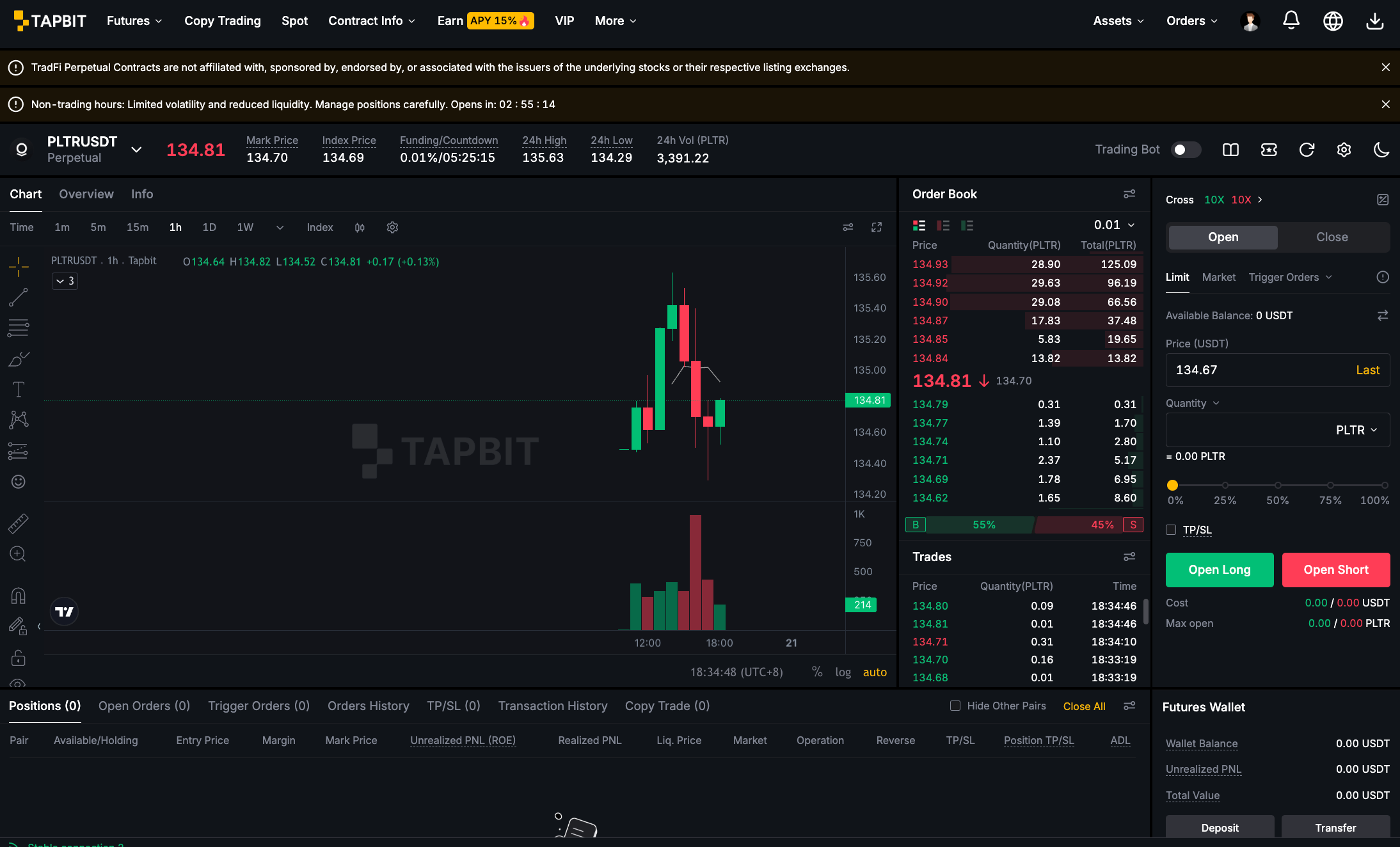
Navigate directly to PLTR futures trading on Tapbit. Or: click Futures in the top menu → search PLTR → select PLTR-USDT Perpetual.
Step 4: Check Key Parameters Before You Trade
Before placing any order, understand these four numbers:
- Mark Price — the fair price used to calculate your P&L and trigger liquidation. It's not always the same as the last traded price.
- Funding Rate — a periodic fee exchanged between long and short holders. If you hold a position overnight, this affects your total cost.
- Leverage — a multiplier on your position size. Higher leverage means higher potential gains and higher liquidation risk. New to futures? Start with 1–3x.
- Liquidation Price — the price at which your position is automatically closed. Always know this number before you enter a trade.
Check the fee structure before placing trades so there are no surprises on costs.
Step 5: Go Long or Short
Long (Buy): You expect PLTR price to rise → click Buy / Long Short (Sell): You expect PLTR price to fall → click Sell / Short
Choose your order type: a Limit Order lets you set your entry price and wait for a fill, while a Market Order executes immediately at the current price.
Always set a Stop Loss. PLTR can move 10–20% around earnings dates. Stop loss protects your position from sudden spikes.
Step 6: Monitor and Close Your Position
Once in a trade, watch three things: your Mark Price vs Entry Price to track real-time P&L, the Funding Rate if you plan to hold overnight, and news flow — government contract announcements, quarterly earnings, and AI sector news are the main PLTR catalysts.
To exit: click Close Position → choose market or limit close.
Not ready to trade actively? Consider copy trading on Tapbit — follow experienced traders and mirror their PLTR positions automatically.
Key Risks Every Crypto Trader Should Know Before Trading PLTR
Futures-Specific Risks
- Leverage amplifies both gains and losses. A 10x leveraged position can be liquidated by a 10% price move.
- Funding rate costs accumulate on long-held positions — especially during high-volatility periods.
- Earnings-day gaps can cause sudden price jumps that bypass stop-loss orders.
- Crypto market hours ≠ stock market hours. During weekends and non-U.S. trading hours, PLTR price may lag or gap when markets reopen.
PLTR Fundamental Risks
- Extreme valuation (~100x forward P/E): any slowdown in growth can trigger sharp sell-offs
- Government contract concentration: policy or budget shifts directly impact revenue
- AI competition: Anthropic, Microsoft Azure AI, and cloud hyperscalers are all targeting Palantir's space
- Market rotation: institutional funds periodically rotate from software stocks to semiconductors, reducing PLTR demand
So: what does PLTR stock mean in crypto? It means the line between stock markets and crypto markets is getting blurrier — fast. Palantir is an AI company. PLTR is its stock. But now crypto traders can trade PLTR price — long or short — without ever touching a traditional brokerage.
Is PLTR a good stock to buy right now? The fundamentals are strong. The valuation is high. The volatility is real. And on Tapbit, you can trade both sides of that story. Is PLTR a good stock to buy or trade for you? Only you can answer that — based on your risk tolerance, your view on AI growth, and how you manage leverage. What Tapbit gives you is the access to act on that view, 24/7, with USDT.
Ready to trade PLTR with USDT? Start here.
This article is for educational purposes only. It does not constitute financial or investment advice. Crypto futures trading carries significant risk. Always do your own research before trading.
FAQ
Q1: What does PLTR stock mean in crypto?
PLTR is the Nasdaq ticker for Palantir Technologies — a U.S. AI software company. In crypto, "PLTR" refers to tokenized stock products (like PLTRx on Kraken or PLTRon via Ondo) and perpetual futures contracts on platforms like Tapbit. Both let crypto users trade Palantir's price without a traditional brokerage account.
Q2: Is PLTR a good stock to buy in 2026?
Palantir delivered 85% revenue growth in Q1 2026 and raised full-year guidance to 71% growth — exceptional by any measure. However, the stock trades at ~100x forward earnings, making it a high-expectation investment. Whether PLTR is a good stock to buy depends on your view of AI growth durability, your risk tolerance, and whether you believe the current valuation is justified. It's not financial advice, but the data paints a picture of a high-growth, high-risk equity.
Q3: Is PLTR a cryptocurrency?
No. PLTR is a stock ticker, not a crypto token or coin. However, tokenized PLTR products (RWA) exist on blockchain platforms, and PLTR-USDT perpetual futures are available on Tapbit. These allow crypto traders to access Palantir's price movement without owning the underlying stock.
Q4: What is the difference between tokenized PLTR and PLTR futures on Tapbit?
Tokenized PLTR (PLTRx, PLTRon) is backed by real Palantir shares held in custody. It provides price exposure but no shareholder rights, and typically offers no leverage. PLTR-USDT futures on Tapbit are derivative contracts with no underlying share custody — settled purely in USDT, with leverage available and 24/7 trading in both long and short directions.
Q5: Why did PLTR fall after reporting record earnings?
Because PLTR is a high-expectation stock. At ~100x forward P/E, the market prices in aggressive future growth. When that growth is already "baked in," even a record quarter may not move the stock upward. This phenomenon — strong fundamentals, falling price — is a core feature of high-valuation growth stocks and creates both long and short trading opportunities for crypto futures traders.


