
SpaceX stock traded near $108 after a sharp post-earnings decline pushed SPCX back toward the lowest area in its short public-market history. The company reported strong growth, but investors focused on the scale of capital spending and the additional share supply created by the first IPO lockup expiration.
Q2 capital expenditure reportedly reached $18.4 billion, including about $15.8 billion associated with AI infrastructure. The stock closed around $108.27 after falling approximately 13.6%, below its $135 IPO price.
Why Did SpaceX Stock Fall After Q2?
The market was not rejecting SpaceX’s growth opportunity. It was questioning the amount of capital required before that opportunity produces dependable free cash flow. Large AI, Starlink and Starship investments can create long-term value, but they also increase financing and execution risk.
The first earnings report also arrived just before more than 900 million insider and pre-IPO shares became eligible for trading. Earnings pressure and lockup supply therefore hit the stock at nearly the same time.
What Did SpaceX Report?
Available reporting highlights several key points:
- Strong overall revenue growth.
- AI-related revenue growth of more than 200% year over year.
- Total quarterly capex of about $18.4 billion.
- AI infrastructure spending of roughly $15.8 billion.
- Operating losses that remained substantial despite growth.
The company has discussed a path toward a much larger annualized revenue run rate. Investors now want evidence that signed contracts and infrastructure deployments can convert into cash generation at an acceptable return.
Where Is SpaceX Spending the Money?
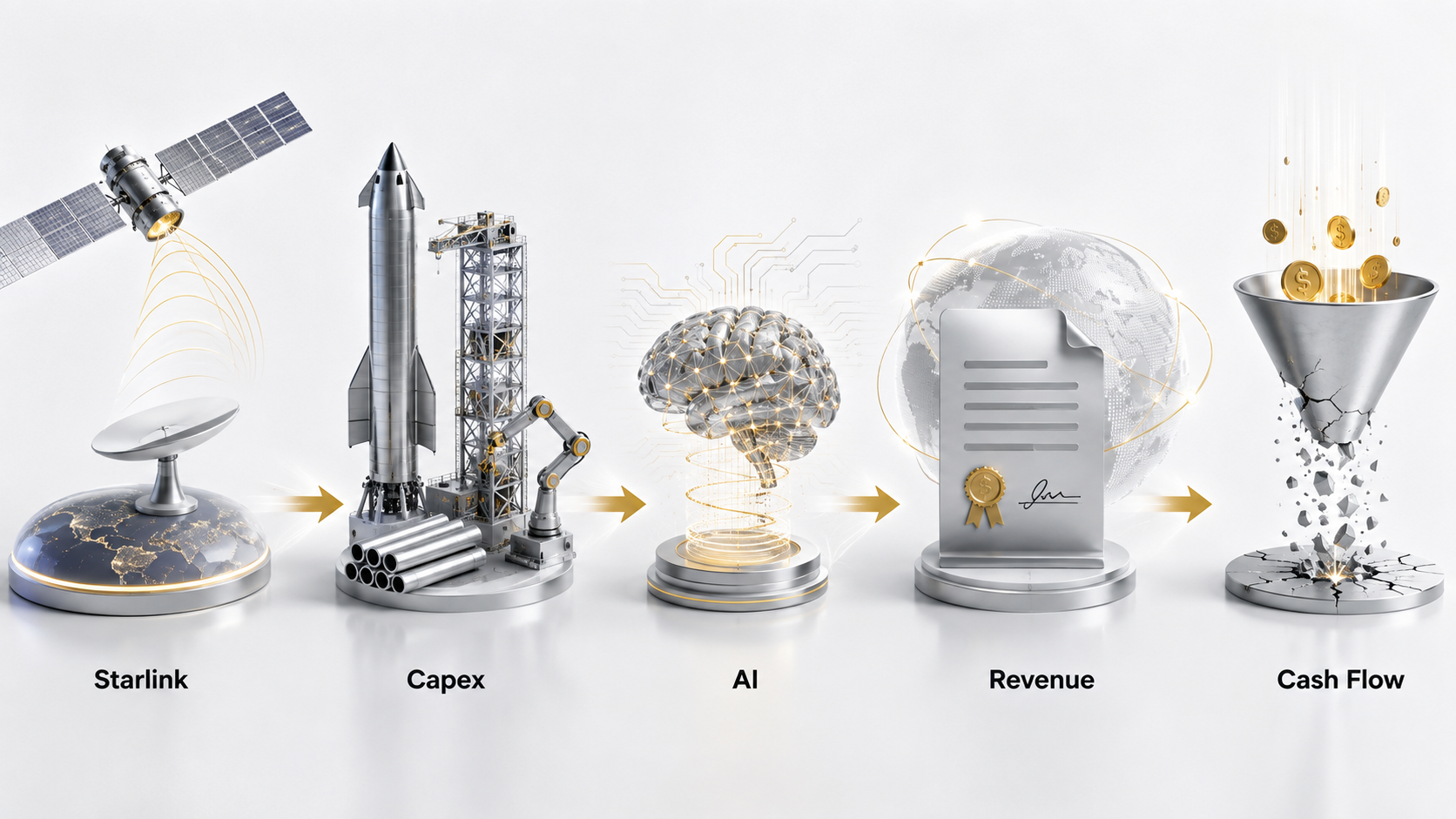
AI Data Centers
SpaceX is investing in compute infrastructure to support AI services, satellite data processing and potentially broader cloud offerings. The opportunity is large, but data centers require power, networking, cooling and advanced chips before revenue scales.
Starship and Launch Infrastructure
Starship can reduce launch cost and increase capacity if the program reaches reliable commercial operation. Development remains capital intensive, and test delays can shift expected returns.
Starlink and Direct-to-Device Connectivity
Starlink is the most visible recurring-revenue engine. Subscriber growth and enterprise connectivity can help fund expansion, but satellite replacement and network investment remain ongoing costs.
Can Starlink Finance the AI Expansion?
Starlink can support the broader company if subscriber growth, pricing and operating margins improve. The critical question is whether cash generated by connectivity services can cover both network maintenance and new AI or launch infrastructure without frequent equity issuance.
Readers can compare the current event with Tapbit Learn’s earlier SpaceX stock price analysis and its explanation of SpaceX tokenized stock structures.
How to Separate Growth Capex From Cash-Burn Risk
Not all capital spending should be treated as equally negative. Launch infrastructure, satellites and network capacity can support identifiable services with existing demand, while experimental AI projects may require a longer period before revenue becomes visible. Investors should separate maintenance spending, capacity expansion and speculative development rather than evaluating the entire capex number as one category.
The next question is funding. A company can sustain heavy investment more comfortably when operating cash flow from established businesses covers a meaningful share of spending. If Starlink revenue and cash generation rise alongside capex, the balance sheet may remain manageable even while free cash flow is weak. If spending accelerates faster than internal cash generation, investors may begin pricing additional debt, equity issuance or slower project timelines.
Return on invested capital will not be clear in one quarter. Useful evidence includes new contracted customers, utilization of added computing capacity, lower launch costs and improving unit economics across the satellite network. Without those signals, a large AI budget remains a promise. With them, the same spending can be reclassified from uncontrolled cash burn to an investment cycle with measurable milestones.
What Does the IPO Lockup Expiration Mean?
A lockup prevents certain insiders and early holders from selling for a defined period after an IPO. Its expiration does not mean all eligible holders will sell. It increases the potential supply of shares available to the market.
Because the newly eligible amount is large relative to the existing float, investors may demand a lower price until they understand actual insider selling. The stock can therefore remain volatile even if operating fundamentals do not change.
SpaceX Stock Technical Levels
The $108 area is the first immediate reference because it contains the post-earnings close and recent low range. A sustained break below roughly $108 would indicate that lockup and capex concerns remain dominant.
The first recovery area is around $115–$125, followed by the $135 IPO price. Reclaiming $135 would be a more meaningful confirmation that the market is again willing to value the company above its offering level.
SpaceX Stock Outlook
Bull Case
AI contracts convert into revenue, Starlink cash flow improves and insider selling is smaller than feared. SPCX holds the low and rebuilds above $125 and eventually $135.
Base Case
Growth remains strong, but capex and the expanded float keep the stock in a wide range. The market waits for several quarters of cash-flow evidence.
Bear Case
Capital needs remain high, project timelines slip or insider selling overwhelms demand. The bear case is confirmed if the stock repeatedly closes below the post-earnings low.
How to Trade SPCX-USDT on Tapbit
Tapbit users can access SpaceX-related price exposure through SPCX-USDT stock-linked perpetual futures. This contract is a derivative, not direct ownership of SpaceX shares, and it does not grant voting rights or dividends.
- Register or log in. Create an account and prepare a futures balance.
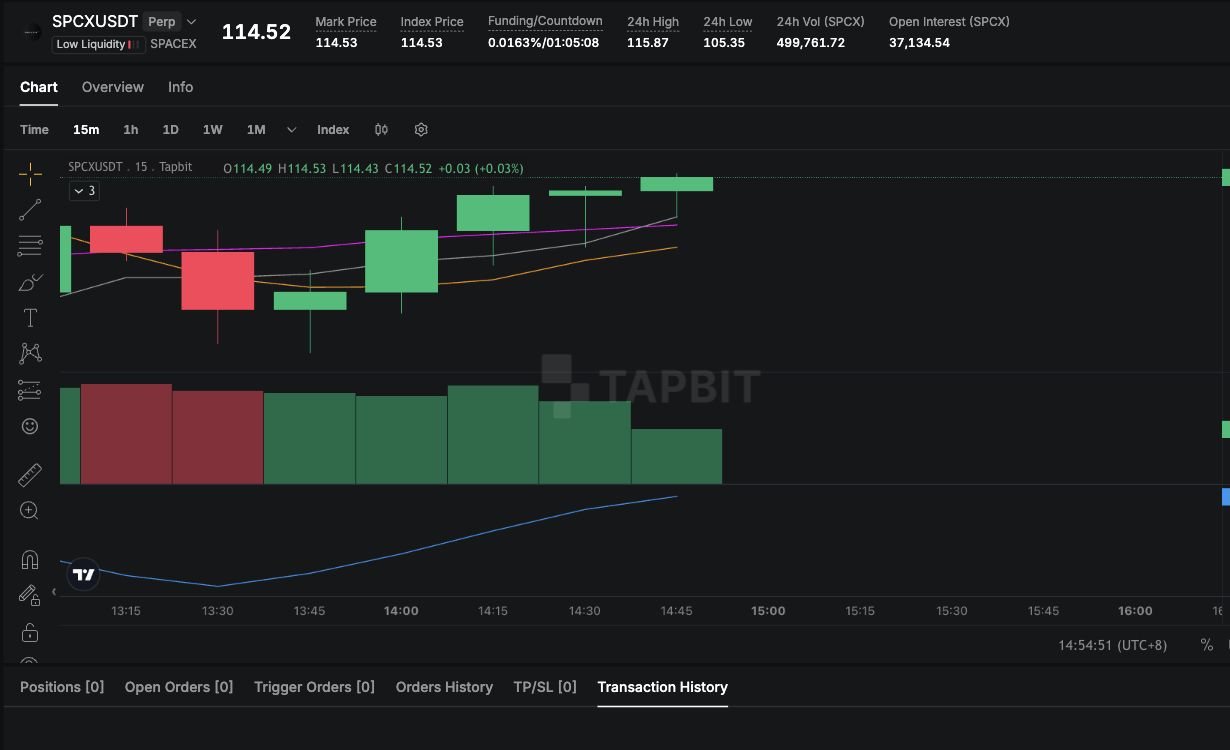
- Open SPCX-USDT. Review the contract name, mark price, index price, funding rate and countdown.
- Set the position. Choose Limit, Market or Trigger Order, set quantity and leverage, then select Open Long or Open Short.
- Manage event risk. Add TP/SL and monitor margin during earnings, Starship tests and insider-selling windows.
SPCX-USDT should not be confused with ordinary shares or tokenized-stock products. The differences are explained in Tapbit Learn’s guide to tokenized stocks.
FAQ
Why did SpaceX stock fall?
Investors focused on $18.4 billion in quarterly capex, the uncertain timing of AI returns and the expiration of the first IPO lockup.
What was the SpaceX IPO price?
SpaceX priced its IPO at $135 per share.
What is SPCX-USDT?
It is a stock-linked perpetual futures derivative providing SpaceX-related price exposure.
Does SPCX-USDT provide SpaceX shares?
No. It provides no direct ownership, voting rights or dividends.


