

What Is SMCI on Robinhood? Supermicro Stock and SMCI-USDT Explained
If you search for “SMCI Robinhood”, you are usually looking at Super Micro Computer, Inc. on Robinhood’s stock platform. SMCI is the Nasdaq ticker for Super Micro Computer, a company known for AI servers, storage systems, networking hardware and data-center infrastructure.
This is an important distinction because SMCI is not a cryptocurrency, and “SMCI on Robinhood” does not mean a special token or a separate coin. In most cases, it simply refers to the regular SMCI stock listing available through Robinhood’s brokerage interface.
What Does SMCI Mean?
SMCI stands for Super Micro Computer, Inc. The company is a major hardware supplier in the AI and data-center market. Investors often watch SMCI because its business is closely tied to demand for:
- AI servers
- GPU systems
- High-performance computing
- Liquid cooling solutions
- Cloud and enterprise infrastructure
Because of this, SMCI is often grouped with other AI infrastructure names. When enthusiasm around AI spending rises, SMCI can attract strong buying interest. When investors worry about margins, accounting issues or customer demand, the stock can also move sharply lower.
What Is SMCI on Robinhood?
On Robinhood, SMCI refers to the ordinary listed shares of Super Micro Computer. A Robinhood user who buys SMCI is using a traditional brokerage product tied to the company’s publicly traded stock.
That is different from searching for a crypto token, a tokenized share or a derivatives contract. Many users mix these concepts together, especially now that stock-linked products and tokenized-asset narratives are becoming more common.
Is SMCI on Robinhood a Cryptocurrency or Tokenized Stock?
No. SMCI on Robinhood is not a cryptocurrency and is not the same thing as a tokenized stock product. It is best understood as a conventional stock listing inside a brokerage app.
That means users should separate four different ideas:
- SMCI stock on a brokerage platform like Robinhood
- Tokenized stocks in blockchain-based systems
- Stock-linked perpetual futures such as SMCI-USDT
- Leveraged stock ETFs or other synthetic products
These products may all reference the same company, but they do not give the same legal rights or carry the same trading structure.
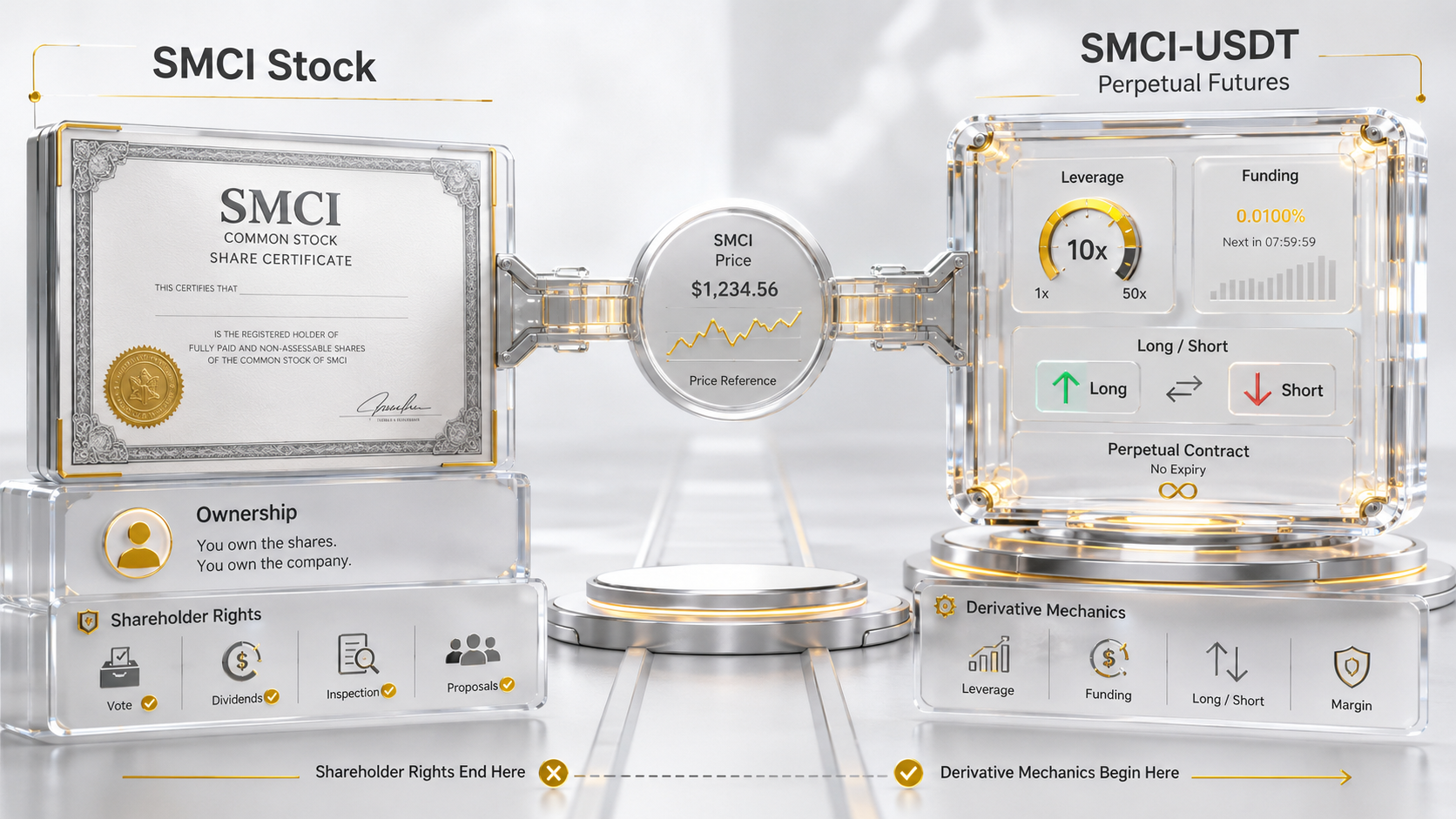
SMCI on Robinhood vs SMCI-USDT on Tapbit
This is the most important comparison for users who want to understand how a stock product differs from a derivatives contract.
| Feature | SMCI on Robinhood | SMCI-USDT on Tapbit |
|---|---|---|
| Instrument Type | Ordinary stock | Stock-linked perpetual futures |
|
Ownership |
Brokerage-held share exposure | No direct share ownership |
| Voting Rights | Potentially available under broker/shareholder structure | None |
| Dividends | Possible if declared and passed through | None |
| Settlement | Brokerage stock account | USDT-margined derivative |
| Leverage | Brokerage rules may apply | Perpetual futures leverage available |
| Position Direction | Mainly long exposure | Both long and short exposure |
SMCI-USDT is a stock-linked perpetual futures derivative. It does not represent direct ownership of Super Micro Computer shares and does not provide shareholder voting rights or dividends.
How Does SMCI-USDT Work?
SMCI-USDT is designed for traders who want SMCI-related price exposure in a futures-style product. Instead of holding ordinary shares, users trade a derivative contract quoted against USDT.
This structure allows both long and short positioning. It can also include leverage, which increases both opportunity and risk. That means a trader can benefit from price moves in either direction, but can also face faster losses or liquidation if risk is not managed properly.
Readers who need more background can also review what tokenized stocks are and how tokenized-stock risks differ from ordinary shares.
Why Do Traders Watch SMCI So Closely?
SMCI is one of the best-known AI infrastructure stocks because its business sits near the center of the server buildout cycle. When AI demand rises, investors often expect stronger orders for GPU server systems, rack-scale solutions and cooling equipment.
AI Server Demand
Supermicro benefits when hyperscalers, enterprises and AI infrastructure providers spend heavily on new server deployments. That is why SMCI often moves with broader AI spending expectations.
Nvidia and GPU Ecosystem Exposure
Many investors treat SMCI as an indirect way to participate in the Nvidia-led AI hardware ecosystem. That connection can support strong momentum, but it also means the stock can react sharply to any changes in GPU supply, customer budgets or AI monetization concerns.
Earnings and Margin Sensitivity
SMCI is not just a demand story. The stock is also highly sensitive to margins, shipment timing, operating efficiency and backlog conversion. As a result, earnings dates can produce unusually large moves.
What Risks Should Traders Know?
- Earnings volatility: results can trigger large price gaps.
- Margin pressure: strong revenue does not always mean strong profitability.
- Supply-chain dependence: AI hardware demand depends on component availability.
- High momentum risk: fast-moving AI names can reverse sharply.
- Derivative risk: leverage, funding and liquidation can increase losses.
How to Trade SMCI-USDT on Tapbit
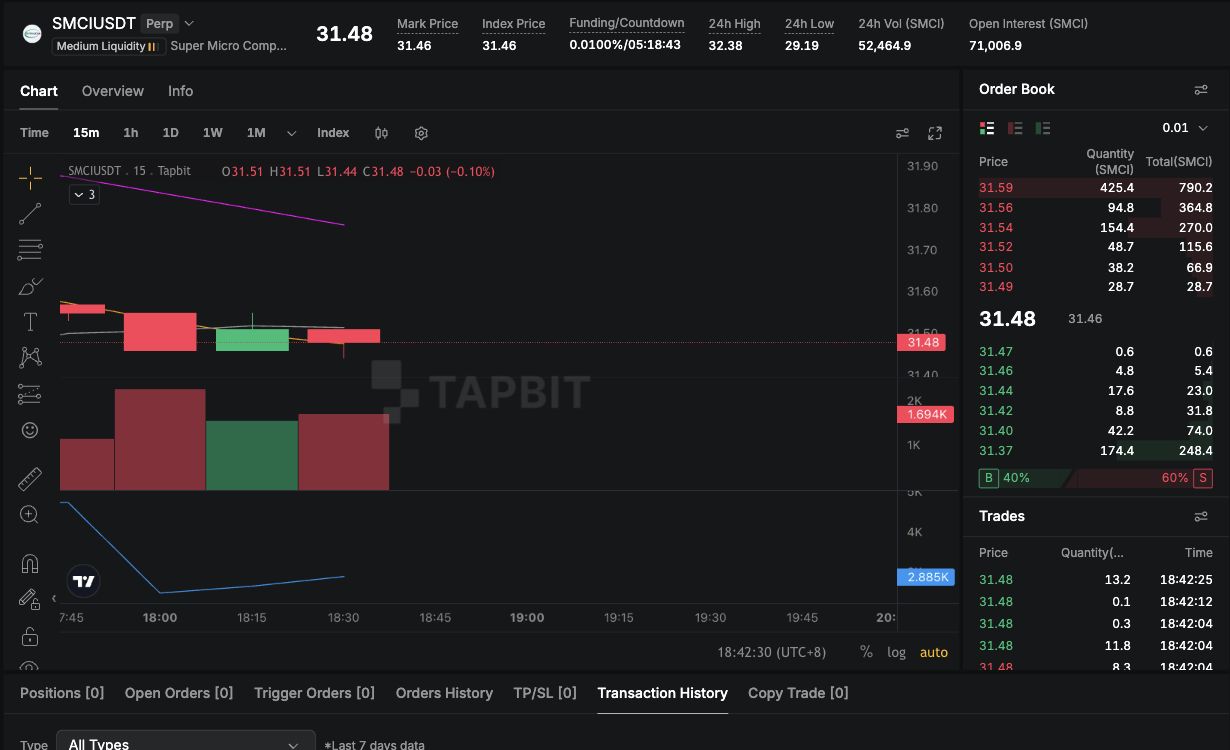
- Register or log in. Create an account or log in, complete the required setup and prepare funds for futures trading.
- Open the futures market. Visit SMCI-USDT stock-linked perpetual futures and review the contract name, mark price, index price and funding details.
- Set the order and position direction. Choose a Limit, Market or Trigger Order, enter price and quantity, set leverage and select Open Long or Open Short.
- Add risk controls and manage the position. Set TP/SL, confirm cost and margin usage, then monitor the position in the platform’s position and order panels.
Final Thoughts
In simple terms, “SMCI on Robinhood” means Super Micro Computer stock on Robinhood’s brokerage platform. It is not a crypto asset and not the same product as Tapbit’s SMCI-USDT.
Robinhood stock exposure and Tapbit futures exposure can both be useful, but they serve different purposes. One is closer to a conventional stock investment path, while the other is built for flexible derivative trading.
FAQ
Is SMCI on Robinhood a cryptocurrency?
No. It refers to Super Micro Computer stock, not a cryptocurrency.
What does SMCI stand for?
SMCI is the Nasdaq ticker symbol for Super Micro Computer, Inc.
Does SMCI-USDT give me Supermicro shares?
No. SMCI-USDT is a derivative contract and does not provide direct ownership of shares.
Does SMCI-USDT provide dividends or voting rights?
No. It does not provide shareholder voting rights or dividends.
Can I short SMCI using SMCI-USDT?
Yes. As a perpetual futures product, SMCI-USDT can be used for both long and short positioning, depending on market conditions and platform settings.


