
Hyperliquid spent years building one of crypto's largest on‑chain derivatives markets while staying outside the US regulatory perimeter. One comment from President Donald Trump has now pushed that boundary into focus.
At an August 19 White House event, Trump said CFTC Chairman Michael Selig was working to bring Hyperliquid into the United States in a compliant form. HYPE rallied on the remarks and continued higher, reaching a record $86.71 on August 27.
The market response was understandable — US capital access could meaningfully expand the platform's reach. But the price move has outpaced the regulatory process. No US launch, approval or timeline has been announced.
That gap between political signals and regulatory action is now the central issue for HYPE.
One Sentence Changed the HYPE Trade
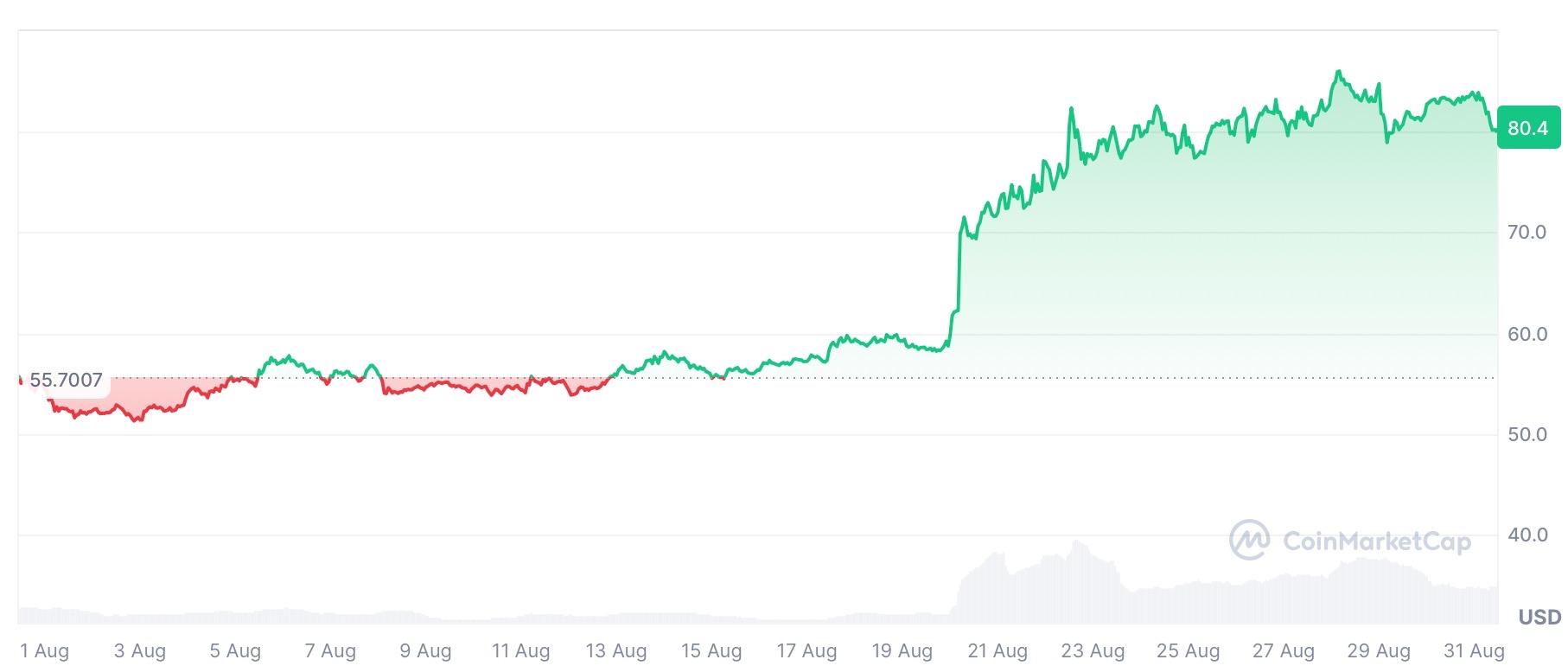
Before Trump’s remarks, HYPE was trading near $60. Data shows that it closed around $58.52 on August 18, climbed to approximately $73.66 by August 20 and reached its new high one week later.
By August 31, HYPE was trading near $80, giving it a circulating market value of roughly $18 billion. The token had gained more than 50% over 30 days and entered CoinGecko’s top 10 by market capitalization.
This was more than a brief headline spike. Traders continued pricing in the possibility that Hyperliquid could gain a legal route into the world’s largest capital market.
Trump’s comment mattered because it addressed a longstanding limit on Hyperliquid’s growth. The platform’s official interface restricts U.S.-related users. Removing that barrier, even through a separate regulated product, could expand its addressable market.
But political attention is not regulatory approval.
The White House event confirmed that Hyperliquid had reached the highest level of the U.S. policy conversation. It did not establish how the platform would meet American derivatives rules.
Washington Has Not Approved Hyperliquid
CFTC Chairman Michael Selig has argued that the United States should bring financial innovation onshore rather than push it toward foreign or unregulated venues. His August remarks also pointed to a broader regulatory roadmap for crypto derivatives, prediction markets and other technology-driven financial products.
Public CFTC records, however, do not show an approved Hyperliquid U.S. platform. There is no announced operating license, registration filing or launch schedule tied to the existing exchange.
The distinction matters because regulated HYPE products already exist in the American market.
Bitnomial filed a physically settled HYPE futures contract with the CFTC in April. Kalshi followed with a perpetual futures contract referencing the HYPE token in June. These filings show that U.S.-regulated exchanges are willing to build products around HYPE.
They do not authorize Hyperliquid’s own trading platform to serve U.S. customers.
A trader can gain exposure to HYPE through a regulated third-party contract without receiving access to Hyperliquid’s on-chain order book. Treating those developments as interchangeable would overstate the progress toward a U.S. launch.
Hyperliquid Has a Business Behind the Political Story
HYPE is not rising solely because of Washington speculation. Hyperliquid already operates at a scale few decentralized trading platforms have reached.
At the end of August, DefiLlama tracked approximately $6.7 billion in total value locked and $13.5 billion in open interest. Perpetual trading volume exceeded $200 billion over the preceding 30 days.
The protocol generated about $64.8 million in fees and $49.6 million in revenue over the same period. Its fee structure creates a direct connection between platform activity and HYPE demand because most eligible trading fees are directed to the Assistance Fund, which purchases HYPE.
This gives the token a clearer economic link to the platform than many governance assets possess. Higher trading activity can produce more fee revenue, which may increase purchases by the fund.
A U.S. expansion could strengthen that mechanism, but only if it generates additional activity. A license or branded American product would carry little economic value if trading volume, liquidity and fees failed to follow.
A U.S. Version Would Probably Look Different
Hyperliquid’s appeal comes from its non-custodial structure, fast execution and fully on-chain order book. American derivatives regulation introduces requirements that do not fit neatly into that model.
A compliant U.S. offering would likely need customer identification, transaction monitoring, market-surveillance systems, reporting procedures and controls over user eligibility. Leverage and available markets could also face restrictions.
That leaves several possible routes.
Hyperliquid could establish a separate regulated entity, work with an existing CFTC-registered exchange or provide infrastructure to a licensed operator. A compliant interface could connect to parts of the underlying network while applying additional controls to U.S. users.
These are plausible structures, not confirmed plans. The important point is that a U.S. launch would probably involve more than removing a geographical restriction from the current website.
The eventual design will determine how much additional value reaches the Hyperliquid network and HYPE token.
The Valuation Already Assumes Substantial Growth

HYPE’s circulating market capitalization was close to $18 billion at the end of August, while its fully diluted valuation approached $77 billion. That difference reflects the large portion of supply that is not yet circulating.
SEC filings discussing Hyperliquid identify approximately 238 million HYPE allocated to core contributors under a multi-year vesting structure. Public tracking services disagree on some individual release dates and quantities, so specific unlock claims should be treated cautiously unless confirmed through wallet movements or official disclosures.
The broader issue is clear: future supply could enter the market while HYPE is trading at a valuation that already anticipates strong platform growth.
Protocol purchases may absorb part of that supply, particularly when trading activity is high. They do not eliminate dilution or selling risk. Contributor behavior, staking decisions and transfers to exchanges remain relevant.
HYPE therefore faces two tests at the same time. Hyperliquid must turn political interest into a workable U.S. product, while platform revenue must support a token valuation that has risen sharply ahead of that outcome.
Washington Opened the Door. Delivery Comes Next.
Trump’s remarks gave Hyperliquid something rare for an offshore-origin crypto platform: public recognition from the U.S. president and an indication that regulators are considering a legal pathway.
The rally was not built on politics alone. Hyperliquid has real trading volume, substantial open interest and a fee model connected to HYPE purchases. Those fundamentals explain why the market treated the statement seriously.
Still, the decisive development has not happened. Hyperliquid has not announced a U.S. platform, and the CFTC has not published an approval for one.
HYPE is now priced as both a successful on-chain derivatives asset and a possible beneficiary of U.S. regulatory change. The next phase will show whether those two stories converge.
Follow market developments and digital-asset research through Tapbit. Tapbit users can access their accounts, while new users can register here.
Frequently Asked Questions
Why did HYPE rise after Trump mentioned Hyperliquid?
Trump said the CFTC chairman was working on a compliant way to bring Hyperliquid into the United States. Traders interpreted the statement as a possible reduction in regulatory risk and began pricing in future access to U.S. users and capital.
Has Hyperliquid been approved in the United States?
No. As of August 31, 2026, there is no announced approval, U.S. platform launch or confirmed launch date. The available information indicates political and regulatory interest, not completed authorization.
Can U.S. users currently trade on Hyperliquid?
The official Hyperliquid interface restricts U.S.-related users. Attempts to bypass geographical restrictions may violate platform terms and expose users to legal and account-related risks.


