

HYPE moved sharply higher after President Donald Trump said Commodity Futures Trading Commission Chair Michael Selig was working to bring Hyperliquid into the United States “in a fully compliant and legal fashion.” The remark gave traders something they had not previously had: a public signal from the White House that a U.S. regulatory route is being explored. It did not, however, amount to an approval, license, or timetable.
Traders can follow the live HYPE/USDT spot market on Tapbit. The supplied market snapshot shows HYPE at $81.295, up 1.54% over 24 hours, after trading between $79.075 and $84.105. That places the token near the upper end of its recent range after a steep August advance.

What Trump Actually Said About Hyperliquid
At an August 19 White House event, Trump said he understood that Selig was working to bring Hyperliquid into the U.S. legally and compliantly. Reporting from CoinDesk and The Block described an immediate double-digit HYPE rally as traders repriced the possibility of regulated U.S. access.
The distinction matters. Trump publicly acknowledged the work, but the CFTC has not announced that Hyperliquid is authorized to serve U.S. users. A compliant path could require registration, product restrictions, identity checks, surveillance standards, customer-protection rules, or a new legal structure. Any of those details could change the economic value of the opportunity.
Why a U.S. Path Matters for HYPE
Hyperliquid is best known for onchain perpetual futures and a fast order-book experience that resembles a centralized trading venue while settling activity through blockchain infrastructure. U.S. users have historically faced limited access to many offshore perpetual products because leveraged crypto derivatives fall inside a demanding regulatory framework.
A workable route into the U.S. could widen the platform’s addressable market and give institutions more confidence to explore onchain trading. It could also create a precedent for other decentralized or hybrid venues. For HYPE, the bullish argument is that more users, volume, fees, and ecosystem activity may strengthen demand for the network’s native token. That relationship is not automatic: regulatory costs or a limited U.S. product set could reduce the commercial upside.
What the HYPE Price Chart Shows
The provided Tapbit chart shows a clear multi-month uptrend, followed by a rapid August breakout from the mid-$50s toward the low-$80s. Volume expanded during the advance, a sign that the move attracted broad participation rather than drifting higher on quiet trading. The same pattern also means many recent buyers entered at elevated prices, leaving the market vulnerable if momentum fades.
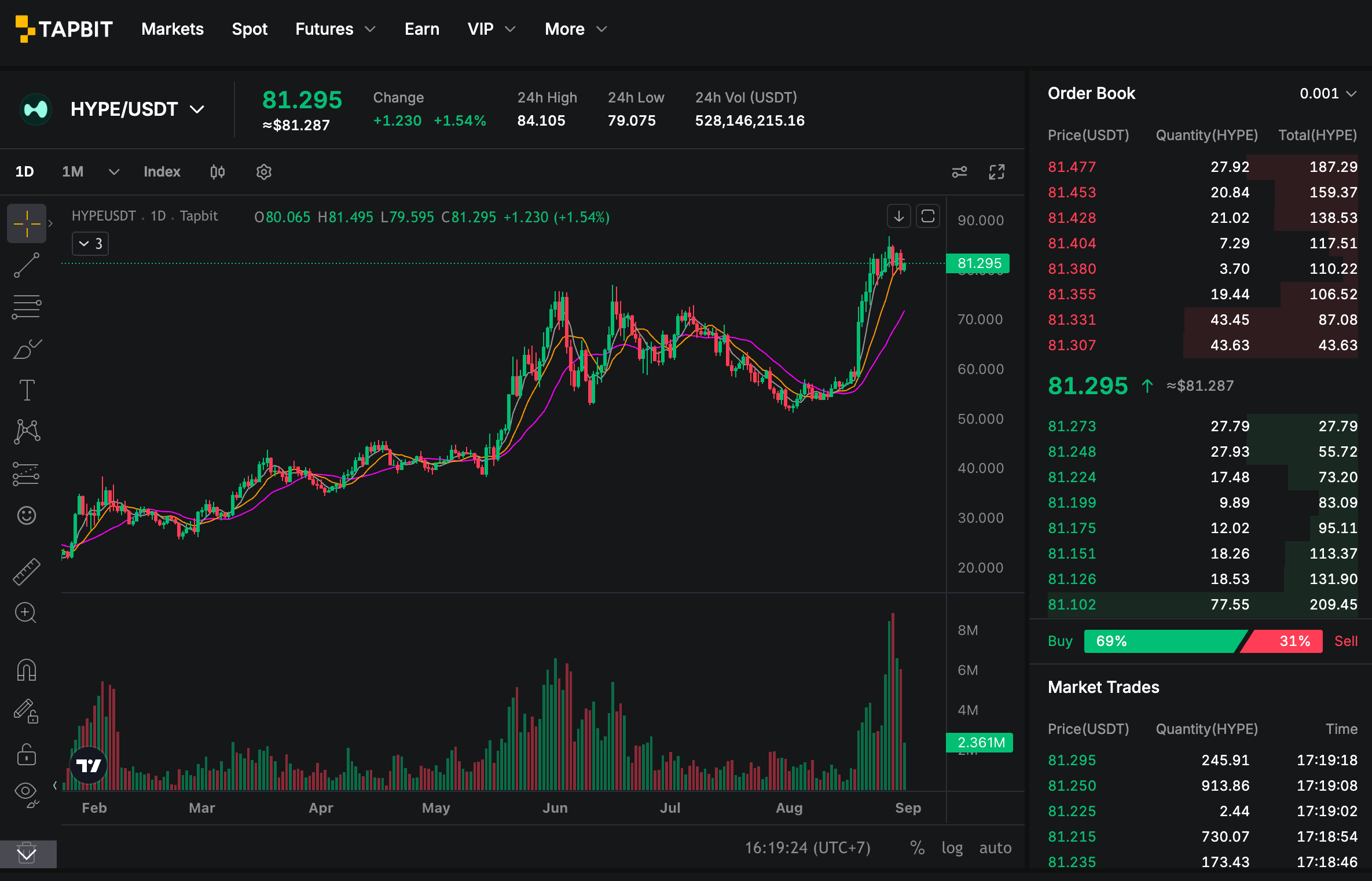
The snapshot records $528.1 million in 24-hour spot volume and an intraday high of $84.105. The $80 area is the first psychological level to watch. Holding it would suggest buyers are accepting the post-news valuation, while repeated failures below $84-$85 could signal that the initial regulatory optimism is already reflected in price.
The Next Catalysts for Hyperliquid
The strongest follow-through would come from a concrete CFTC proposal rather than another supportive comment. Traders should watch for details on which legal entity would operate in the U.S., what products could be offered, whether retail users would qualify, and how onchain custody and compliance would work.
Network fundamentals matter as well. Sustained trading volume, fee generation, developer activity, stablecoin liquidity, and new markets would provide a stronger base than headlines alone. If usage continues to grow while regulators outline a credible route, HYPE could retest the recent high and attempt a breakout. If activity cools while policy work drags on, the token may consolidate even if the long-term story remains intact.
What Could Reverse the Rally
The first risk is regulatory disappointment. “Working to bring” a platform onshore is not the same as approving its existing model. Negotiations can take months, and a final framework may be narrower than traders expect. The second risk is positioning. A fast rally can attract leveraged longs and raise funding costs, making the market sensitive to liquidations when price slips.
There is also execution risk. Hyperliquid must preserve the speed and liquidity that made it popular while meeting U.S. requirements. Strong competitors, smart-contract incidents, validator concerns, declining volume, or changes to token economics could weaken the investment case independently of Washington.
Conclusion
Trump’s comment moved Hyperliquid from a regulatory question mark to a visible policy discussion, which helps explain HYPE’s strong reaction. Yet the market is pricing a possibility, not a completed U.S. launch. The next durable move will depend on CFTC specifics, continued platform usage, and whether HYPE can hold the $80 region after its rapid advance. A break above $84-$85 with sustained volume would strengthen the bullish case; a loss of $80 could expose a deeper reset toward the former breakout zone.
FAQ
Did Trump approve Hyperliquid for the U.S.?
No. Trump said the CFTC chair was working on a legal and compliant path, but regulators have not announced final approval, operating terms, or a launch date.
Why did HYPE rise after the comment?
Traders interpreted the statement as evidence that U.S. regulators are exploring a route for Hyperliquid rather than simply excluding the platform. That could expand its potential market if a workable framework is completed.
What price levels matter for HYPE now?
Based on the supplied snapshot, $80 is the nearest psychological support, while the recent $84-$85 area is the first major resistance zone. These levels can change quickly with market conditions.
Can U.S. access guarantee a higher HYPE price?
No. The effect would depend on the final rules, permitted products, user demand, platform fees, token economics, and broader crypto liquidity. Regulatory progress can reduce one uncertainty without removing market risk.


