
DEBIT arrived with launch‑friendly tailwinds: a Binance Alpha campaign, simultaneous exchange listings, an AI‑agent narrative, and a relatively small circulating supply.
The token began trading on August 26 and reached an all‑time high of $1.74 on August 29. By August 31, it was around $1.53, with a circulating market cap of roughly $26.4 million.
Reported 24‑hour volume exceeded $236 million — nearly nine times the token's circulating market value.
That number speaks to launch‑week interest. It speaks much less to whether Teller's new AI product can generate sustainable demand for DEBIT going forward.
The Listing Rush Explains the Early Price Action
Binance Alpha introduced the token on August 26 and offered an airdrop to qualifying Alpha Points users. Bitget and KuCoin opened DEBIT/USDT spot trading on the same day, giving the new asset immediate access to several pools of traders.
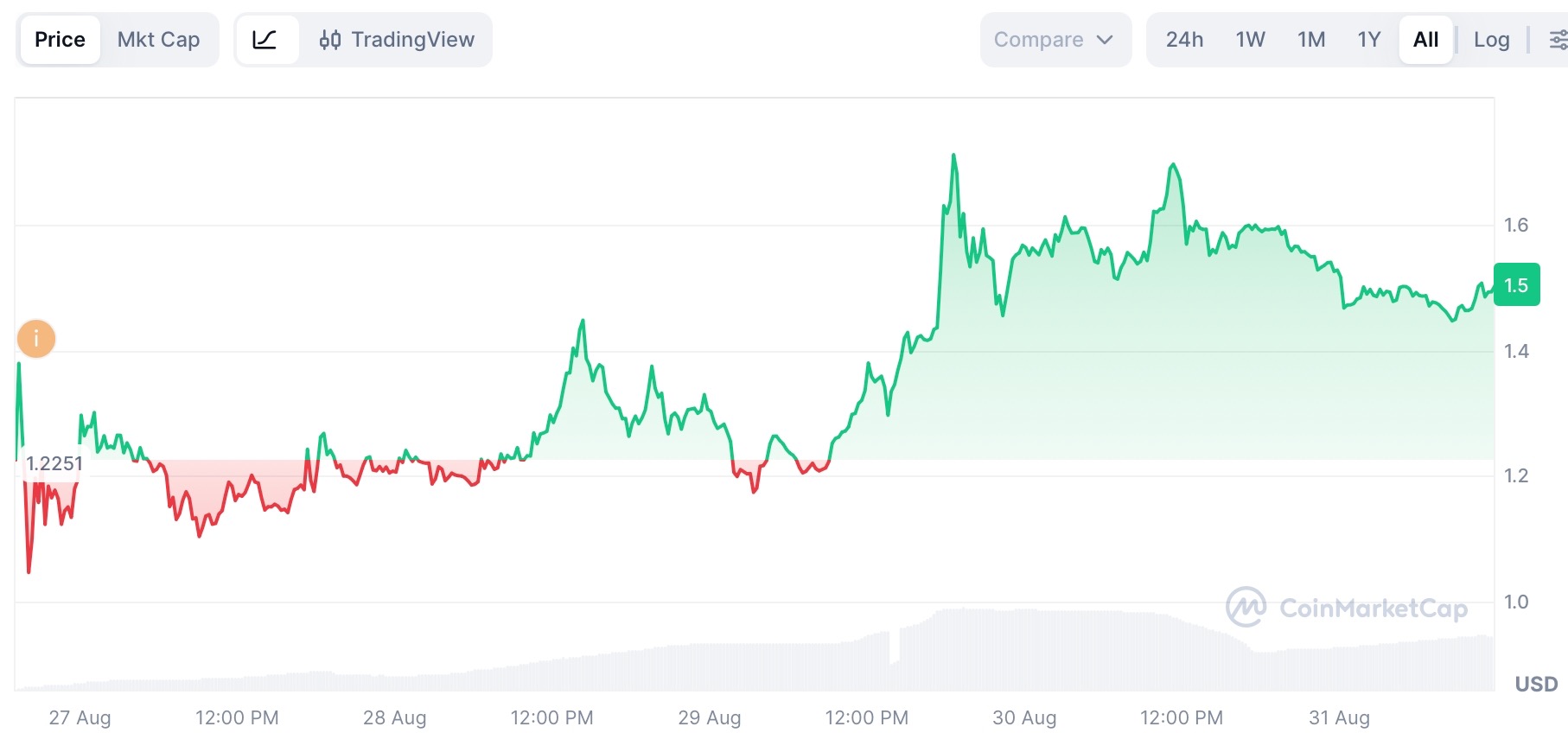
DEBIT initially traded as low as $0.8172 before reaching $1.74 on August 29. Its price nearly doubled between those two points.
This pattern is common during token launches. Exchange access expands quickly, airdrop recipients decide whether to hold or sell, and traders compete to establish a price before much historical data exists.
DEBIT’s reported volume-to-market-cap ratio makes the launch particularly speculative. High turnover can improve liquidity, but it can also indicate that the same available supply is changing hands repeatedly. Volume alone does not prove long-term demand.
Teller and Debit AI Play Different Roles
Teller is the established lending platform. The project says it has operated since 2019, connecting users with traditional loan offers and providing on-chain loans backed by crypto assets.
Debit AI is a newer automation layer built alongside that platform. It is designed to let users instruct an AI agent to perform financial actions such as swaps, borrowing, cross-chain routing, portfolio monitoring and strategy execution.
The product proposition is straightforward. Instead of manually moving between wallets, bridges, lending markets and swap interfaces, a user can describe a task in natural language and allow the agent to execute it within defined limits.
DEBIT is associated primarily with this AI layer. Public project materials describe the token as a utility credit used to access agent functions and other platform services.
That distinction matters because Teller can have a functioning lending business without automatically creating demand for DEBIT. The token thesis depends on Debit AI gaining users and turning their activity into measurable token consumption.
Teller Brings History, but Not Automatic Token Value
Unlike many newly launched tokens, DEBIT is connected to a project with operating history.
Teller reports more than $80 million in processed loans, over $1.5 million in generated yield and a network of more than 50 lenders. Its services include loan pre-qualification through third-party licensed lenders and on-chain USDC loans backed by assets such as BTC and ETH.
The project also has recognizable financial backers. Teller announced a $6.85 million funding round in 2022 led by Blockchain Capital, with participation from Franklin Templeton, Toyota Ventures, Bessemer Venture Partners, Upstart and others.
That funding supports the case that Teller is not an anonymous project created for the August token launch. It does not mean those investors purchased DEBIT, participated in its tokenomics or endorsed its current valuation.
The distinction is important in crypto research. Equity or strategic investment in a company does not necessarily give the associated token the same rights, revenue claims or protections.
DEBIT Needs a Verifiable Demand Loop
The strongest case for DEBIT is based on usage rather than governance. If users pay DEBIT to run AI agents, continued activity could create recurring demand. Portfolio monitoring, strategy execution and cross-chain operations may consume credits each time they run, giving the token an economic function beyond speculation.
The unanswered question is how meaningful that consumption will become.
Public data does not yet show how many people are using Debit AI, how much DEBIT an average task consumes or whether tokens collected by the platform are burned, retained or returned to circulation. The relationship between Teller’s lending revenue and DEBIT is also unclear.
A credible demand loop would look something like this: more users activate agents, those agents execute more paid tasks, DEBIT is consumed or removed from available supply, and token demand grows with product usage.
Without that final connection, Teller’s loan volume and Debit AI’s token value remain separate stories.
The next useful disclosure would not be another exchange listing. It would be a dashboard showing agent activity, paying users and DEBIT consumption.
A 17.22% Float Changes How the Price Should Be Read
CoinMarketCap reports a total supply of 100 million DEBIT, with 17.22 million circulating. At the current price of $1.53, that gives a circulating market cap of roughly $26.4 million and a fully diluted valuation of about $153 million.
That gap between float and total supply is a key valuation factor. A small initial float can drive rapid price appreciation due to limited trading supply, but it also introduces future dilution risk if locked tokens are released faster than demand grows.
DEBIT's public disclosures do not yet include a detailed, independently verifiable schedule for team, investor, treasury, ecosystem, or market‑making allocations. Without that, it's difficult to estimate future supply pressure.
A missing schedule doesn't guarantee an imminent sell‑off — but it does mean traders can't model supply with confidence.
So price research should extend beyond circulating market cap. The FDV, allocation wallets, and future exchange transfers may be more informative than the headline token price
The AI Agent Also Introduces Execution Risk

Debit AI aims to perform financial operations rather than simply provide information. That raises the stakes.
An automated agent may encounter poor liquidity, bridge delays, smart-contract failures, unexpected slippage or incorrect user instructions. A strategy can execute exactly as configured and still produce a loss.
Teller describes the system as non-custodial and says users can set limits on assets, venues, chains, transaction size and daily spending. Those controls may reduce exposure, but they do not remove smart-contract or execution risk.
The product will need to demonstrate that its safeguards work under real market conditions. Security reviews, transparent routing, clear permission management and a reliable way to revoke agent access will matter more than the “AI-powered” label.
What Comes After the Launch Trade?
DEBIT’s first week was driven by visibility. Binance Alpha brought users, exchange listings created liquidity, and the AI-finance narrative gave traders an immediate reason to pay attention.
The next stage will require evidence. Product data should show whether people use Debit AI after the airdrop and listing campaigns fade. Token disclosures should explain how the remaining supply is allocated and released. On-chain activity should reveal whether DEBIT is being spent for services or primarily transferred between traders.
Teller’s existing loan business gives the project more substance than a typical launch-week token. DEBIT still has to prove that this business can support the new token rather than merely lend its name and history to it.
Market participants can follow broader digital-asset coverage and trading opportunities through Tapbit. Existing users can log in to Tapbit, while new users can open an account.
Frequently Asked Questions
What is the Teller DEBIT token?
DEBIT is a BEP-20 utility token associated with Debit AI, an AI-powered financial execution layer connected to the Teller lending ecosystem. It is intended to provide access to AI-agent functions and platform services.
Is DEBIT the same as Tellor TRB?
No. Teller’s ticker is DEBIT. Tellor is a separate blockchain oracle project whose token ticker is TRB. The two projects are unrelated.
Why did DEBIT attract attention in August 2026?
DEBIT launched on August 26 through Binance Alpha and began spot trading on platforms including Bitget and KuCoin. Its airdrop, multiple listings, AI-agent narrative and low initial circulating supply contributed to its early visibility.


