

Solar has not shut down. Its blockchain continues to produce blocks, validators remain active, and self‑custodied SXP can still be transferred across the network.
The market around SXP, however, paints a different picture.
Binance ended SXP spot trading in April 2026, and Bithumb and Coinone withdrew support in March. Solar currently lacks an active development roadmap, and its remaining public markets are so shallow that a few hundred dollars can sway the quoted price.
The distinction is important: a blockchain can remain operational long after its token has lost meaningful liquidity.
Solar Has Entered Maintenance Mode
Solar grew out of Swipe, the crypto payment platform acquired by Binance in 2020. The project later moved away from its original payment-card identity and became an independent Layer 1 network. SXP was retained as the native token for transaction fees, staking and validator voting.
That transition produced a functioning blockchain, but it did not produce enough lasting activity to compete with larger networks.
The situation became clearer on January 26, 2026. Solar said operational constraints and unresolved issues surrounding the project’s legacy structure had prevented further development. Several potential successor teams reviewed Solar but declined to take responsibility for it.
The announcement ended with a direct conclusion: no further protocol updates were planned.
Solar’s network did not close. A subsequent governance update confirmed that block production would continue, independent validators would remain active and balances would not change. Seed infrastructure would be maintained where possible.
In practical terms, Solar is now a maintenance-only network. It can process transactions, but there is no active roadmap showing how it intends to attract new applications, developers or users.
The Proposed Migration Never Happened
Former Solar contributors attempted to create an optional migration framework for holders. The proposal did not authorize an immediate token swap. It only asked validators to approve the preparation of a detailed migration plan.
Among participating validators, support was unanimous. Participation reached only 54.7%, however, falling short of the required 67% quorum. The proposal failed and no migration followed.
This point is particularly important because Monolythium, a separate initiative involving former Solar contributors, has sometimes been discussed as a possible successor. Solar’s own information page states that Monolythium is not a continuation of Solar. It has not inherited Solar’s assets or governance, and SXP holders are not automatically entitled to an airdrop.
Any website or social account promoting a guaranteed SXP migration should therefore be treated with caution.
Korean Exchanges Questioned Solar’s Sustainability
SXP’s loss of exchange access began before the Binance delisting. Bithumb and Coinone first announced the end of SXP trading support on February 10, 2026, with trading scheduled to stop on March 13. Both decisions came through South Korea’s Digital Asset Exchange Alliance review process.
These notices went beyond ordinary price volatility. Korean exchanges were questioning whether Solar still had a credible operating future.
SXP Price Data Now Needs a Warning Label
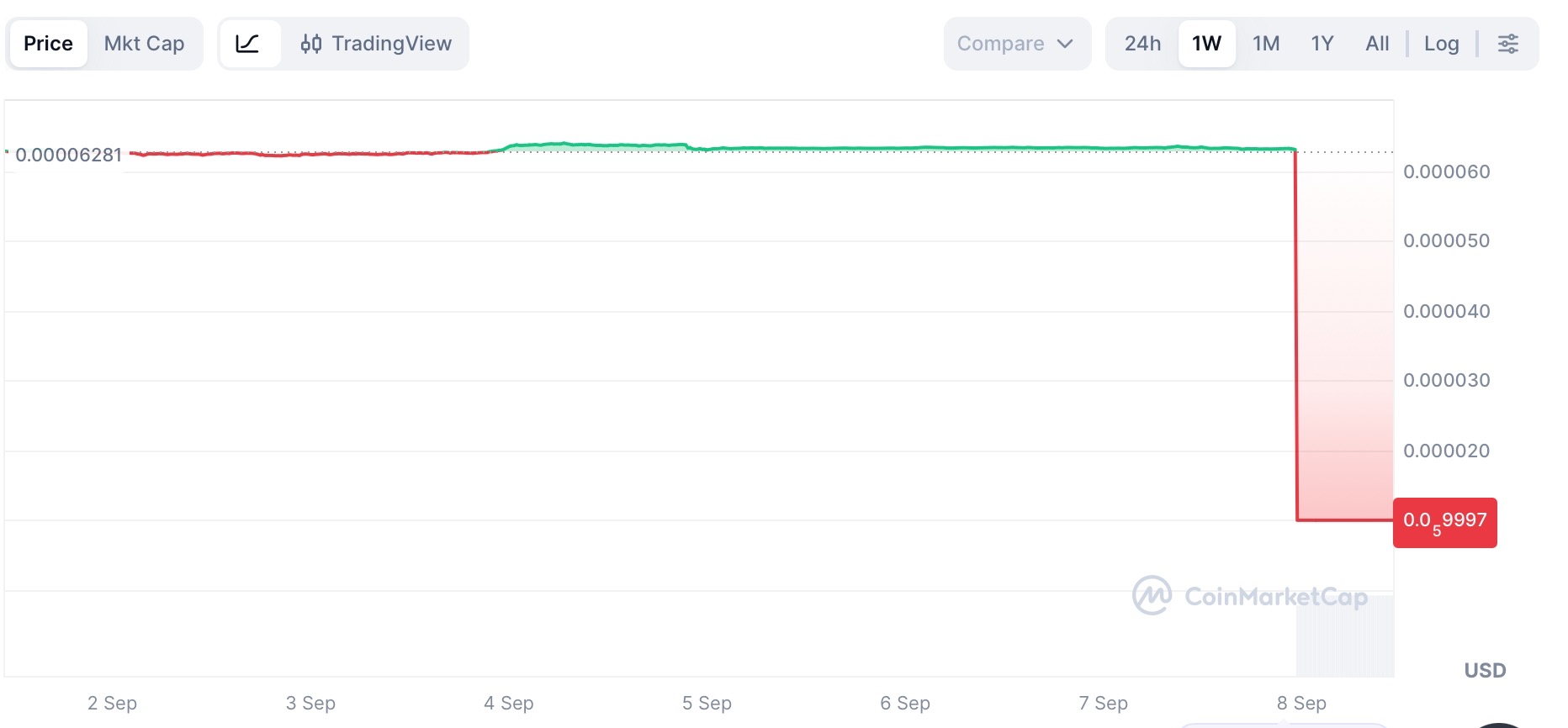
As of September 8, 2026, SXP was worth nearly $0.0000099, with an estimated market capitalization of roughly $2.1 million. That placed it about 99.9% below its May 2021 record of $5.79.
Those figures appear precise. The market underneath them is not.
CoinGecko reported less than $200 in 24-hour trading volume at the time of review. Most of that activity came from one SXP/WETH pool on Uniswap. Available liquidity within 2% of the quoted price was only around $126 on either side.
At that depth, a modest trade can change the displayed price sharply. A 20% daily move may reflect one small transaction rather than a broad change in investor demand.
Market capitalization is equally easy to misread. Multiplying the last traded price by the reported supply produces a figure above $2 million, but holders could not collectively sell at that valuation. There is not enough visible liquidity to support it.
SXP may still print large percentage gains from time to time. In this market, volatility is not evidence of recovery.
Is Solar Dead?
Calling Solar “dead” misses part of the story. The network remains capable of producing blocks and processing transfers. Validators continue to participate, and the ledger has not been reset. Solar has not suffered a collapse comparable to Terra’s failed stablecoin mechanism or FTX’s bankruptcy.
Yet continued block production is a low bar for an application-focused Layer 1. A network also needs developers, users, accessible markets and a reason for its native token to be held or spent.
Solar currently lacks an active development team and forward roadmap. Major exchanges have removed SXP, while the markets still tracked publicly offer very limited depth. Its technical existence has outlasted its commercial momentum.
What Would Count as a Genuine Recovery?
A price spike alone would prove little. SXP’s order books and decentralized pools are too shallow for short-term gains to carry much information.
A credible recovery would require activity outside the price chart: a capable team taking responsibility for development, a published roadmap, measurable network usage and restored support from reputable exchanges. Any migration would need clear terms, a verifiable governance process and adequate technical support for holders.
None of those conditions has been confirmed.
For now, Solar is better understood as a case study in the difference between network survival and market survival. Its blockchain continues to operate, but the infrastructure that once gave SXP visibility and liquidity has largely disappeared.
Tapbit Academy covers cases like SXP to help readers examine market structure, liquidity and project activity instead of relying on price alone. More market research is available on Tapbit. Users can access the platform through the login page or create an account.
Frequently Asked Questions
Is Solar still operating in 2026?
Yes. The Solar blockchain still produces blocks, and independent validators continue to operate. However, the network is in maintenance mode, with no active protocol development roadmap.
Why did the SXP price collapse?
The decline followed years of weakening ecosystem activity and liquidity. The end of active development, delistings by Korean exchanges and Binance’s removal of SXP accelerated the loss of market access and confidence.
Is SXP really down 99.9%?
CoinGecko’s tracked SXP price was approximately 99.9% below its 2021 high as of September 8, 2026. However, remaining liquidity is extremely limited, so both current price and market capitalization should be interpreted cautiously.


