
STONK could mathematically reach $1, but the supplied market snapshot does not establish that it will. From $0.2239, the token would need to rise about 346.6%, making its price roughly 4.47 times higher. Using the screenshot's circulating supply of 864.163 million tokens, that target implies a market capitalization of approximately $864.2 million.
Those numbers turn a simple price question into a more demanding one: can StonkFun attract enough lasting demand to support a valuation approaching $1 billion after an already sharp rally? The following analysis uses the supplied September 3–9 chart as its baseline. It presents conditional scenarios, not a dated price promise.
Which STONK Is This Analysis About?
This article concerns STONK associated with StonkFun, sometimes misspelled as StoneFun. CoinMarketCap's StonkFun asset profile identifies the project as a Solana token-launch and trading platform whose launched tokens trade in Raydium concentrated-liquidity pools, including pairs against third-party tokenized-equity assets.
That description should not be extended into a claim that STONK itself is a share, a stock-backed security or a redeemable claim on corporate assets. It is also distinct from similarly named STONKS tokens and unrelated STONK projects. Before evaluating a purchase, match the network and exact mint address across project materials, the explorer and the intended trading venue.
Readers comparing broader crypto opportunities can create a Tapbit account and review the markets available to them. This general platform link does not establish that this particular STONK token is listed on Tapbit.
What the Rally Actually Shows
The supplied CoinGecko screenshot displays a price of $0.2239 and a seven-day gain of 966.9%. It reports approximately $193.507 million in market capitalization and $98.729 million in 24-hour trading volume, with a displayed daily range between $0.1372 and $0.224. The line chart shows a rapid acceleration followed by several sizable pullbacks before another move higher.
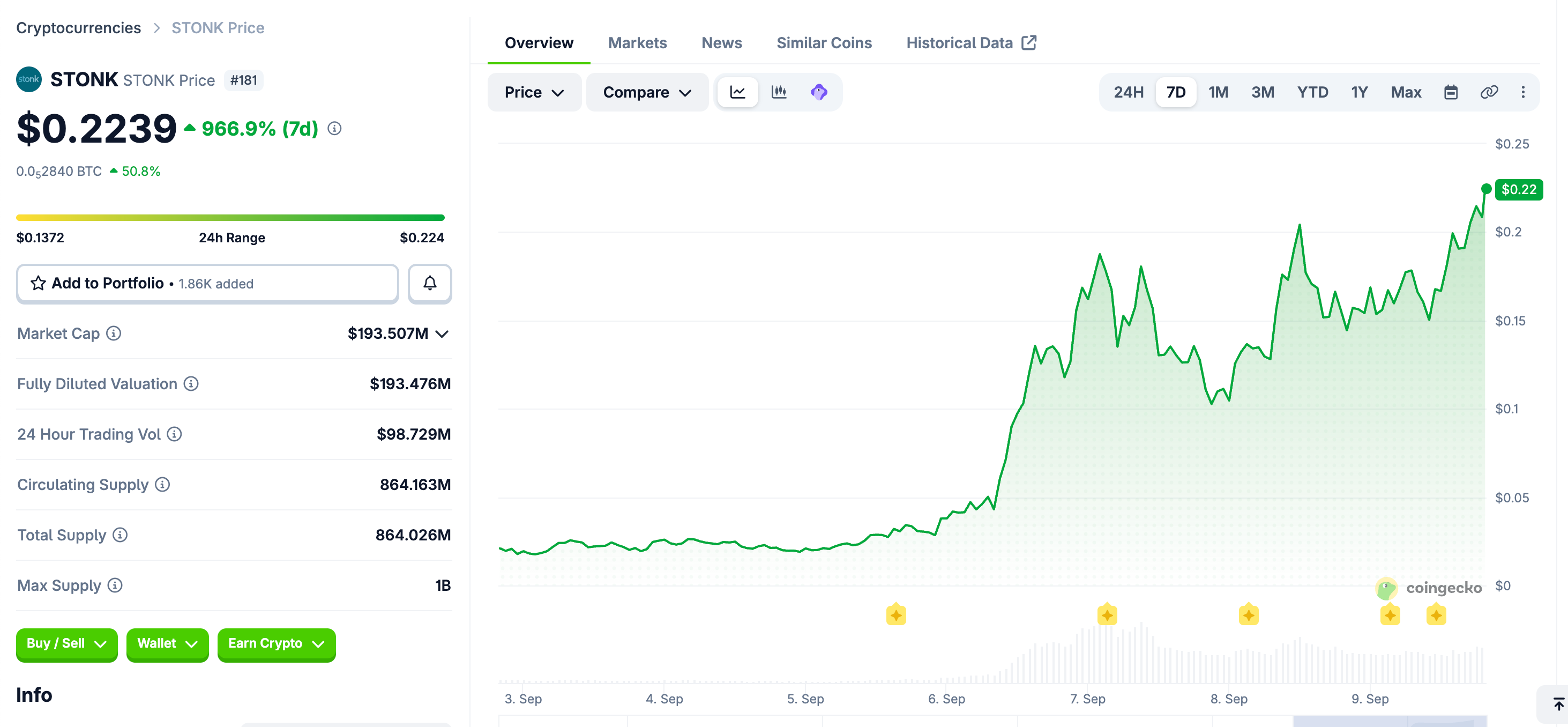
This is evidence of strong recent momentum, not proof of its cause. The chart alone cannot tell us whether purchases came from recurring platform users, short-term speculation or concentrated wallets. Reported daily volume is roughly 51% of the displayed market cap, but that turnover ratio does not measure the amount that can be sold near the quoted price. The same tokens can trade repeatedly during a volatile session.
Can STONK Reach $1? The Market Cap Calculation
The calculation is price multiplied by circulating supply. Keeping the screenshot's 864.163 million circulating tokens unchanged gives the following valuation checkpoints. These are arithmetic reference points, not price forecasts or independently confirmed support and resistance levels.
| STONK price | Change from $0.2239 | Implied circulating market cap |
|---|---|---|
| $0.10 | -55.3% | $86.4 million |
| $0.2239 | Baseline | $193.5 million |
| $0.25 | +11.7% | $216.0 million |
| $0.50 | +123.3% | $432.1 million |
| $1.00 | +346.6% | $864.2 million |
The screenshot contains a small but important inconsistency: circulating supply is shown as 864.163 million, while total supply is 864.026 million. It also displays fully diluted valuation slightly below circulating market cap. Those fields should be reconciled before treating them as a precise tokenomics record. They may reflect different update times or methodology, but the image alone cannot identify the cause.
The displayed maximum supply is one billion. At that hypothetical supply, $1 would correspond to $1 billion in valuation. This does not mean that burned tokens can be reminted or that the full maximum will enter circulation. Conversely, the roughly $671 million difference between the baseline and target market caps is not the cash inflow required: market cap reprices the entire supply using the marginal traded price.
The Bull Case Requires More Than Another Viral Week
A constructive scenario would involve price holding its recent gains while market depth, repeat users and economically meaningful platform activity improve. Sustained acceptance above the snapshot's $0.224 daily high would be more informative than a brief spike. The $0.25 and $0.50 checkpoints help describe the scale of further gains, but neither has been established here as a technical barrier.
For the $1 thesis to strengthen, platform growth must translate into demand for STONK or another verifiable benefit to holders. Fee generation at the application level does not automatically belong to token owners. Any proposed buyback, burn or distribution should be checked against actual transactions and current rules. A price rise accompanied by deteriorating liquidity or increasingly concentrated ownership would weaken the bullish interpretation.
Consolidation and Downside Scenarios
A middle scenario is that attention remains elevated but the rally pauses while buyers and sellers establish a new range. Trading around the chart's recent $0.15–$0.22 area would represent consolidation relative to this snapshot, not a promise that the range will hold. Lower volume during that period could indicate reduced selling, reduced demand or both; order flow and pool depth would help distinguish them.
In a bearish scenario, profit-taking accelerates as new buyers retreat. Losing the displayed $0.1372 daily low would undermine the immediate momentum case, although one intraday print is weaker evidence than repeated failures to recover it. A return toward the visible $0.10 area would mean a drawdown of about 55% from $0.2239. That level is not a floor: a severe liquidity withdrawal or project-specific failure could produce a deeper decline.
No reliable deadline or numerical probability for $1 follows from a seven-day chart. A move can remain mathematically possible while becoming less plausible as trading activity and the underlying business weaken.
Liquidity, Supply and Tokenized-Stock Risks
For a fast-moving token, executable liquidity matters more than the appearance of a large headline valuation. Review quotes for the size you intend to trade, the distribution of liquidity across venues and how spreads behave during selling. Concentrated-liquidity positions can become less useful when the market moves outside their active ranges. Historical volume cannot guarantee a future exit.
Tokenized-equity pairs add another layer of complexity. If a quote asset tracks a stock, its own price changes can affect a pool's dollar-denominated value even without a comparable change in demand for the launched token. Issuer restrictions, redemption conditions and tracking differences belong to that quote asset; pairing with it does not grant STONK holders shareholder rights.
Supply reductions also need careful interpretation. A smaller verified supply lowers the capitalization associated with $1, but burning tokens does not guarantee stronger demand or a higher price. Holder concentration, mint permissions and the funding of any buyback program matter alongside the headline amount burned.
Conclusion
STONK reaching $1 would require approximately a 4.47-fold price increase from the supplied $0.2239 snapshot. At the displayed circulating supply, the implied market cap is about $864.2 million. The target is mathematically possible, but the recent 966.9% weekly gain cannot establish its likelihood.
The stronger case would combine sustained demand, usable liquidity and documented value capture for STONK. Until those conditions are demonstrated and supply figures are reconciled, $1 is best treated as an upside scenario. This article is for informational purposes only and does not constitute financial advice.
FAQ
How much must STONK rise to reach $1?
From the supplied $0.2239 price, it needs an increase of approximately 346.6%, or a price multiple of 4.47.
What would STONK's market cap be at $1?
Using 864.163 million circulating tokens from the screenshot, approximately $864.2 million. If one billion tokens were circulating, it would be $1 billion.
Is StonkFun the same as StoneFun?
The project identified in the market-data profile is StonkFun. Verify the contract and network rather than relying on a similar spelling or ticker.
Does STONK give holders ownership of stocks?
Trading in an ecosystem that uses tokenized-stock pairs does not itself grant STONK holders equity, voting rights or redemption rights over shares.
Can STONK fall after rising almost 1,000%?
Yes. A strong previous gain does not prevent a major drawdown, especially if liquidity weakens or early holders sell into declining demand.


