
Zora's latest product update sounds straightforward: let creators choose the asset their coin trades against. In practice, it moves the platform well beyond its NFT origins.
A post on Zora can now trade against ETH, USDC, or eligible tokens on Solana and Robinhood Chain. Profiles have their own Creator Coins. Trends can become markets, and Zora has added research tools, activity tracking, and trading automation to support that.
The company frames this as the creator economy. A more precise description might be an attention market, where content, personalities, and online narratives each come with their own liquidity pools.
That model gives creators a new revenue channel — but also presents a tougher challenge: issuing tokens is straightforward; sustaining demand across millions of small markets is not.
Zora Has Moved Beyond NFTs
Zora began as infrastructure for minting and trading digital media. Its early appeal was straightforward: artists could publish on-chain and sell their work without relying entirely on a centralized marketplace.
The current product looks different. Images, videos, memes and other posts can become fungible tokens with built-in markets. Instead of selling one NFT to one collector, a creator can have a tradeable profile coin and issue separate coins linked to individual posts.
This changes the economic relationship between creators and their audiences. Supporters are no longer limited to buying finished work or paying for access. They can trade assets connected to a creator’s popularity.
The trade-off is equally clear. A market price can measure demand, but it can also turn every piece of content into a short-lived speculation. A post that attracts attention today may have little liquidity next week.
Creator Coins Put the Profile on the Market
Every eligible Zora account can activate a Creator Coin tied to its profile. Each Creator Coin has a fixed supply of one billion tokens.
Half of that supply enters the market. The other half belongs to the creator and vests linearly over five years. Once activated, the Creator Coin cannot be disabled or replaced.
Posts are connected to this profile-level economy. By default, a new post coin can trade against the creator’s coin, while creators may also choose a different asset through Custom Pairs.
The structure gives creators a financial interest in the market around their work. They can receive trading rewards and gradually access their token allocation. That does not guarantee meaningful income. Earnings still depend on other users continuing to trade.
This is the tension at the center of Zora. It offers a direct monetization mechanism, but the mechanism rewards market activity more visibly than content quality.
Custom Pairs Change the Product
Zora introduced Custom Pairs in August 2026. When creating a coin, a user can select a supported asset as the other side of the market instead of accepting the default pairing.
The feature currently works across Base, Solana and Robinhood Chain. Eligible pairing assets may include ETH, USDC, Solana-based tokens and some Robinhood stock tokens. Once a pair is created, it cannot be changed.
For Custom Pairs, Zora applies a 1% trading fee. Its published fee schedule allocates 0.70% to the creator, with the remaining portion divided between the protocol and the deployment infrastructure. The exact fee structure differs for Creator Coins, content coins and older markets, so legacy pairs should not be assumed to follow the same model.
Custom Pairs make Zora more flexible, but they also introduce another layer of risk. The value and liquidity of a content coin may now depend on its paired asset. If that asset becomes volatile, loses liquidity or faces restrictions, the content market inherits part of the problem.
Robinhood Chain Opens a New Direction
Creators can deploy coins and interact with supported assets on the network. Zora also allows certain coins to be paired with Robinhood stock tokens, although its documentation says US users cannot trade those pairs.
This does not turn a Zora coin into a share of a public company. Nor does trading against a stock token necessarily give the holder the same ownership, voting or dividend rights as owning the underlying stock.
What it does create is a connection between internet content and tokenized traditional assets. A creator could theoretically build a market around a company, industry or investment theme and quote that market against a related stock token.
Whether users need such markets is still unproven. The feature may broaden Zora’s reach, but novelty alone does not produce durable liquidity.
Attention Markets Bring Internet Trends On-Chain
Zora expanded to Solana in February 2026 with Attention Markets, allowing users to create tradeable markets around memes, discussions and cultural moments.
Unlike a prediction market, these assets do not necessarily settle according to a future event. They behave more like open-ended tokens whose prices reflect how much attention a subject can attract.
That makes them easy to launch and difficult to value. There may be no cash flow, redemption value or measurable claim behind the token. Price depends on participation, liquidity and the willingness of later buyers to remain involved.
Early Attention Markets were relatively small. CoinDesk reported that one of the first markets briefly reached a market capitalization of roughly $70,000 while generating about $200,000 in trading volume. Those figures illustrate the appeal of fast-moving markets, but also how quickly volume can rotate through a low-value asset.
Zora’s challenge is not launching more markets. It is keeping enough users and capital active after the underlying trend fades.
Zora Is Building for Traders and AI Agents
The platform’s 2026 updates increasingly resemble trading infrastructure.
Zora added realized profit-and-loss tracking, cost-basis calculations and shareable performance cards. Its CLI allows users and developers to inspect price history, recent trades, wallets and major holders. It also supports tools for watchlists, automated selling and monitoring other traders.
The Zora Agent, currently presented as a read-only assistant, can answer questions about creators, trends, wallets and market activity. Zora warns that its answers may be inaccurate and should not be treated as financial advice.
These products reveal where Zora is heading. Content creation remains the entry point, but discovery and trading are becoming central to the user experience.
That may increase activity. It may also encourage faster speculation in markets that already have limited depth.
How ZORA Fits Into the System
ZORA launched with a total supply of 10 billion tokens. The project originally described it as a memecoin for the Zora community and stated that it did not provide governance rights or ownership in Zora.
Its role has since become more practical. Creator Coins are paired with ZORA, rewards may be paid in ZORA, and the token sits inside the liquidity structure supporting parts of the platform.
This gives ZORA a connection to product activity, but not a direct claim on Zora’s revenue or equity. Growth in posts or registered accounts does not automatically create proportional demand for the token.
The more useful metrics are trading volume in ZORA-based markets, liquidity depth, creator earnings and the amount of ZORA locked inside active pairs.
The Price Rebound Needs Context
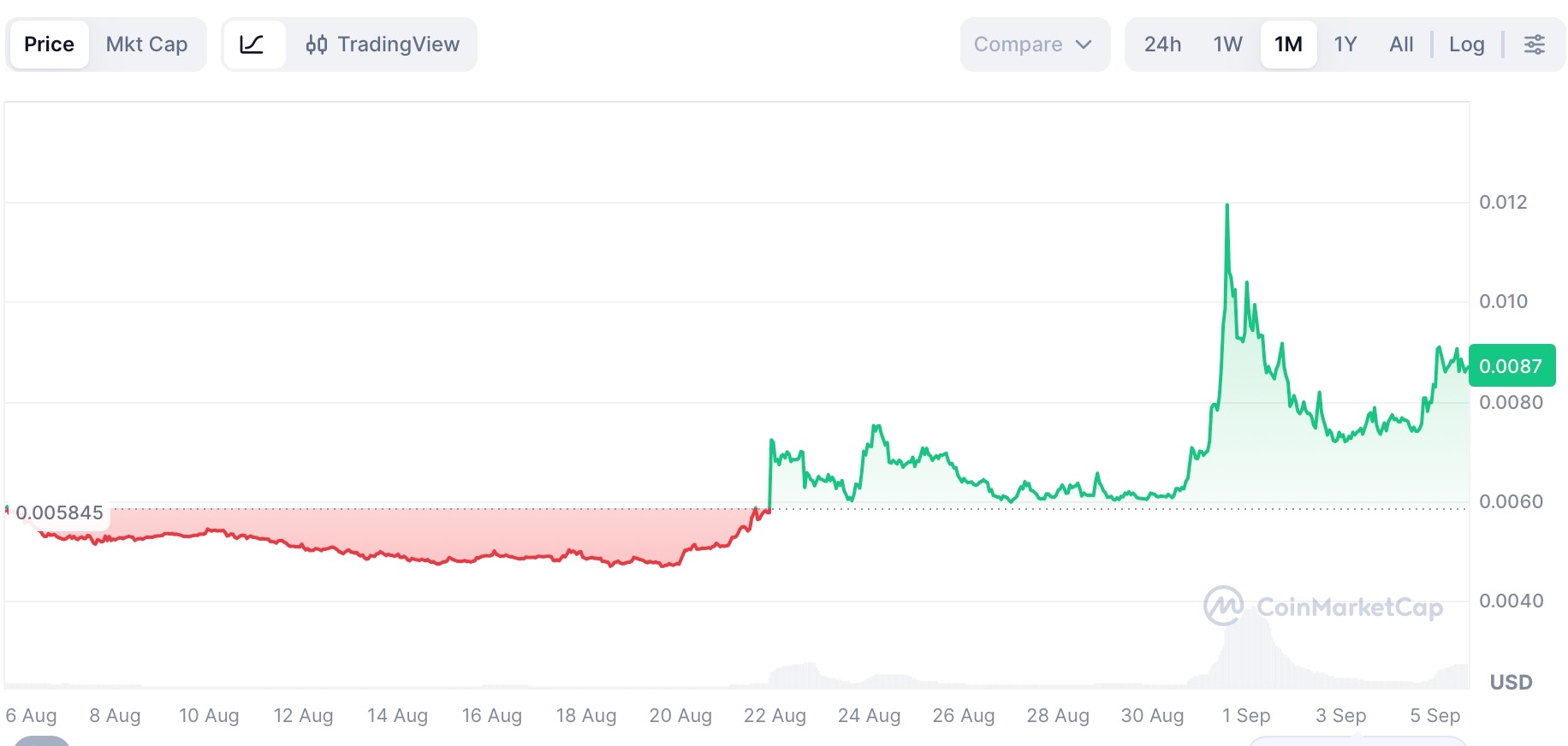
At the time of review on September 5, ZORA is traded near $0.0087, with a market capitalization of approximately $33 million and around 4.47 billion tokens in circulation.
The token had gained roughly 18% over seven days, but it remained about 95% below its August 2025 all-time high. Its fully diluted valuation was approximately $74 million.
Recent trading volume was large relative to market capitalization. That can signal renewed interest, but it can also indicate speculative turnover in a relatively small market. A sharp increase in volume should not be mistaken for durable user growth without supporting platform data.
The Question Zora Still Has to Answer
Zora has built an effective system for creating markets. Its next test is whether those markets remain useful after their launch.
Creator fees provide a genuine revenue mechanism, but they depend on trading. Custom Pairs make markets more flexible, but they fragment liquidity across more assets and networks. AI tools can improve discovery, yet they may also accelerate short-term trading in markets with little fundamental information.
The strongest evidence for Zora will not be the number of coins created. It will be repeat traders, sustained liquidity, recurring creator earnings and demand that survives beyond a viral post.
ZORA may benefit if the token remains central to that activity. Its large remaining supply and lack of governance or equity rights, however, limit what can be inferred from platform growth alone.
Tapbit’s market insights follow similar shifts across crypto, tokenized assets and on-chain trading. Readers already using the platform can log in, while those opening a new account can register here.
Frequently Asked Questions
What is Zora used for?
Zora allows users to turn profiles, posts and internet trends into tradeable on-chain coins. It also provides creator rewards, market data and tools for researching and trading those assets.
Is Zora still an NFT platform?
NFT infrastructure remains part of its history and ecosystem, but the consumer product now focuses more heavily on fungible content coins, Creator Coins and attention-based markets.
What is a Zora Creator Coin?
A Creator Coin is a token connected to a Zora profile. It has a fixed supply of one billion tokens, with 50% placed in the market and 50% allocated to the creator under a five-year vesting schedule.


