

Nearly four years after the exchange behind it collapsed, FTX Token continues to trade.
As of September 8, FTT was priced near $0.22 — above its July 30 low of roughly $0.19. Reported daily volume had also risen above $3 million.
The continued trading activity, however, does not imply a clear revived role for the token. FTX is not operating as an exchange, the plan to restart it was abandoned, and creditor distributions do not confer rights on those who buy FTT today.
The token still has a price. What it no longer has is a clear economic function.
FTT Remains Close to Its Lowest Price
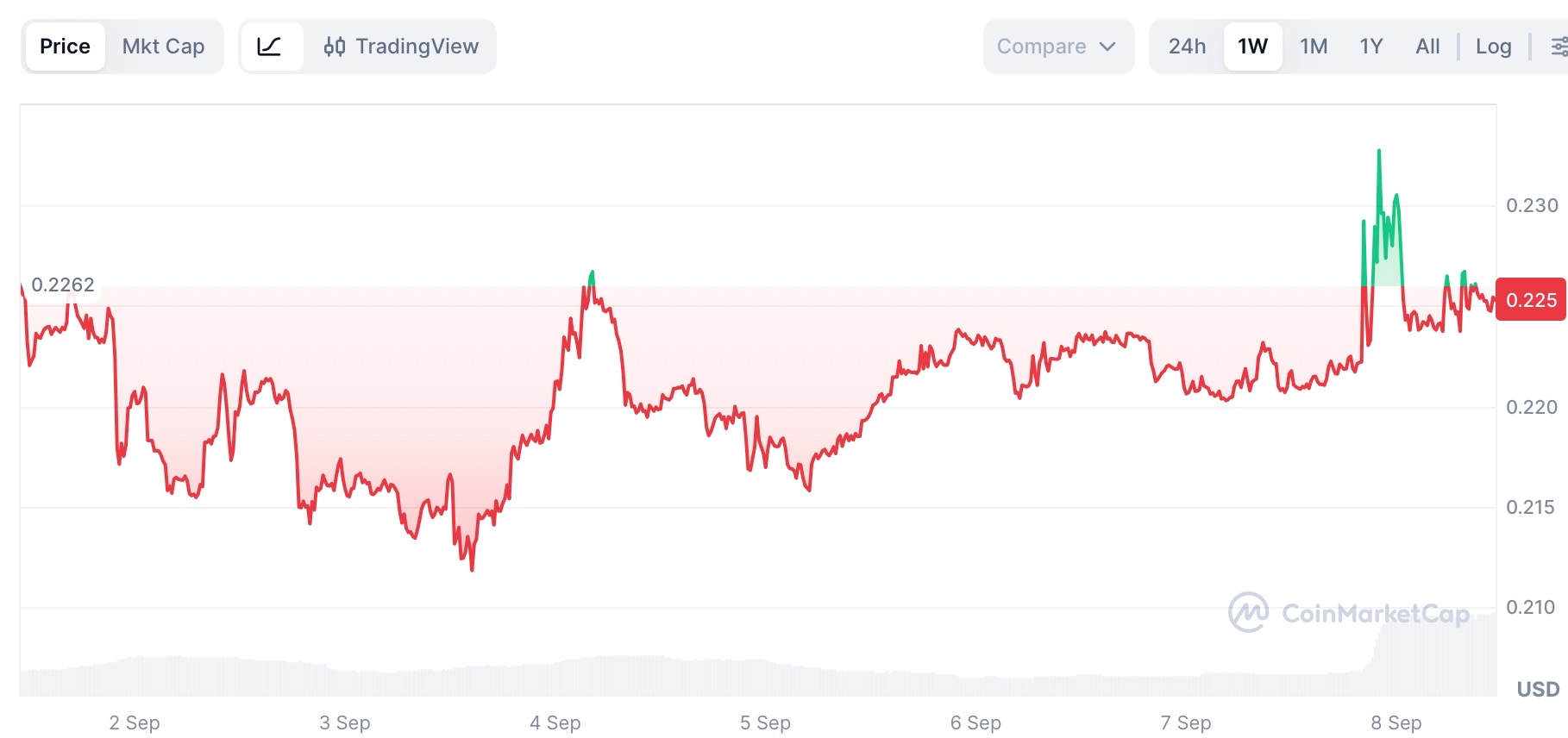
CoinGecko showed FTT near $0.2246 at the time of review, with a 24-hour range between approximately $0.2207 and $0.2387. The token was around 18% above its July all-time low but still 99.7% below the $84.18 peak recorded in September 2021.
FTT continues to trade on several centralized exchanges, including Binance, MEXC and Gate. Binance’s FTT/USDT pair remains one of the more active markets.
Liquidity is much smaller than the reported volume might suggest. CoinGecko showed roughly $15,000 of Binance buying depth and $20,000 of selling depth within 2% of the quoted price. An order that would be routine in a larger market could therefore move FTT noticeably.
Short-term gains should be viewed in that context. A rebound from $0.19 to $0.22 does not require the return of FTX or a major change in the token’s fundamentals.
FTT Was Designed for an Exchange That No Longer Operates
FTT launched in 2019 as the platform token of FTX. Its value proposition depended on the exchange.
Holders could access trading-fee discounts, participate in platform programs and use FTT within parts of the FTX trading ecosystem. FTX also promoted a token buyback and burn system linked to exchange activity.
Those features mattered because FTX was generating trading volume and attracting users. After the exchange halted withdrawals and entered bankruptcy in November 2022, the commercial system behind FTT disappeared.
FTT can still move between wallets and trade on external exchanges because it exists as a blockchain token. That technical existence does not restore its former benefits.
There is no active FTX exchange providing fee discounts. No operating platform has adopted the original buyback program. FTT does not give holders ownership in the bankruptcy estate, the FTX Recovery Trust or a future exchange.
FTX Is Paying Creditors, Not FTT Traders
FTX’s bankruptcy process reached another milestone on July 31, 2026, when the FTX Recovery Trust began its fifth distribution. Approximately $900 million was scheduled for eligible holders of allowed claims who had completed the required steps by the June 16 record date.
The distribution is part of a court-approved process for resolving claims that arose before and during the bankruptcy. Eligible creditors must complete claim reconciliation, identity verification, tax documentation and onboarding with an authorized distribution provider.
The available providers include Kraken, BitGo and Payoneer, depending on jurisdiction. Funds are sent through these providers after approval by the Recovery Trust.
Buying FTT on an exchange does not make someone an FTX creditor. It does not create an allowed claim or provide access to future distributions.
This distinction is often lost when FTT moves around repayment headlines. The bankruptcy estate can recover assets and pay customers while FTT remains economically separate from that process.
The Bankruptcy Plan Cancels FTT Claims and Interests
The treatment of FTT is not simply unclear. It is addressed in the confirmed reorganization plan. The order confirming the plan states that FTT Claims and Interests are cancelled. They do not receive the same treatment as allowed customer and creditor claims.
That means FTT is not a recovery token. It cannot be redeemed for a share of the assets collected by the estate, and it does not participate in distributions made by the FTX Recovery Trust.
A person who had assets trapped on FTX may have a customer claim based on the bankruptcy records and approved valuation process. That legal claim is different from owning FTT in a private wallet or purchasing it after the collapse.
The distinction also applies to price speculation. A large creditor payment may improve sentiment around the broader FTX recovery, but it does not add cash flow, redemption value or governance rights to FTT.
There Is No FTX Restart Behind the Token
FTX explored a possible exchange restart during the early stages of the bankruptcy. That plan was abandoned in January 2024 after the estate failed to find an investor willing to provide enough capital to rebuild the platform.
The current FTX organization is focused on asset recovery, litigation, claim administration and creditor distributions. Its support website functions as a bankruptcy information portal, not a trading platform.
There has been no verified announcement that FTX plans to reopen its exchange or restore FTT’s original benefits.
Rumors about “FTX 2.0” can still influence the token because traders remember its former relationship with the exchange. Unless a restart is confirmed through court filings and official FTX channels, those rumors do not give FTT additional utility.
A Large Wallet Still Hangs Over the Market

On November 13, 2022, an address associated with the FTT deployer transferred approximately 195.9 million tokens to another wallet. That represents close to 60% of the supply currently tracke.
The transfer remains visible on Ethereum and is the basis for a warning displayed by CoinGecko about previously locked FTT entering circulation.
It is not a new 2026 transaction. Some market reports have presented the transfer as a recent unlock or a fresh catalyst. The blockchain timestamp shows that it occurred during the original FTX collapse in 2022. Repeating it as current news would be misleading.
The concentration still matters. A wallet holding such a large share of supply creates uncertainty about ownership, control and possible future distribution. Without verified information about the address, however, it would be irresponsible to claim that those tokens are about to be sold.
The Question Is Not Whether FTT Can Rally
A token with limited liquidity can rally without a fundamental catalyst. FTT has done so before, particularly when reports revived speculation about creditor payments or an exchange restart.
The more useful question is whether anything has changed the rights attached to the token.
At present, the answer is no. FTX remains closed, its restart was abandoned and its bankruptcy plan cancels FTT claims and interests. Recovery Trust distributions go to approved creditors, not current token holders.
That leaves FTT dependent on secondary-market demand. Its price may rise or fall, but there is no operating exchange underneath it and no recovery mechanism anchoring its value.
Tapbit Academy examines the difference between market price and underlying rights, especially when distressed tokens continue trading after their original business has disappeared. Readers can explore more digital-asset research through Tapbit. Account access is available from the login page, and new users can begin through registration.
Frequently Asked Questions
What is the current FTT price?
FTT traded near $0.22 on September 8, 2026. Crypto prices change continuously, so the latest quote and order-book depth should be checked before making any decision.
Why is FTT still trading after FTX collapsed?
FTT remains a transferable blockchain token. External exchanges can continue listing it even though the FTX exchange no longer operates. Continued trading does not mean the token has recovered its former utility.
Does FTT still provide trading-fee discounts?
No active FTX exchange exists to provide the original fee discounts and platform benefits associated with FTT.


