
SK Hynix has been one of South Korea’s most watched AI chip stocks, but the latest pullback shows how quickly momentum can reverse when expectations are already stretched. After a strong run tied to high-bandwidth memory, AI servers, and global semiconductor demand, SK Hynix-related trading products suddenly came under pressure as the broader KOSPI rally lost steam.
For traders following the stock through crypto-style derivatives, Tapbit’s SKHYUSDT market offers a direct way to monitor price action. You can Trade SKHYUSDT on Tapbit while keeping in mind that stock-linked perpetual contracts can move quickly and may carry liquidity, funding, and leverage risks.
SK Hynix Stock Pullback: What the Chart Shows
Based on the chart provided, SKHYUSDT was trading near 132.90, with the weekly candle showing an open around 163.72, a high near 164.69, a low near 114.17, and a close near 132.96. That represents a weekly decline of about 18.79% from the opening level shown on the Tapbit chart.
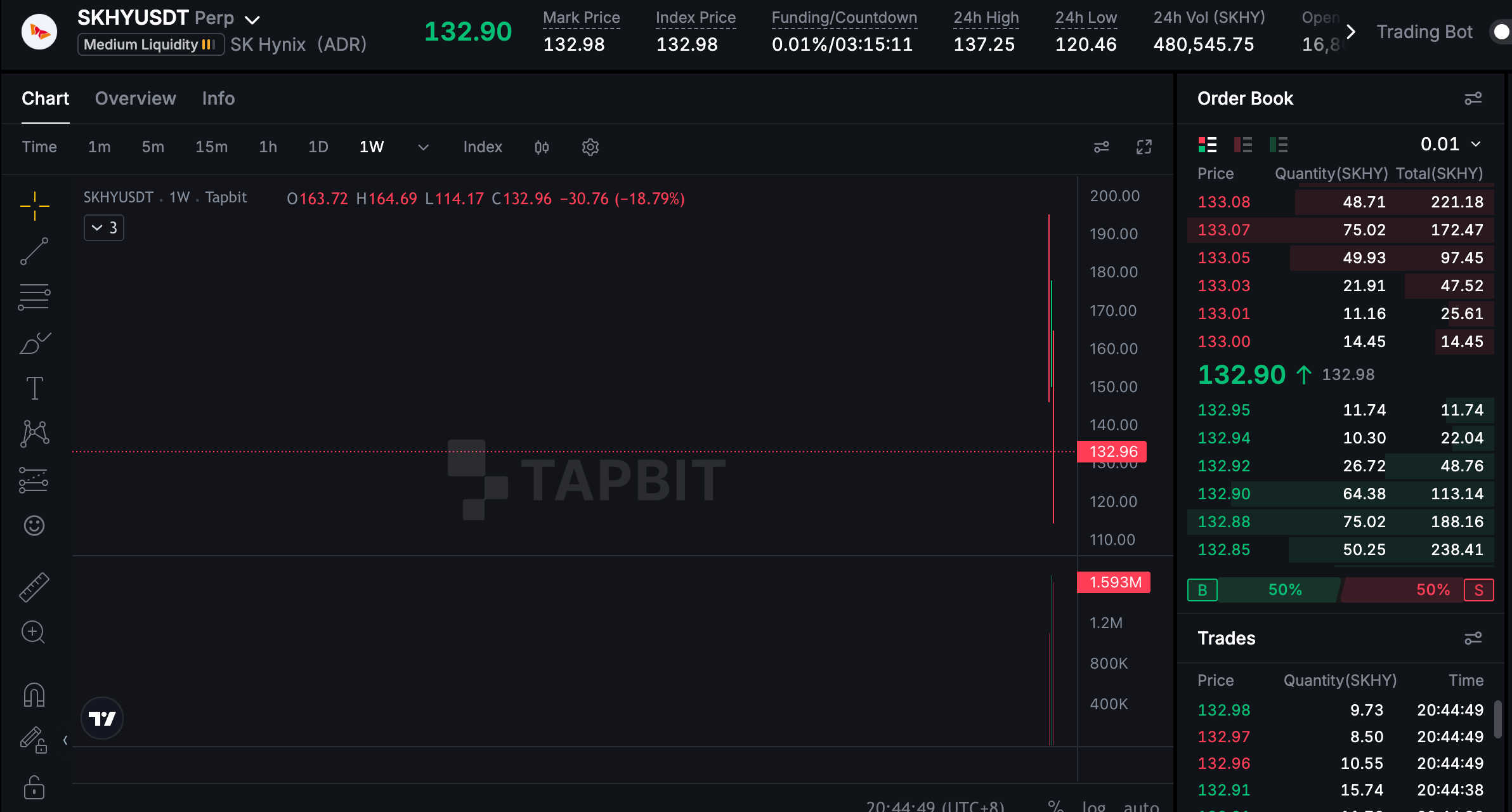
The move is important because the drop was not a slow drift lower. The candle shows a wide trading range, heavy volatility, and a sharp reversal from recent highs. That kind of structure often signals a market that has shifted from trend-following buying to fast profit-taking and risk reassessment.
Why Did SK Hynix and KOSPI AI Chip Stocks Fall?
The simplest explanation is that the AI chip trade became crowded. SK Hynix has benefited from excitement around high-bandwidth memory, AI accelerators, and demand from large cloud and chip customers. When a stock becomes a symbol of a bigger market narrative, it can rise faster than fundamentals can confirm. The same setup can also create sharper downside when traders start locking in gains.
The KOSPI pullback likely reflects several forces working at the same time: profit-taking after a strong AI rally, concern that memory prices may not rise in a straight line, sensitivity to U.S. semiconductor sentiment, and foreign-capital flows out of high-beta Korean technology names. In short, the story did not necessarily disappear, but the market began pricing it with less patience.
KOSPI Crash or Healthy Correction?
Calling every sharp decline a “crash” can be misleading. A true crash usually involves broad forced selling, panic liquidity, and a wider breakdown across sectors. This move looks more like a concentrated correction in high-momentum AI and semiconductor exposure, though the speed of the decline makes it feel severe for anyone holding leveraged positions.
| Market Signal | What It Suggests |
|---|---|
| Fast weekly drop | Momentum traders are reducing exposure |
| Wide high-low range | Volatility has expanded sharply |
| Large 24h volume | Both buyers and sellers are active |
| Still above weekly low | Dip buyers appeared after the deepest selloff |
| Medium liquidity label | Order execution risk may be higher than in major pairs |
Why AI Chip Stocks Are So Sensitive to Sentiment
AI chip stocks trade on a mix of current earnings and future capacity expectations. SK Hynix is closely watched because of its role in advanced memory, especially HBM products used in AI infrastructure. When investors believe AI capex will keep expanding, chip suppliers can trade at premium valuations. When they worry that spending may slow, margins may peak, or supply may catch up, those premiums can compress quickly.
This is why SK Hynix can remain a strong company while the stock still sells off. A good long-term theme does not prevent short-term drawdowns, especially after a large rally.
Key SK Hynix Price Levels Traders Are Watching
From the provided weekly chart, the 120 area appears important because the 24-hour low was near 120.46 and the weekly low was near 114.17. If SKHYUSDT holds above that zone, the market may treat the decline as a volatile reset. If it breaks lower again, traders may begin watching whether the move turns into a deeper trend reversal.
On the upside, the 137-140 area is an early recovery zone, while the 160-165 area marks the previous weekly high region. A move back toward those highs would likely require a return of AI-chip optimism, stronger broader KOSPI sentiment, or supportive earnings guidance.
What Could Help SK Hynix Recover?
The bullish case depends on whether investors continue to believe in the AI memory cycle. Strong HBM demand, stable pricing, positive earnings revisions, and renewed buying in Nvidia-linked supply chains could help sentiment recover. A broader rebound in Korean equities would also matter because SK Hynix is not trading in isolation.
For now, the key question is whether buyers view the correction as a discount or whether the market needs more time to rebuild confidence after such a large weekly reversal.
Main Risks After the KOSPI AI Rally Breaks
The biggest risk is that a crowded AI trade unwinds further. If investors start questioning capex growth, memory margins, or valuations across the semiconductor supply chain, SK Hynix could remain volatile. Currency moves, export demand, U.S. tech sentiment, and geopolitical risks around semiconductors can also affect Korean chip stocks.
For derivatives traders, risk is even more immediate. Stock-linked perpetuals can amplify price exposure, and liquidity can change quickly during volatile sessions. Traders should avoid assuming that a rebound is guaranteed just because a stock has already fallen sharply.
Conclusion
SK Hynix’s sharp decline does not automatically mean Korea’s AI chip story is over. It does mean the market has become less forgiving. The provided SKHYUSDT chart shows a steep weekly pullback, wide volatility, and a clear break in short-term momentum.
The recovery case depends on whether AI memory demand remains strong enough to justify premium valuations. Until then, traders should treat the move as a high-volatility reset rather than a simple buying opportunity. SK Hynix can still be a major AI semiconductor name, but the KOSPI pullback shows that even strong narratives can break when positioning becomes crowded.
FAQ
Why did SK Hynix stock fall?
SK Hynix fell as traders took profits from the AI chip rally, while broader KOSPI sentiment weakened and investors reassessed semiconductor valuations.
Is the KOSPI crash caused by AI stocks?
The pullback appears heavily connected to high-momentum technology and semiconductor names, though broader market sentiment and foreign flows may also contribute.
What is SKHYUSDT?
SKHYUSDT is a stock-linked perpetual contract that tracks SK Hynix ADR-related price exposure on Tapbit. It is not the same as owning SK Hynix shares.
Can SK Hynix recover?
It can recover if AI memory demand, HBM pricing, earnings guidance, and broader semiconductor sentiment remain strong. However, the chart shows volatility is currently elevated.
Is SK Hynix still an AI stock?
Yes. SK Hynix remains closely tied to AI infrastructure because of its role in advanced memory products used in AI servers and accelerators.


