
Coca-Cola shares reached a record high after the beverage company reported better-than-expected quarterly results and raised its 2026 outlook. The stock gained 5% on July 28, closing at $88.27 after touching an intraday high of $90.22.
The rally came during a difficult session for many technology and semiconductor stocks. That contrast drew additional attention to Coca-Cola as investors looked beyond the AI trade and returned to businesses with predictable demand, established brands and steady cash flow.
Coca-Cola’s latest performance was not simply the result of higher prices. Global sales volumes increased, margins improved and several major brands gained momentum. The 2026 FIFA World Cup also provided a powerful marketing platform for Coca-Cola and Powerade.
Still, KO is no longer trading like an overlooked defensive stock. Its valuation has climbed alongside its earnings, leaving less room for disappointment.
Coca-Cola Delivered a Strong Second Quarter
Coca-Cola reported second-quarter net revenue of approximately $13.4 billion, up 7% from the same period last year. Organic revenue, which excludes currency movements and structural changes, increased 6%.
The company’s global unit case volume rose 5%. This figure measures the volume of finished beverages sold by Coca-Cola and its bottling partners, making it a useful indicator of underlying consumer demand.
Price and product mix contributed another 2% to growth. That balance is important. In periods of weak consumer demand, beverage companies may rely heavily on price increases to protect revenue. Coca-Cola instead delivered growth from both volume and pricing.
Operating income rose 9%, while the reported operating margin increased from 34.1% to 34.9%. On a comparable basis, the operating margin reached 35.6%, up from 34.7% a year earlier.
Reported earnings increased 16% to $1.03 per share. Comparable earnings were $0.97 per share, above the market estimate of approximately $0.93.
Why Volume Growth Matters
Coca-Cola has considerable pricing power, but there is a limit to how much any consumer company can raise prices without affecting demand. This is particularly relevant when household budgets are under pressure.
The latest quarter reduced some of those concerns. Global unit case volume increased 5%, while North American volume rose 3%. North American price and product mix also increased 4%, suggesting the company was able to combine higher pricing with positive demand.
Trademark Coca-Cola volume grew 5% across all geographic operating segments. Coca-Cola Zero Sugar was an even stronger contributor, recording 16% global volume growth.
Diet Coke and Coca-Cola Light grew 7%, while the wider sparkling soft drinks category increased 4%. These results show that Coca-Cola is capturing demand across its original, diet and zero-sugar products instead of depending on a single formulation.
For investors, volume growth provides a stronger signal than revenue growth driven mainly by inflation. It suggests that consumers are continuing to purchase the company’s products even as spending patterns change.
The World Cup Gave Coca-Cola a Global Marketing Moment
Coca-Cola was one of the most visible corporate sponsors of the 2026 FIFA World Cup. The company launched a connected campaign across more than 180 markets and worked with over 20 million retail outlets.
According to Coca-Cola, its digital and social content generated more than 60 billion impressions and nine billion views. The campaign helped Trademark Coca-Cola become the leading brand by share of voice during the tournament.
Powerade also benefited. Its quarterly volume increased 8%, supported by marketing around matches and the additional exposure created by hydration breaks. Those breaks gave sponsors more opportunities to reach viewers while encouraging demand for sports drinks.
The World Cup contributed to the quarter, but it was not the only growth driver. Product innovation, zero-sugar beverages and broader international demand also supported sales.
The next question is whether Coca-Cola can retain consumers gained during the tournament. A major sporting event can produce a temporary increase in visibility, while lasting value depends on repeat purchases after the event ends.
Zero Sugar Remains a Structural Growth Driver
Coca-Cola Zero Sugar’s 16% volume increase stands out because it reflects a longer-running change in consumer preferences rather than a single marketing event.
Consumers continue to look for products with less sugar and fewer calories without abandoning familiar beverage brands. Coca-Cola can respond to this trend using its existing distribution network, retail relationships and marketing scale.
The company is also expanding Coca-Cola Zero Zero, a version with zero sugar, calories and caffeine, into parts of Asia Pacific and Latin America following its performance in Europe.
Beyond sparkling beverages, water volume grew 6%, sports drinks grew 5% and tea grew 6%. Juice, value-added dairy and plant-based beverages increased 2%. Coffee was the weaker category, declining 2%.
This product mix gives Coca-Cola more ways to participate in different consumption occasions. The company is no longer dependent entirely on traditional carbonated soft drinks, although its flagship brands remain central to earnings.
Readers following shifts across consumer, technology and other global markets can find additional market information through Tapbit.
Defensive Rotation Added to the Rally
Coca-Cola’s earnings arrived while semiconductor and other AI-related stocks were under pressure. The Dow Jones Industrial Average gained about 1% on July 28, while the Nasdaq declined slightly.
That environment likely increased interest in companies with stable demand and lower historical volatility. Coca-Cola has a beta of approximately 0.3, meaning its shares have generally moved less sharply than the broader market.
The company also pays a quarterly dividend of $0.53 per share. At the July 28 closing price, its indicated dividend yield was approximately 2.4%.
These characteristics can make KO attractive during periods when investors are reducing exposure to more volatile sectors. However, low historical volatility does not prevent the stock from falling, especially when its valuation becomes elevated.
What Happened at fairlife?
Coca-Cola also entered the earnings period with questions surrounding fairlife, its US dairy and nutrition business.
On July 16, the company disclosed that fairlife had experienced a ransomware attack involving unauthorized access to part of its systems. Production at its US facilities was temporarily suspended as the company investigated the incident.
By July 27, most production had resumed across fairlife’s four US facilities. Coca-Cola said existing inventory prevented a significant disruption to retail availability and that product quality and safety were not affected.
Based on the information available at the time, the company did not expect the incident to have a material impact on its financial condition or operating results. The latest update is available through Coca-Cola’s investor relations website.
The quick restoration limits the immediate financial concern, but the incident shows that cybersecurity has become an operational risk even for traditional consumer businesses.
India and Packaging Costs Are Key Weak Spots
Coca-Cola’s results were strong overall, but regional performance was uneven.
Asia Pacific volume increased 8%, led by sparkling beverages and Trademark Coca-Cola. At the same time, the region’s price and product mix declined 9%, reflecting affordability initiatives and an unfavorable sales mix.
The company also lost beverage market share in India. Management linked part of the weakness to aluminum can shortages, which created gaps in packaging sizes and price points.
Higher aluminum and PET plastic prices are a broader issue. Coca-Cola said these costs had increased more than expected, partly because of energy market disruptions. Higher packaging, transportation and commodity costs may put pressure on margins during the second half of the year.
Coca-Cola can respond through sourcing changes, package design, productivity improvements and selective price increases. But pushing prices too far could weaken demand, particularly among lower-income consumers.
Is Coca-Cola Stock Becoming Expensive?
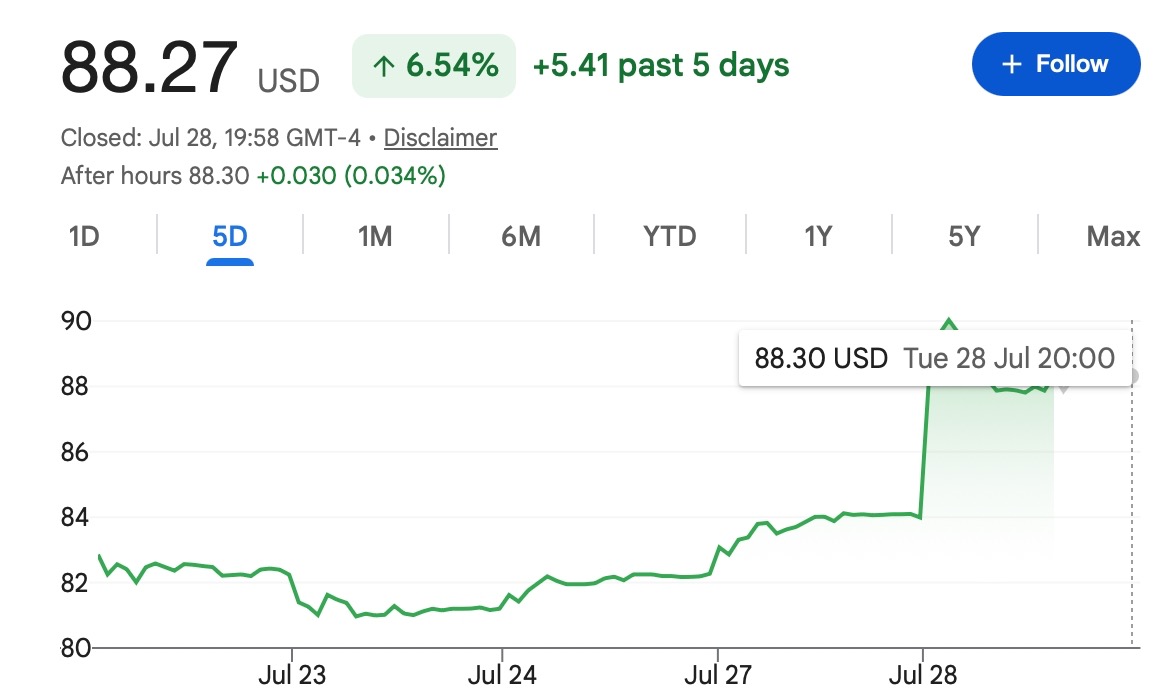
After its latest rally, KO trades close to 28 times trailing earnings. The stock has gained more than 26% since the beginning of 2026 and is near its record high.
That valuation is notable for a company forecasting organic revenue growth of approximately 5%. Investors are paying a premium for brand strength, cash generation, dividends and relatively stable demand.
The premium can remain in place if Coca-Cola continues gaining market share and delivering higher margins. The risk is that a slowdown in volume, weaker currencies or rising costs could cause investors to reconsider how much they are willing to pay for that stability.
Analyst price targets also show limited agreement on how much upside remains. Following the earnings release, published targets ranged from the mid-$80s to around $100. Price targets are opinions rather than reliable forecasts, but the range illustrates the current valuation debate.
Key Risks for KO Stock
The most immediate risk is that the World Cup created a temporary boost that will not continue into later quarters. Investors should watch third-quarter volumes, particularly for Powerade and Trademark Coca-Cola.
Input costs are another concern. Aluminum, PET plastic, energy and transportation expenses may rise faster than the company can offset them through productivity or pricing.
Consumer affordability also matters. Coca-Cola has maintained demand despite previous price increases, but lower-income consumers may reduce discretionary purchases if economic conditions weaken.
Foreign exchange can work in both directions. Currency movements are supporting the 2026 earnings outlook, but a stronger US dollar could become a headwind in future periods.
Finally, valuation leaves less room for error. A high-quality business can still be a poor short-term trade if expectations rise faster than earnings.
Conclusion
Coca-Cola stock is rising because the company delivered the combination investors wanted to see: positive volume growth, higher revenue, wider margins and stronger guidance.
The 2026 FIFA World Cup gave Coca-Cola and Powerade an exceptional marketing platform, while Coca-Cola Zero Sugar continued to show strong underlying demand. Higher free cash flow expectations and a recovery in fairlife production added to the positive picture.
The main challenge is price. KO is trading near a record high and at a valuation that assumes continued execution. Packaging costs, weaker performance in India, currency dependence and the possibility of fading post-World Cup demand could test that optimism.
Coca-Cola remains a strong global consumer business, but the stock’s latest rally means investors must evaluate both the quality of the company and the price being paid for it.
Users can create a Tapbit account or log in to Tapbit to explore available global markets and trading tools.
Frequently Asked Questions
Why is Coca-Cola stock rising?
Coca-Cola stock rose after the company reported stronger-than-expected second-quarter revenue and earnings, delivered 5% global volume growth and raised its 2026 outlook. Its defensive characteristics also attracted attention while technology stocks were under pressure.
What is Coca-Cola’s stock ticker?
The Coca-Cola Company trades on the New York Stock Exchange under the ticker KO. It should not be confused with Coca-Cola Consolidated, an independent bottling company that trades under the ticker COKE.
How did Coca-Cola perform in the second quarter of 2026?
Coca-Cola reported approximately $13.4 billion in net revenue, up 7% year over year. Organic revenue grew 6%, global unit case volume increased 5% and comparable earnings reached $0.97 per share.


