
RKLB stock has fallen back toward $58 after Rocket Lab announced a record $266 million U.S. Space Force contract. The decline does not erase the strategic value of the agreement, but it shows that a major contract headline is not enough to protect a high-growth space stock from profit-taking, sector weakness and valuation pressure.
The current setup has changed from a potential breakout above the upper-$60s into a support test. Investors now need to determine whether the $56–$58 area can form a durable base or whether the sell-off will extend before Rocket Lab’s August 10 earnings report.
RKLB Stock Price Today: Current Price and Recent Performance
RKLB is trading near $58, well below the approximately $68.34 reaction high reached after the Space Force announcement. The stock has therefore given back most of the initial contract-driven advance and moved below the former $63–$64 support area.
This price action changes the short-term interpretation. The market is no longer confirming a higher base above $63. Instead, RKLB is testing the lower end of its late-July trading range. A rebound from approximately $56–$58 would suggest that buyers still view the pullback as an opportunity. A sustained break below that zone would indicate that selling pressure remains dominant.
On the upside, the first recovery test is the $60–$61 area. A stronger repair would require RKLB to reclaim approximately $63–$64, which has shifted from support into resistance. The upper-$60s remain a later confirmation zone rather than the immediate target.
What Is the Latest Rocket Lab News?
The $266 Million Space Force Contract
Rocket Lab’s agreement with the U.S. Space Force covers 12 confirmed suborbital missions and options for up to six additional launches. The first mission is expected no earlier than the end of 2026, and most launches are planned from a new Rocket Lab location at the Pacific Spaceport Complex in Kodiak, Alaska.
The contract is strategically significant because it is Rocket Lab’s largest launch award to date and expands the company’s role in missile-defense and hypersonic testing. It also strengthens the argument that Rocket Lab is becoming an integrated national-security space contractor rather than remaining only a commercial small-launch provider.
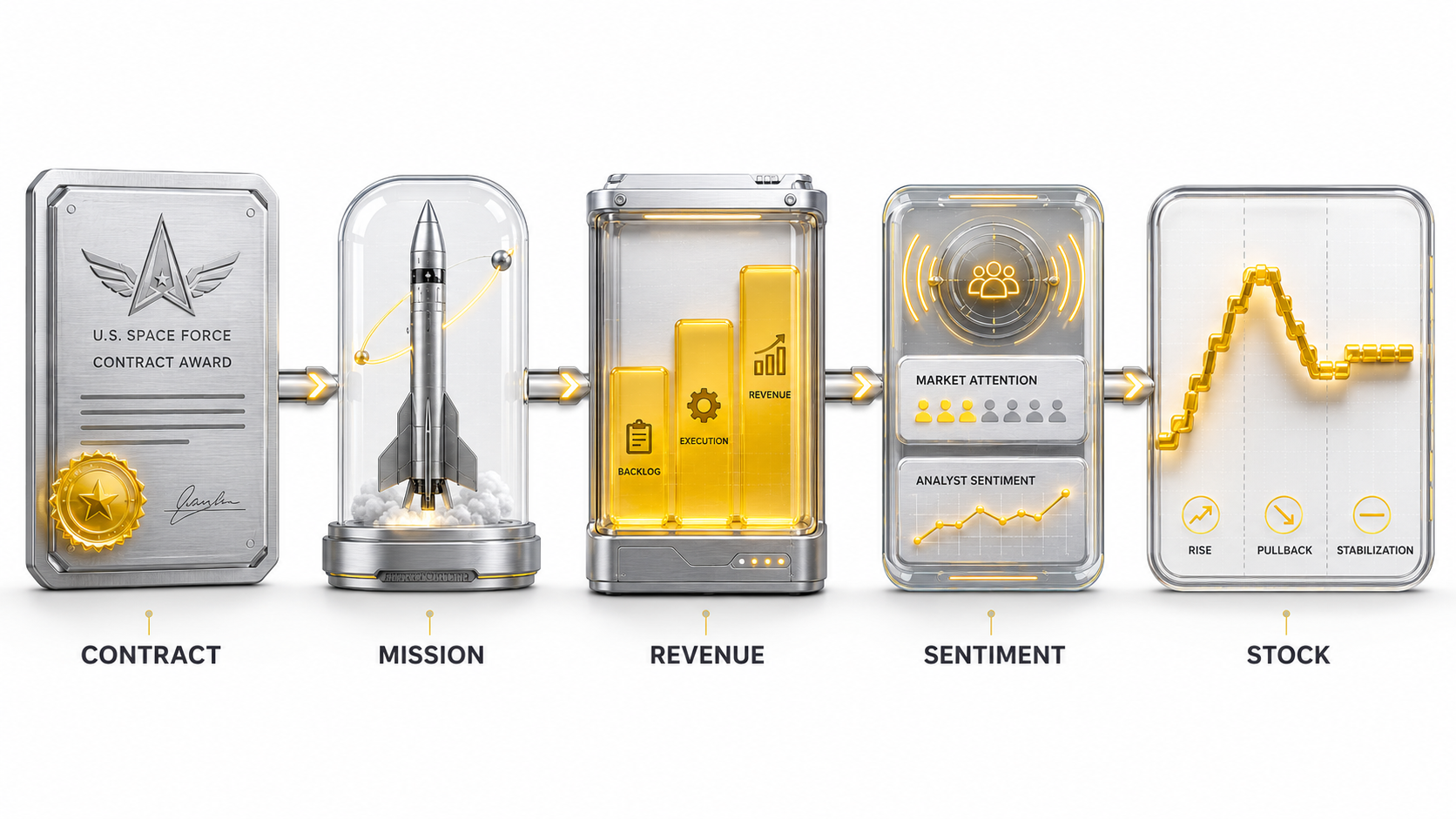
However, the full $266 million will not become immediate quarterly revenue. Mission schedules, option exercise, performance milestones and contract accounting determine when revenue is recognized. The stock can therefore fall even when backlog improves if investors believe the financial contribution is too distant or already reflected in valuation.
Why RKLB Fell Despite the Contract
The decline toward $58 appears to reflect a combination of factors rather than a reversal of the contract itself. RKLB had already experienced a large advance earlier in the year, leaving the stock vulnerable to profit-taking when momentum weakened.
The wider space sector has also come under pressure. Space-linked equities have been affected by the post-IPO decline in SpaceX, political uncertainty around future U.S. defense spending and a broad reduction in appetite for high-beta growth stocks. Rocket Lab can therefore fall with the sector even while reporting favorable company-specific news.
Valuation is another important factor. Investors are not only pricing current Electron and Space Systems revenue; they are also paying for future Neutron execution, additional government contracts and the possibility of higher-margin recurring space infrastructure revenue. When confidence in distant growth falls, the share price can decline faster than near-term fundamentals change.
ARK Invest Bought the Pullback
ARK Invest reportedly purchased 62,497 Rocket Lab shares on July 29 during the broader space-stock sell-off. The purchase is a sentiment signal, but it does not establish a technical bottom. RKLB still needs to hold support and show that buyers can absorb continued selling.
Why Is RKLB Stock Moving Today?
RKLB’s current move can be separated into three layers.
Company-Specific Catalysts
The Space Force contract, launch performance, Neutron development, acquisition integration and the upcoming earnings report remain the most important company-level drivers. Positive developments can improve the long-term case without preventing short-term volatility.
Space-Sector Sentiment
Rocket Lab trades as part of a volatile space-equity group. Weakness in SpaceX, AST SpaceMobile, Intuitive Machines, Planet Labs or sector ETFs can reduce demand for RKLB even when Rocket Lab’s own news is constructive.
Broader Market Conditions
Interest rates, Nasdaq direction, geopolitical risk and U.S. defense-budget expectations all affect the valuation of capital-intensive growth companies. A higher required return reduces the present value investors assign to revenue expected years in the future.
RKLB Stock Chart: Has the Bullish Trend Broken?
The short-term trend has weakened because RKLB fell below the former $63–$64 support zone. The stock is now trying to establish support around $56–$58, an area that overlaps recent lows in the broader correction.
A stabilization pattern would involve several sessions holding above approximately $56, a recovery through $60–$61 and eventually a close back above $63–$64. A bearish continuation would involve repeated failed rebounds followed by a decisive break below the latest low.
RKLB Support and Resistance Levels
| Level | Why It Matters | Interpretation |
|---|---|---|
| $56–$58 | Current support area and recent correction lows | Holding it supports a stabilization or rebound attempt |
| $60–$61 | First recovery area | Reclaiming it would reduce immediate downside pressure |
| $63–$64 | Former support and pre-breakdown zone | A close above it would improve the short-term structure |
| $68–$69 | Contract-reaction and upper-range resistance | A later breakout would provide stronger trend confirmation |
These levels are reference zones rather than guaranteed turning points. Contract news, launch events and earnings can create gaps through technical levels.
What Investors Should Watch Next
Rocket Lab is scheduled to report second-quarter 2026 results after the U.S. market close on August 10. The report will be the next major test of whether operational progress can offset the recent valuation reset.
The company previously reported first-quarter revenue of $200.3 million and backlog of $2.2 billion. Management guided second-quarter revenue to $225 million–$240 million and an adjusted EBITDA loss of $20 million–$26 million. Investors should compare actual revenue, gross margin, cash use and backlog conversion with those expectations.
Commentary on the $266 million Space Force contract, Neutron development and the integration of acquired capabilities will also matter. The market may require evidence of execution rather than another large headline award.
For broader context, read Tapbit Learn’s analysis of how Rocket Lab differs from SpaceX.
How to Trade RKLB-USDT on Tapbit
Tapbit offers RKLB-USDT stock-linked futures. The contract is a derivative linked to Rocket Lab-related price movements. It is not direct ownership of Rocket Lab stock and does not provide voting rights, dividends or other shareholder benefits.
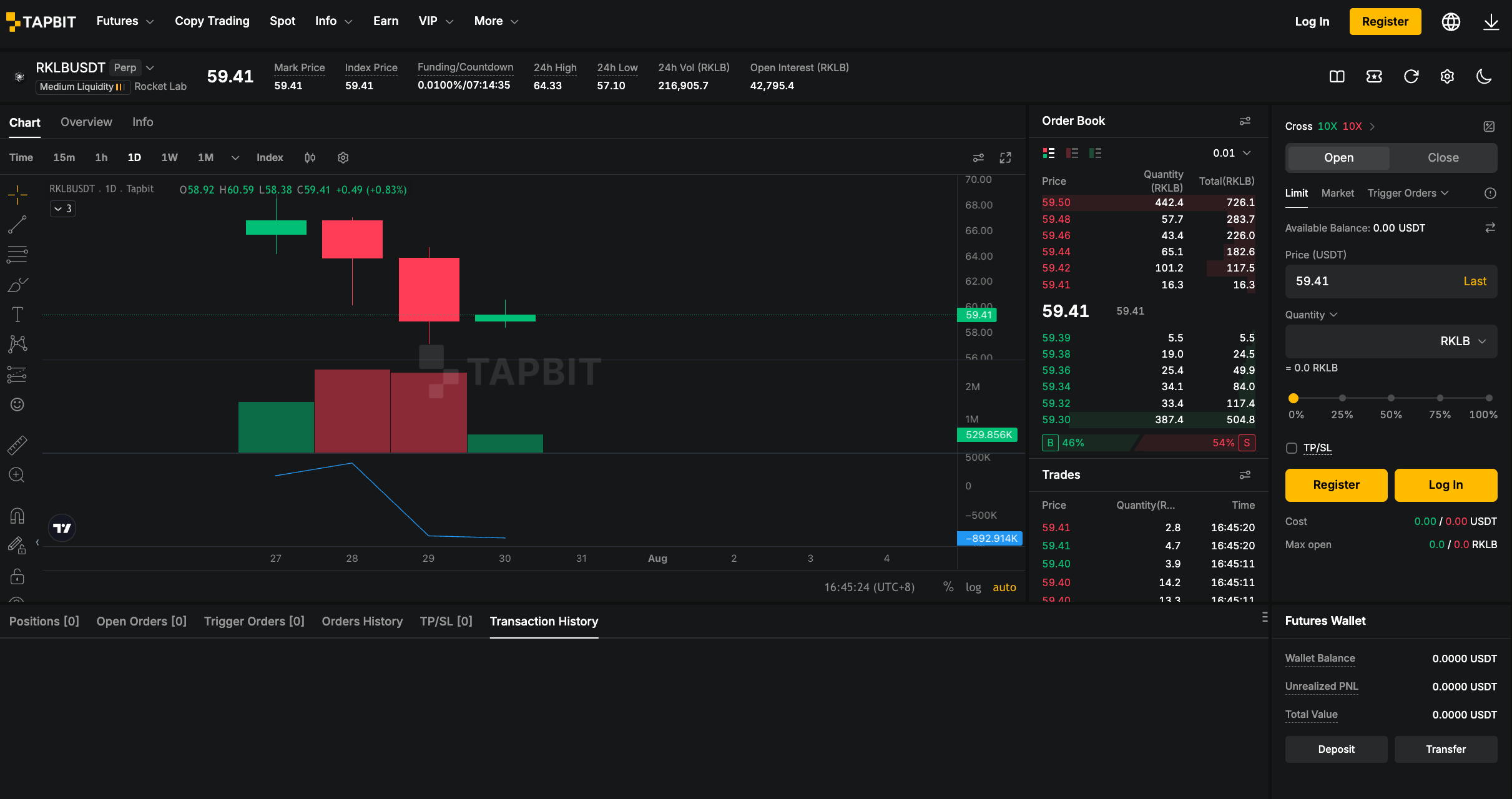
- Step 1: Create an account and fund the futures account.
- Step 2: Open RKLB-USDT and review the live contract price, funding information, liquidity and available leverage.
- Step 3: Choose the direction, order type and position size after defining the maximum acceptable loss.
- Step 4: Set stop-loss and take-profit levels, then monitor Rocket Lab news, U.S. market hours and liquidation risk.
Near $58, RKLB is no longer trading as a confirmed breakout. It is testing whether the market will defend a lower support zone before earnings. The contract improves Rocket Lab’s long-term backlog, but price recovery still requires buyers to reclaim the levels lost during the pullback.


