

RKLB stock has fallen toward $58, changing the forecast from a breakout discussion into a test of whether Rocket Lab can establish a lower support base. The company’s operating story still includes growing revenue, a large government backlog and the long-term Neutron opportunity, but the market is applying a lower valuation to those future expectations.
An updated forecast must separate the business outlook from the current chart. Rocket Lab can continue winning contracts while the stock falls if investors become less willing to pay for distant growth, higher capital requirements or execution risk.
RKLB Stock Forecast: What Has Changed at $58?
The most important change is technical. RKLB has lost the former $63–$64 support zone and is now trading near the lower end of its recent range. That weakens the immediate momentum case and raises the importance of the approximately $56–$58 area.
Fundamentally, the latest Space Force contract improves future mission visibility. It does not remove the risks associated with Neutron development, operating losses, acquisition integration or sector-wide valuation pressure.
Rocket Lab Revenue and Contract Growth
Launch Services and Government Missions
Rocket Lab’s current launch business is built around Electron and HASTE. The new $266 million Space Force award includes 12 confirmed suborbital missions and up to six additional options, strengthening the company’s national-security launch position.
Government contracts can improve backlog and customer credibility, but they are executed over time. The forecast depends on mission timing, successful delivery and the margin Rocket Lab earns after launch-site, production and operational costs.
Space Systems and Recurring Revenue Potential
Rocket Lab’s Space Systems segment includes spacecraft, satellite components, solar products, software and mission infrastructure. This business can reduce dependence on the timing of individual launches and may eventually produce more recurring revenue.
However, acquisitions and vertical integration also increase complexity. The company must convert a larger technology portfolio into revenue and margin without allowing integration costs to rise faster than operating scale.
Tapbit Learn previously explained how Rocket Lab differs from SpaceX. Rocket Lab’s forecast increasingly depends on the combined value of launch, spacecraft and components rather than one rocket alone.
How Neutron Could Change the RKLB Forecast
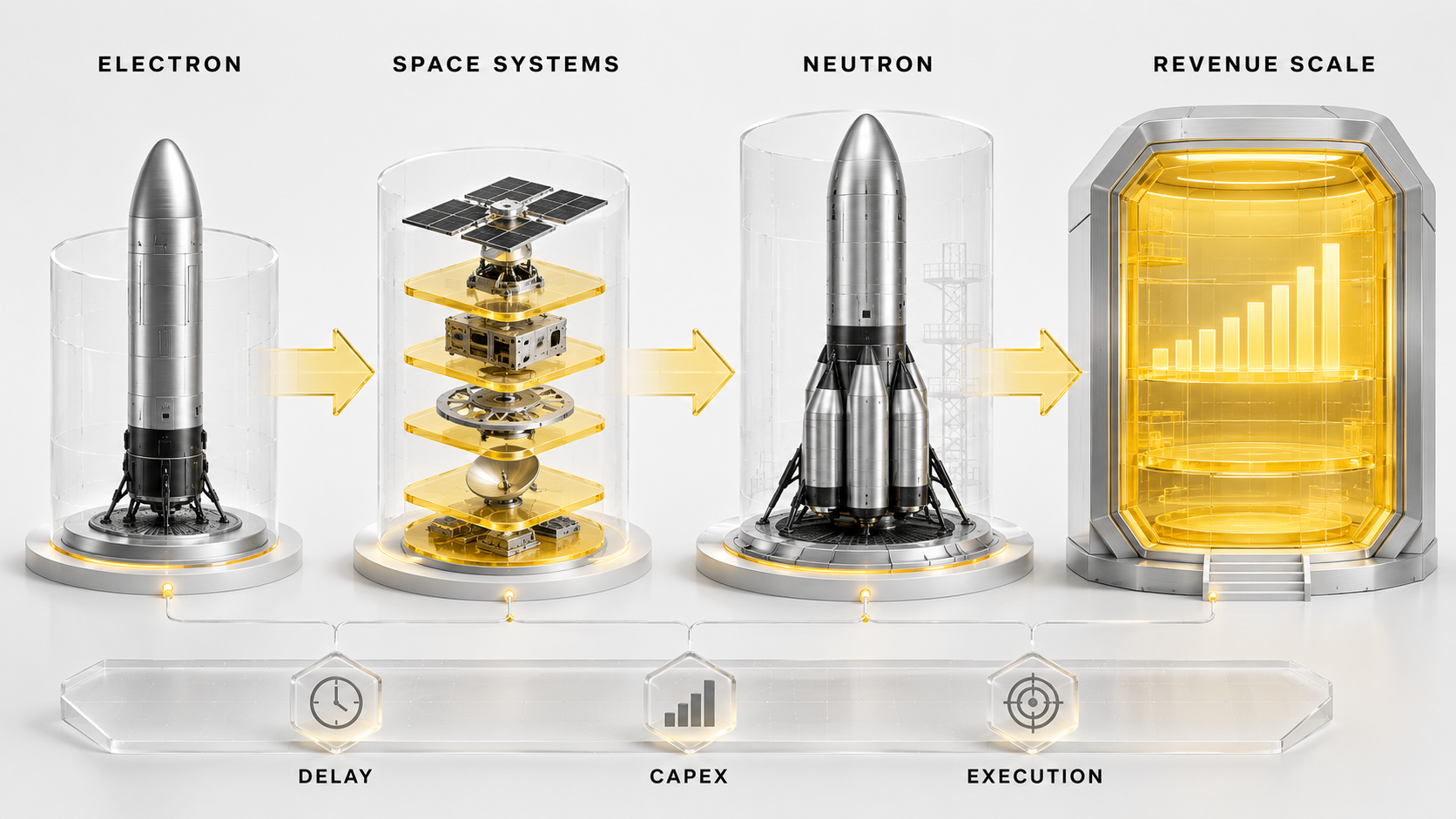
Neutron remains the largest long-term catalyst. The medium-lift rocket is intended to serve constellation deployment, national-security missions and higher-value commercial launches.
If Neutron progresses on schedule, Rocket Lab could compete for missions that are not suitable for Electron and create additional demand for its spacecraft and component businesses. That would increase the company’s revenue ceiling.
The downside is that new launch vehicles are expensive and technically difficult. Testing delays, redesigns and launch-date slippage can increase capital expenditure while pushing meaningful revenue further into the future. Near $58, the market appears less willing to assume that all future milestones will arrive on schedule.
RKLB Bull, Base and Bear Scenarios
| Scenario | Business Assumption | Price Confirmation or Invalidation |
|---|---|---|
| Bull | RKLB holds $56–$58, Q2 execution is strong and Neutron milestones remain credible | Reclaims $60–$61, then closes above $63–$64 |
| Base | Revenue grows, but losses and valuation pressure continue | Builds a broad range around $56–$64 while awaiting new catalysts |
| Bear | Support fails, cash use rises or Neutron timing weakens | Sustained break below the latest $56 area |
The Bull Case for RKLB
The bull case begins with stabilization rather than an immediate return to the highs. RKLB first needs to defend the current support region and show that the sell-off is losing momentum.
Fundamental confirmation would include second-quarter revenue within or above guidance, stronger backlog conversion, manageable cash use and credible progress on Neutron. Additional government contracts would help, but the market may demand evidence that existing awards are becoming revenue.
The Bear Case for RKLB
The bear case is that the stock’s earlier valuation included too much future success. If Neutron development takes longer, operating costs remain high or the space sector continues to de-rate, RKLB could trade below the current support zone even while the company reports revenue growth.
A break below approximately $56 would weaken the base-building thesis. It would not prove that Rocket Lab’s business has failed, but it would indicate that the market is still reducing the valuation assigned to future growth.
RKLB Support, Resistance and Forecast Invalidation Levels
Current Support Zone
The first support area is approximately $56–$58. It overlaps the recent correction low and the area where buyers must begin to absorb selling pressure.
First Rebound Confirmation
A recovery through approximately $60–$61 would be an early sign of stabilization. It would not fully repair the chart but would show that buyers can push the stock away from the lows.
Stronger Trend Repair
The former $63–$64 support area is now a more important resistance zone. A sustained close above it would improve the short-term forecast and make a later test of the upper-$60s more realistic.
Forecast Invalidation
A sustained break below the latest support around $56 would invalidate the immediate rebound setup. The forecast would then need to be rebuilt using the next confirmed price base rather than assuming a rapid recovery.
What Could Make the Forecast Wrong?
The forecast may prove too cautious if Rocket Lab reports stronger-than-expected revenue, better margins or accelerated Neutron progress. It may prove too optimistic if mission schedules slip, integration costs increase or the broader space sector continues to sell off.
Contract value should also be interpreted carefully. A large award improves long-term visibility but does not guarantee immediate profit. Investors need to monitor both contract execution and the cost required to deliver each mission.
What to Watch in the August 10 Earnings Report
Rocket Lab will report second-quarter 2026 results after the U.S. market close on August 10. Management previously guided revenue to $225 million–$240 million, GAAP gross margin to 33%–35% and an adjusted EBITDA loss of $20 million–$26 million.
The strongest confirmation would be revenue and backlog growth combined with disciplined spending. Investors should also look for updates on Neutron, the $266 million Space Force contract and the timing of future mission revenue.
How to Trade RKLB-USDT on Tapbit
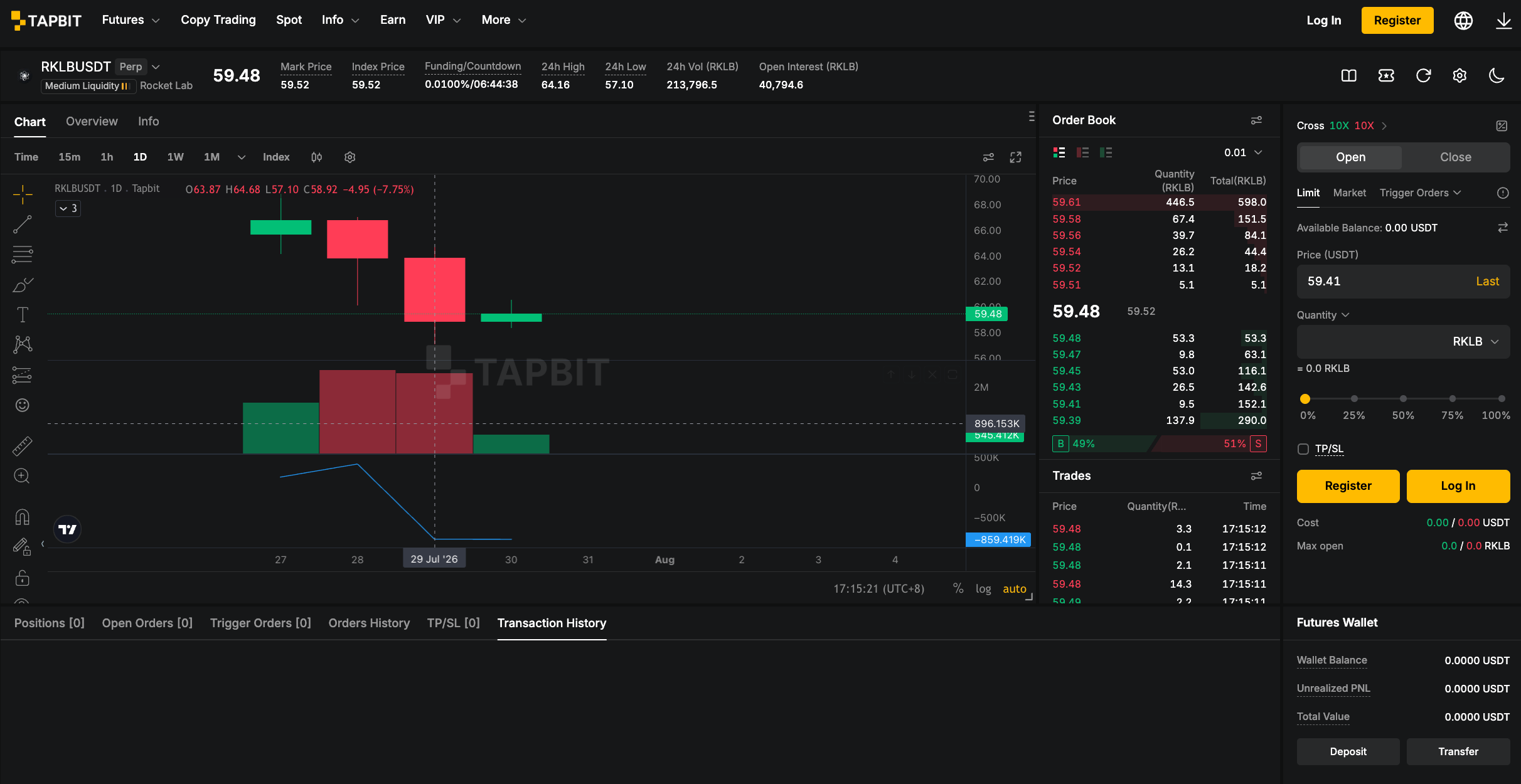
Tapbit’s RKLB-USDT stock-linked futures provide derivative exposure to Rocket Lab-related price movements. They are not direct RKLB shares and provide no voting rights, dividends or shareholder ownership.
- Step 1: Create an account and fund the futures account.
- Step 2: Open RKLB-USDT and review the live contract price, funding, liquidity and leverage.
- Step 3: Select the direction and position size based on a predefined maximum loss.
- Step 4: Set risk controls and monitor Rocket Lab earnings, launches, contract news and U.S. market hours.
At approximately $58, RKLB is trading at a critical observation point rather than a confirmed rebound. The bull case requires support to hold and operating catalysts to convert into financial evidence. The bear case becomes stronger if the stock loses the latest low before those catalysts arrive.


