

The space trade is no longer just a private-market story.
For years, SpaceX was the company everyone wanted exposure to but could not easily buy. That made Rocket Lab one of the most obvious public-market names for investors looking at the space economy. It was not SpaceX, but it gave traders a liquid way to play the same broad theme: rockets, satellites, defense demand, and the buildout of space infrastructure.
Now the setup has changed. With SpaceX in the public market, investors have a new question to answer. Is it better to chase the leader after a huge debut, or look at Rocket Lab as a smaller, more execution-driven alternative?
There is no simple answer. SpaceX has the scale. Rocket Lab has the optionality. Crypto space-themed products have the speed. But each one carries a very different kind of risk.
SpaceX is still the company setting the pace
SpaceX has something most space companies do not: a full ecosystem. It builds rockets, launches satellites, operates Starlink, and controls much of the value chain from manufacturing to customer revenue. Starlink is the key piece. It gives SpaceX recurring revenue instead of relying only on launch contracts, and it creates a flywheel that competitors will find hard to match.
More satellites support better coverage. Better coverage brings more users. More users bring more cash flow. That cash flow can support more launches and more infrastructure.
That is why investors are willing to assign SpaceX a premium. But after a major IPO, the story is no longer cheap or hidden. Expectations are high. Public float is still limited. Future lock-up expirations could also bring more volatility. So even if SpaceX remains the strongest company in the sector, that does not automatically make it the easiest stock to trade.
Sometimes the best company is also the most crowded trade.
Rocket Lab is a different kind of space bet
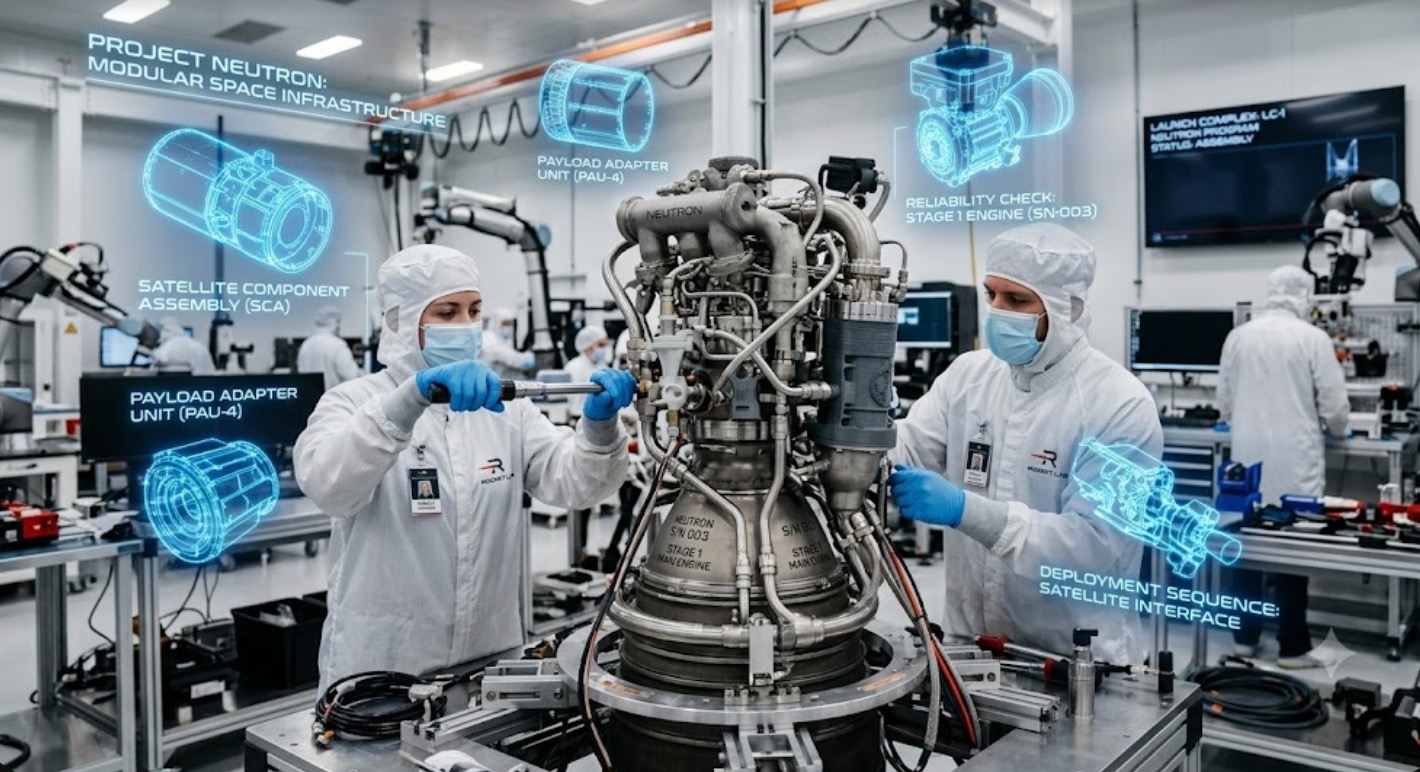
Rocket Lab should not be treated as a smaller version of SpaceX. The business model is different. SpaceX is a vertically integrated platform built around its own network and launch needs. Rocket Lab is more like an open infrastructure provider. It sells launch services, spacecraft systems, satellite components, and mission capabilities to outside customers.
That difference matters. Rocket Lab does not have Starlink. It does not have the same consumer revenue engine. But it can benefit from a wider set of customers, especially governments, defense agencies, satellite operators, and companies that need access to orbit without relying on one dominant provider.
That makes Rocket Lab more of an execution story than a platform story. If it keeps winning contracts and expands into larger launch markets, the upside is real. If schedules slip or costs rise, the market will punish it quickly.
Neutron is the name to watch
Rocket Lab already has credibility because of Electron. The company has proven it can launch small payloads and serve customers with a reliable small-launch product.
But Electron only takes Rocket Lab so far. Neutron is the real test. If Rocket Lab can bring Neutron to market successfully, it moves into a larger and more valuable launch category. That could open the door to bigger constellation work, heavier government payloads, and stronger long-term revenue potential.
That is why Neutron matters so much to the stock.
The risk is obvious: rockets are hard. Delays are normal in aerospace, but markets do not always forgive them. Every test, schedule update, and launch window will matter. For investors, Rocket Lab’s story is not just about demand. It is about whether the company can execute without burning too much time or capital.
Defense demand gives the sector a real floor
The space economy is not only about commercial satellites or broadband internet. Defense is becoming one of the strongest drivers.
Governments want better missile tracking, resilient satellite networks, secure communications, hypersonic testing, and independent launch capacity. That creates demand for companies that can actually build and deliver hardware.
This is where Rocket Lab has a real lane.
Government contracts may not be as exciting as consumer Starlink growth, but they can provide more visible demand. In a sector where many companies still sell big visions more than real revenue, contract-backed work matters.
The market will likely keep rewarding companies that can show backlog, launches, and customer traction instead of just futuristic presentations.
How to read the trade now
The space economy used to be mostly an access problem. SpaceX was private, so traders looked for substitutes.
Now it is a selection problem. SpaceX gives investors the strongest scale story, but also comes with high expectations after going public. Rocket Lab gives investors a clearer public-market growth story, but with much higher execution risk. Crypto space products give traders speed and flexibility, but mostly through sentiment rather than ownership.
None of these are interchangeable. SpaceX is the leader. Rocket Lab is the challenger with room to prove itself. Crypto products are tools for trading the noise around the theme.
Tapbit View
SpaceX’s public debut has made the space economy impossible to ignore, but it has not removed the need to be selective. SpaceX remains the benchmark. Its launch scale and Starlink network give it a moat that few companies can match. But after a historic listing, valuation, float, and future lock-up dynamics matter more than before.
Rocket Lab is still worth watching because it offers a different kind of exposure. It is smaller, more transparent, and more dependent on execution. The upside depends heavily on Neutron, government demand, and continued contract growth.
For crypto traders, space-themed assets can capture short-term momentum around launches, IPO headlines, and satellite narratives. But they should not be confused with equity ownership.
The cleanest way to think about the theme is simple: SpaceX is scale, Rocket Lab is execution, and crypto space products are momentum. The opportunity is real, but so is the risk.
Traders can follow more market updates on Tapbit, log in, or register to stay connected with global market opportunities.
Frequently Asked Questions (FAQ)
Is Rocket Lab the next SpaceX?
Not exactly. Rocket Lab is not a smaller copy of SpaceX. SpaceX has a vertically integrated model built around rockets, Starlink, and its own satellite network. Rocket Lab is more of an open infrastructure provider, serving government and commercial customers with launch services, spacecraft systems, and components.
Why are investors still watching Rocket Lab after SpaceX’s IPO?
Rocket Lab still offers a different kind of public-market space exposure. It is smaller, more execution-driven, and more dependent on contract growth and Neutron progress. For investors who think the space economy will keep expanding, Rocket Lab remains one of the clearer names to watch.
What is Neutron, and why does it matter?
Neutron is Rocket Lab’s larger rocket program. If successful, it could move the company beyond small launches and into bigger constellation, commercial, and government missions. That would raise Rocket Lab’s revenue ceiling, but delays or cost overruns remain major risks.


