
For years, quantum computing was mostly just a mix of breathless press releases and massive, incomprehensible numbers that never actually led anywhere. But the narrative shifted. The industry stopped focusing on pure physics experiments and started tackling actual engineering problems. Fast forward to mid-2026, and those lab breakthroughs have evolved into real commercial deployments, hybrid machine learning frameworks, and verifiable numbers.
On Tapbit, we monitor downstream tech infrastructure because the future of digital asset security depends entirely on the computing power tracking it. Here is the straight breakdown of what has changed in the quantum landscape and what it means for our industry.
Google Willow and the "Quantum Echoes" Era

In late 2024, Google introduced its Willow processor, a 105-qubit superconducting chip that proved a massive architectural milestone: as they added more qubits, the error rate actually went down instead of up. By October 2025, they took this a step further, publishing their "Quantum Echoes" algorithm results in Nature.
Running the Out-of-Time-Order Correlators (OTOC) algorithm, Willow knocked out calculations in about two hours—a task that would take Frontier, the world's fastest supercomputer, roughly 150 years to simulate. That is a documented 13,000-fold speedup over classical capabilities. Instead of just running abstract math puzzles, Google used 65 of Willow's qubits to accurately predict the molecular structure of 15-atom and 28-atom systems. Crucially, scientists cross-checked and verified these quantum predictions using traditional Nuclear Magnetic Resonance (NMR) spectroscopy. This proves quantum machines can deliver real, verifiable data, not just uncheckable black-box outputs.
IBM Heron r2: Moving into Enterprise Workloads
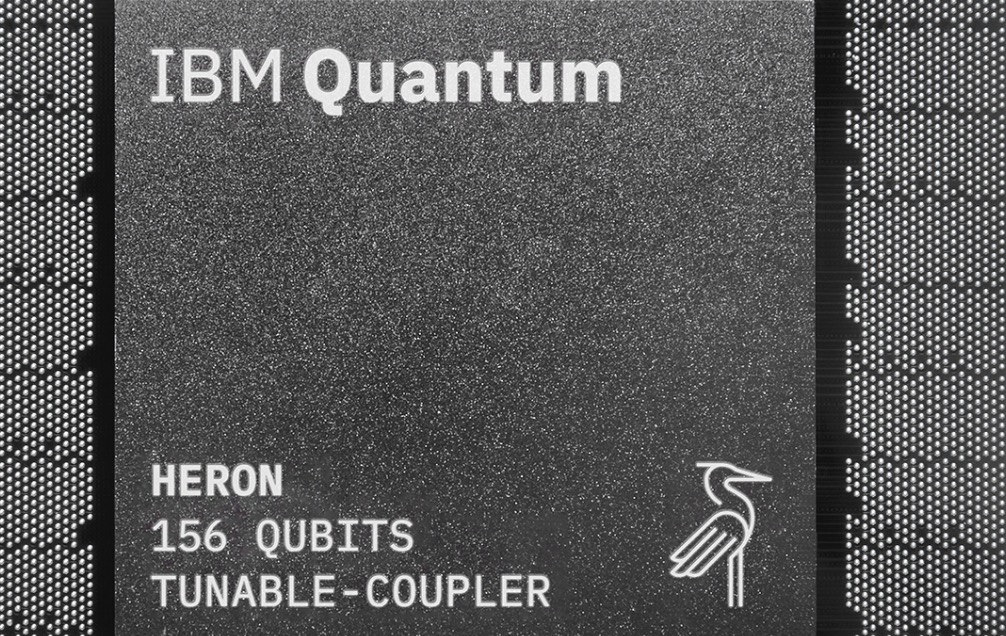
IBM has always favored steady, incremental engineering over flashy headlines, and their latest hardware rollout shows exactly why that approach works. As of May 2026, their tech is actively driving hybrid enterprise applications. The second-generation Heron r2 chip bumped its qubit count from 133 to 156 while introducing a feature called "two-level system mitigation" to directly suppress core noise and hardware instability.
This month, quantum software firm Kipu Quantum launched a hybrid classical-quantum framework running directly on this new processor. The system allows enterprises to extract quantum features using a tiny fraction—around 20%—of their classical training datasets. Once the quantum processor handles that heavy lifting, the rest of the model runs entirely on classical hardware for offline inference. This completely bypasses quantum queue times while delivering massive accuracy boosts for complex tasks like molecular toxicity tracking and medical image diagnostics.
Microsoft & Atom Computing: Commercial Deliveries are Live
While Google and IBM are betting heavily on superconducting chips, Microsoft and Atom Computing have focused on a completely different architecture: neutral atoms. The team made waves by creating 24 logical qubits using ultracold neutral atoms, dropping error rates significantly compared to the raw physical hardware.
Atom Computing’s commercial AC1000 platform now packs over 1,200 physical qubits, handling advanced technical maneuvers like all-to-all qubit connectivity and mid-circuit measurements. Microsoft integrated these logical qubits directly with Azure’s quantum virtualization system, successfully delivering these commercial systems to their first wave of corporate clients back in 2025. They are now actively deploying next-step strategies for 2026, including building out the massive "Magne" quantum system for Denmark's EUR 80 million "QuNorth" initiative. Neutral atom technology is officially out of the lab and taking commercial orders.
The Post-Quantum Cryptography (PQC) Mandate
The biggest takeaway for the Web3 and digital asset space doesn't involve hardware updates at all. It's the regulatory clock that is now officially ticking.
The US National Institute of Standards and Technology (NIST) finalized its first official post-quantum cryptography standards, pushing out algorithms like ML-KEM and ML-DSA to withstand future quantum attacks. Current asymmetric encryption schemes—the exact math protecting your private keys, wallet signatures, and smart contracts—will eventually be vulnerable to code-breaking quantum computers. NIST’s move is a clear signal to the industry: digital asset networks need to start transitioning to quantum-resistant alternatives right now, long before these advanced machines are scaled.
The Desk Verdict
The conversation around quantum computing has completely changed. We aren't sitting around waiting for some mythical, perfect quantum computer to appear a decade from now. Instead, the industry is moving fast toward hybrid models—using quantum chips to train specific datasets, then running them on the classical systems we use every day.
For anyone navigating the Web3 or institutional trading space, the priority isn't tracking hardware benchmarks anymore. The real task is auditing your digital infrastructure and preparing for the mandatory transition to post-quantum cryptographic standards.
Skip the unvetted infrastructure. Execute with precision on Tapbit.
-
Institutional Execution: Log in to Tapbit for reliable trading backed by audited, enterprise-grade security architecture.
-
New to the Exchange? Register on Tapbit today to access our professional charting suite and claim your verified welcome rewards.
-
Track the Capital: Monitor actual on-chain liquidity depth and live market data natively on the Tapbit Homepage.
Frequently Asked Questions
What makes Google's Willow chip an architectural milestone?
Google's Willow processor broke a massive historical roadblock in quantum development: previously, adding more qubits increased noise and hardware instability. With Willow, the error rate actually decreases as more qubits are added. Furthermore, its calculations are fully verifiable. When it used 65 qubits to predict the molecular structures of 15-atom and 28-atom systems, scientists were able to cross-check and prove the results using traditional classical physics tools like Nuclear Magnetic Resonance (NMR) spectroscopy.
How much faster is Google Willow compared to traditional supercomputers?
Running the Out-of-Time-Order Correlators (OTOC) algorithm, Willow finished its calculations in about two hours. For Frontier—the fastest classical supercomputer in the world—to simulate that exact same task, it would take roughly 150 years. This represents a massive, peer-reviewed 13,000-fold speedup.
What is unique about the way enterprises are using the IBM Heron r2?
Instead of trying to run entire datasets on a quantum machine, companies are deploying hybrid classical-quantum frameworks, such as the one launched by Kipu Quantum. The 156-qubit Heron r2 processor is used to extract quantum features from a tiny fraction (around 20%) of a classical training dataset. Once that heavy lifting is done, the model runs entirely on everyday classical systems for offline inference. This completely bypasses quantum queue times while delivering accurate results for complex tasks like molecular toxicity tracking.


