
Novo Nordisk has sold more than five million Wegovy pill prescriptions, raised its 2026 outlook, and continued returning cash to shareholders.
Yet its US‑listed shares closed August at $45.33.
That apparent contradiction lies at the heart of the Novo Nordisk debate. The company is performing better than the stock price suggests, but investors are looking past current prescription volumes — they want to know how much profit those prescriptions will deliver once US prices fall and competition with Eli Lilly intensifies.
The Wegovy pill has passed its launch phase. The harder test begins in 2027.
The Second Quarter Was Not the Main Problem
Novo Nordisk reported adjusted second-quarter sales growth of 7% at constant exchange rates. Adjusted operating profit reached DKK 33.39 billion, and management improved its full-year outlook for both sales and operating profit.
The company now expects adjusted sales and operating profit to range from flat to a 6% decline at constant exchange rates. That remains a weak growth forecast by Novo’s historical standards, but it is better than the previous range.
Investors focused elsewhere. Novo recorded DKK 6.3 billion in non-cash impairments related to pipeline assets, including approximately DKK 4 billion connected to monlunabant. The ZEUS Phase 3 trial of ziltivekimab also failed to meet its primary endpoint.
Those setbacks do not reduce current Wegovy prescriptions. They do weaken confidence in the products expected to support growth after the existing semaglutide franchise matures.
The market’s reaction was therefore less about the quarter Novo reported and more about the earnings it may generate several years from now.
The Wegovy Pill Has Found a Market
The oral version of Wegovy received FDA approval in December 2025 and became broadly available in the United States on January 5, 2026.
Its launch has been substantial.
Novo announced that the pill passed three million prescriptions within its first five months. More than 80% of new prescriptions at that stage went to people who had not previously used a GLP-1 therapy, according to company data. By the second-quarter report, cumulative prescriptions had exceeded five million.
That suggests the pill is doing more than taking patients away from injectable Wegovy. It is bringing some people into obesity treatment who were unwilling or unable to begin with an injection.
Clinical performance also supports the product. In the OASIS 4 trial, patients assigned to oral semaglutide achieved mean weight loss of 16.6% under the trial’s treatment-policy estimate.
The launch is no longer the speculative part of the Novo Nordisk stock story. The pill has regulatory approval, pharmacy distribution and measurable prescription demand.
The uncertainty lies in what that demand is worth.
Eli Lilly’s Oral Rival Is Already Here
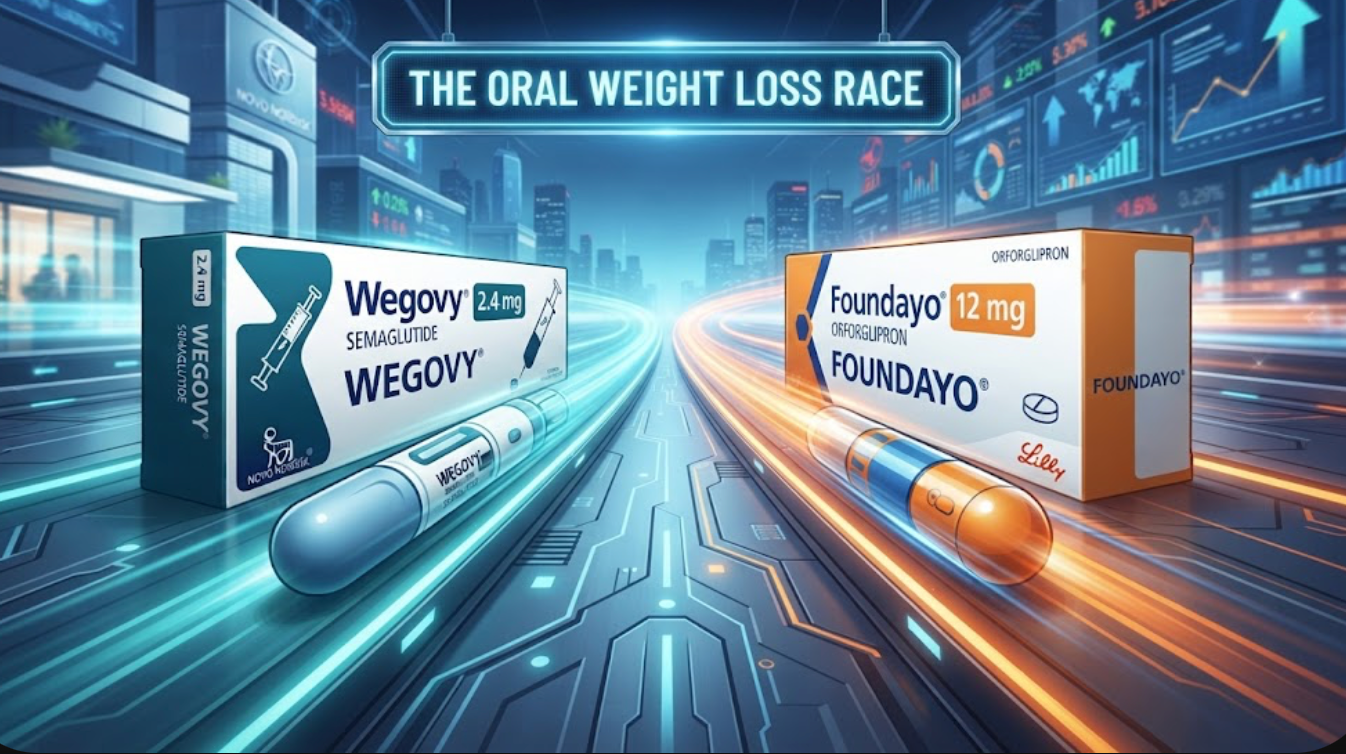
Wegovy was the first oral GLP-1 approved in the United States for weight management. It is no longer the only one.
The FDA approved Eli Lilly’s Foundayo, also known as orforglipron, on April 1, 2026. Lilly began accepting prescriptions immediately, with shipments starting several days later.
Foundayo produced average weight loss of 12.4% at its highest dose in the ATTAIN-1 trial. That figure is below the result reported for the Wegovy pill, although the numbers come from separate trials and should not be treated as a direct comparison.
Lilly’s product has a practical advantage: it can be taken without food or water restrictions. Its self-pay pricing starts at $149 per month, placing it directly in the same market Novo is trying to develop.
The competitive question is no longer whether Lilly will enter oral obesity treatment. It is how patients, doctors and insurers will divide demand between the two products.
Wegovy may appeal to patients prioritizing stronger trial efficacy. Foundayo may attract those who value simpler dosing or already use Lilly’s obesity-care services. Pricing and insurance access could matter as much as clinical differences.
The 2027 Price Cut Changes the Earnings Math
Novo Nordisk will reduce the US wholesale acquisition cost of Wegovy and several other semaglutide products to $675 per month from January 1, 2027. The announced change represents a reduction of approximately 50% for Wegovy and 35% for Ozempic.
A wholesale list price is not the same as the amount Novo ultimately receives. Rebates, insurance negotiations, pharmacy benefit managers and direct-to-patient discounts all affect net revenue. The company’s realized price will not necessarily fall by the full headline percentage.
Even so, the direction is clear. Novo is accepting lower published prices in exchange for the possibility of broader access and higher prescription volume.
That trade can work if more patients receive coverage, remain on treatment and continue refilling prescriptions. It becomes damaging if volume growth slows while revenue per prescription declines.
The 2027 debate therefore comes down to one calculation: Can prescription growth outrun price compression?
Until investors have better evidence, strong Wegovy pill volume will not automatically translate into a higher valuation for Novo Nordisk stock.
The Pipeline Has More Work to Do
Novo’s current obesity portfolio remains commercially important, but the market wants a credible successor.
CagriSema combines cagrilintide with semaglutide. It has produced meaningful weight loss in late-stage trials, but results have not established the decisive advantage over Eli Lilly that some investors expected.
Novo’s second-quarter materials indicate that a US decision on CagriSema for obesity is expected in the fourth quarter of 2026. That decision will matter, but approval alone may not restore confidence. Investors will also examine the product label, target population, manufacturing capacity and likely position against Lilly’s treatments.
Competition is moving quickly. Lilly reported 48% second-quarter revenue growth, driven mainly by Mounjaro and Zepbound, and raised its full-year revenue guidance. It has also completed the clinical data package needed to support future applications for retatrutide, a next-generation obesity candidate.
Novo does not need every pipeline product to defeat Lilly. It does need enough differentiated products to prevent its growth story from resting almost entirely on semaglutide.
Why Novo Nordisk Stock Remains Near $45
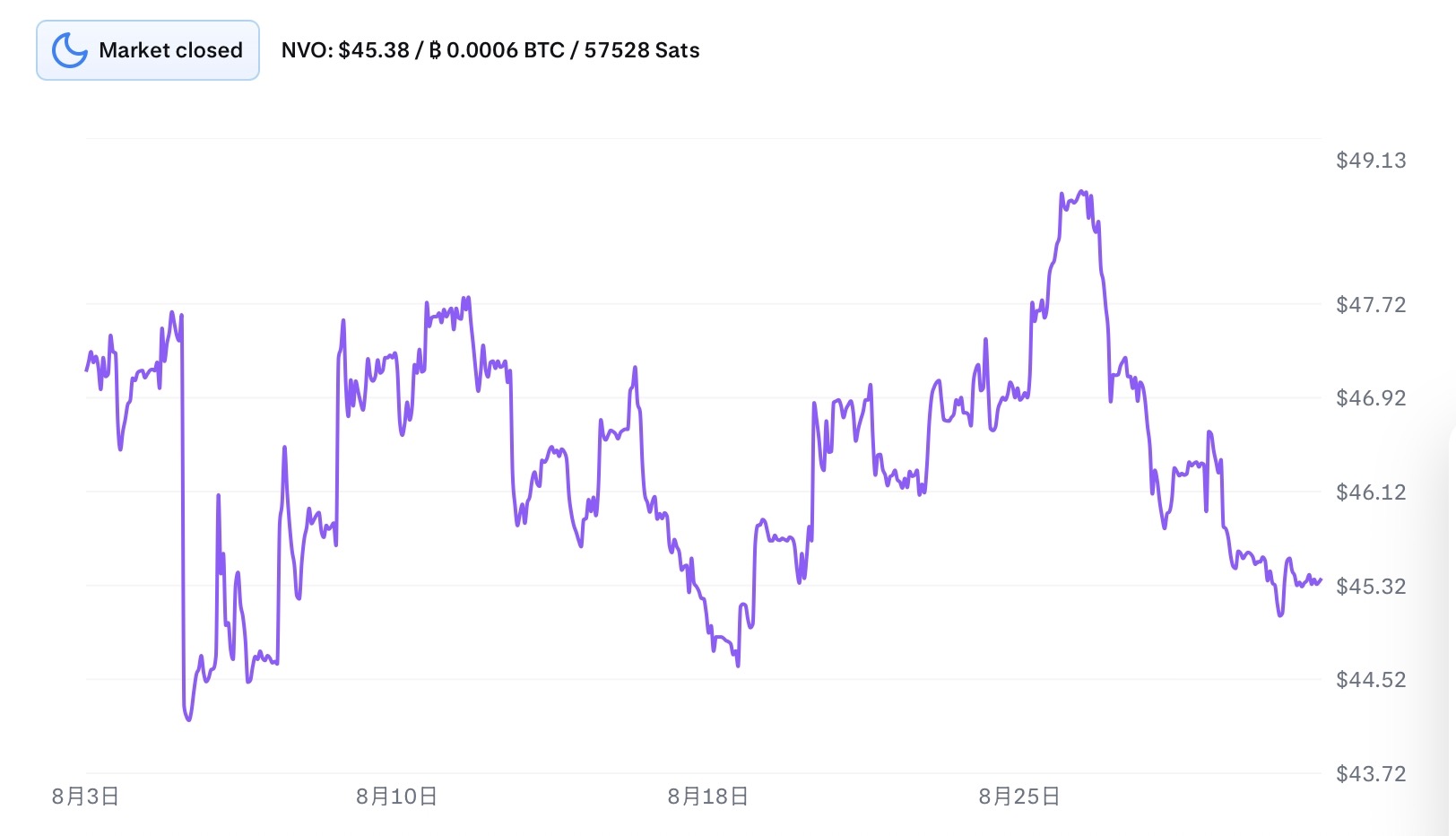
Novo’s ADR closed at $45.33 on August 31, below the $47 to $48 range seen around August 11.
The lower price reflects several concerns at once. US pricing is moving down, Lilly has momentum across both injectable and oral treatments, and recent pipeline setbacks have reduced the probability of an easy return to high growth.
There is still a credible case for the stock.
Obesity treatment remains underpenetrated relative to the size of the eligible population. Oral Wegovy is reaching patients who are new to GLP-1 therapy. Novo continues to generate substantial cash flow and can fund research, manufacturing, dividends and share repurchases.
The valuation cannot be judged by comparing the share price with its old peak. The relevant comparison is between Novo’s current market value and the earnings it can sustain after the 2027 pricing reset.
A lower multiple may represent an opportunity if oral Wegovy expands the market and CagriSema strengthens the pipeline. It may be appropriate if price pressure and Lilly’s market share continue to outweigh volume growth.
September 21 Could Reset the Discussion
Novo Nordisk will hold its Capital Markets Day in London on September 21, 2026.
The event gives management an opportunity to move the discussion beyond cumulative prescription milestones. Investors will be looking for updated information about oral Wegovy demand, patient retention, international launches and the economics of the 2027 price change.
The pipeline presentation may be even more important. Novo needs to explain how CagriSema, higher-dose Wegovy and other development programs fit together rather than presenting each as a separate catalyst.
Useful answers would include how the company plans to compete with Foundayo, where it expects the largest access gains from lower prices and which pipeline assets can reduce dependence on semaglutide.
Without that detail, another strong prescription update may produce the same market response as the second-quarter results: approval of current execution, but little change in the long-term valuation.
The Wegovy Pill Solved One Problem, Not the Whole Case
Novo Nordisk has answered an important question. Patients will use an oral version of Wegovy, and many of them are entering GLP-1 treatment for the first time.
The company has not yet answered the question reflected in its stock price.
Investors still need to see whether oral Wegovy can defend its position against Foundayo, whether higher volume can absorb the 2027 price cut and whether Novo’s pipeline can produce another product with durable commercial value.
Until then, the Wegovy pill is a successful launch inside an unsettled investment case.
Tapbit follows the companies and market themes shaping global asset trading. More market research is available through Tapbit, with direct access for existing users and new account registration.
Frequently Asked Questions
What was the Novo Nordisk stock price at the end of August 2026?
Novo Nordisk’s US-listed ADR closed at approximately $45.33 on August 31, 2026. Stock prices change continuously and should be checked through a current market-data source.
Why did Novo Nordisk stock fall after raising guidance?
Investors focused on future pricing pressure, competition with Eli Lilly and pipeline setbacks rather than the improved 2026 outlook. The market is primarily evaluating Novo’s earnings potential from 2027 onward.
Is the Wegovy pill approved in the United States?
Yes. The FDA approved oral Wegovy in December 2025, and the product became broadly available in the United States in January 2026.


