

Bitcoin was designed to transfer value without relying on banks — not to underpin lending markets, liquidity pools, or complex financial applications.
BTCFi aims to bridge that gap without altering Bitcoin itself.
The term covers protocols that allow holders to stake Bitcoin, borrow against it, use it as collateral, or move BTC‑backed assets into DeFi. Renewed interest has followed projects like Babylon, Lombard, and Stacks, which are introducing new ways to put Bitcoin to work.
The headline numbers are notable — DefiLlama's Bitcoin dashboard showed roughly $4.11 billion in total value locked as of September 1. Yet the more telling question isn't how much Bitcoin has entered these systems, but what happens to that Bitcoin afterward — and where the advertised yield actually originates.
BTCFi Is Larger, but Not Necessarily More Active

Babylon accounted for approximately $3.08 billion of the Bitcoin DeFi TVL recorded by DefiLlama. Lombard contributed about $694 million within the Bitcoin category, while tBTC and the Lightning Network represented roughly $349 million and $298 million respectively.
Those figures make BTCFi look like an established financial market. Trading activity tells a more restrained story.
Bitcoin-related decentralized exchanges recorded only about $508,000 in volume over the preceding 24 hours. The gap between TVL and trading volume suggests that BTCFi is currently driven more by staking, collateral and BTC-backed products than by active on-chain trading.
TVL also needs careful interpretation. The same Bitcoin may appear in several connected products. BTC deposited into one protocol could produce a liquid token that is then supplied to another lending market. Both positions may be included in broader ecosystem statistics.
A rising TVL figure therefore shows that more capital is entering the system. It does not automatically demonstrate strong user demand, revenue or sustainable yield.
Babylon Is Turning Bitcoin Into Collateral
Babylon remains the largest name in BTCFi by recorded TVL. Its original proposition was Bitcoin staking: allowing BTC holders to support other networks and receive rewards without moving their assets through a conventional bridge.
The project is now expanding toward Bitcoin-backed credit.
Recent Babylon Labs updates have focused on Trustless Bitcoin Vaults, fixed-rate borrowing through Aegis and planned integrations that could allow Bitcoin to serve as collateral in larger lending markets. Ledger has also added transaction-signing support for Babylon’s vault structure.
The idea is economically significant. A holder could retain exposure to BTC while borrowing stablecoins or other assets against it. That could create genuine demand from miners, companies and long-term holders that need liquidity but do not want to sell their Bitcoin.
Still, “trustless” should not be treated as shorthand for “risk-free.” A Bitcoin-backed loan can depend on scripts, price oracles, liquidation rules, smart contracts and external networks. Bitcoin may secure the underlying asset, but it does not automatically secure every application built around it.
The durability of Babylon’s model will depend on whether borrowers are willing to pay for this liquidity after promotional rewards decline.
Lombard Shows the Appeal of Liquid Bitcoin
Lombard takes a different route. Users can deposit Bitcoin and receive LBTC, a BTC-backed asset designed for use across multiple networks and DeFi applications.
Lombard recorded approximately $931 million in TVL, including about $864 million attributed to Bitcoin. This combined figure is higher than Lombard’s value on the Bitcoin chain dashboard because it includes deployments and products on Ethereum, Base and other networks.
LBTC gives holders more flexibility than idle Bitcoin. It can be transferred, supplied to lending markets or used in other DeFi strategies while retaining exposure to BTC.
The financial results remain modest relative to the capital involved. DefiLlama recorded roughly $278,000 in Lombard fees over 30 days and about $41,600 in protocol revenue. Recorded revenue for token holders was zero.
That does not make Lombard irrelevant. It shows why TVL alone is an incomplete measure. Nearly $1 billion in deposited assets is evidence of capital attraction, but fees and recurring revenue provide a clearer view of actual economic use.
LBTC also introduces several connected risks. Users are exposed to Lombard’s infrastructure, the protocols that generate staking rewards, the networks where LBTC circulates and any DeFi application in which it is deposited.
Stacks Is Approaching Its Next Bitcoin Staking Test
According to the Stacks announcement, the pilot was scheduled to end around Bitcoin block 966,350, estimated for September 10, 2026. It distributed 22.4 BTC to 1,044 participants, while deployed sBTC exceeded 5,000 BTC at its peak.
The project’s next objective is a broader Bitcoin Staking system designed to let users earn BTC-denominated rewards without using a conventional wrapped token or centralized custodian. The final mainnet implementation, reward structure and operating record will determine whether that promise holds up in practice.
Stacks is also expanding the infrastructure around sBTC. BitGo has announced support for the asset, while the sBTC signer set has been undergoing a rotation. Deposits and withdrawals require approval from at least 70% of the signer network.
That threshold is an important detail. sBTC may be anchored to Bitcoin, but access to the peg still relies on a distributed signer arrangement. Users should understand that distinction before treating sBTC as interchangeable with native BTC.
Stacks reported 2,949 BTC in sBTC supply at the end of the second quarter. It also reported approximately 1.6 million cumulative wallets and around 4,200 daily active users. These project-supplied figures suggest growing activity, although the next test is whether applications can generate regular fees and demand without relying heavily on ecosystem incentives.
Bitcoin Yield Is Not One Product
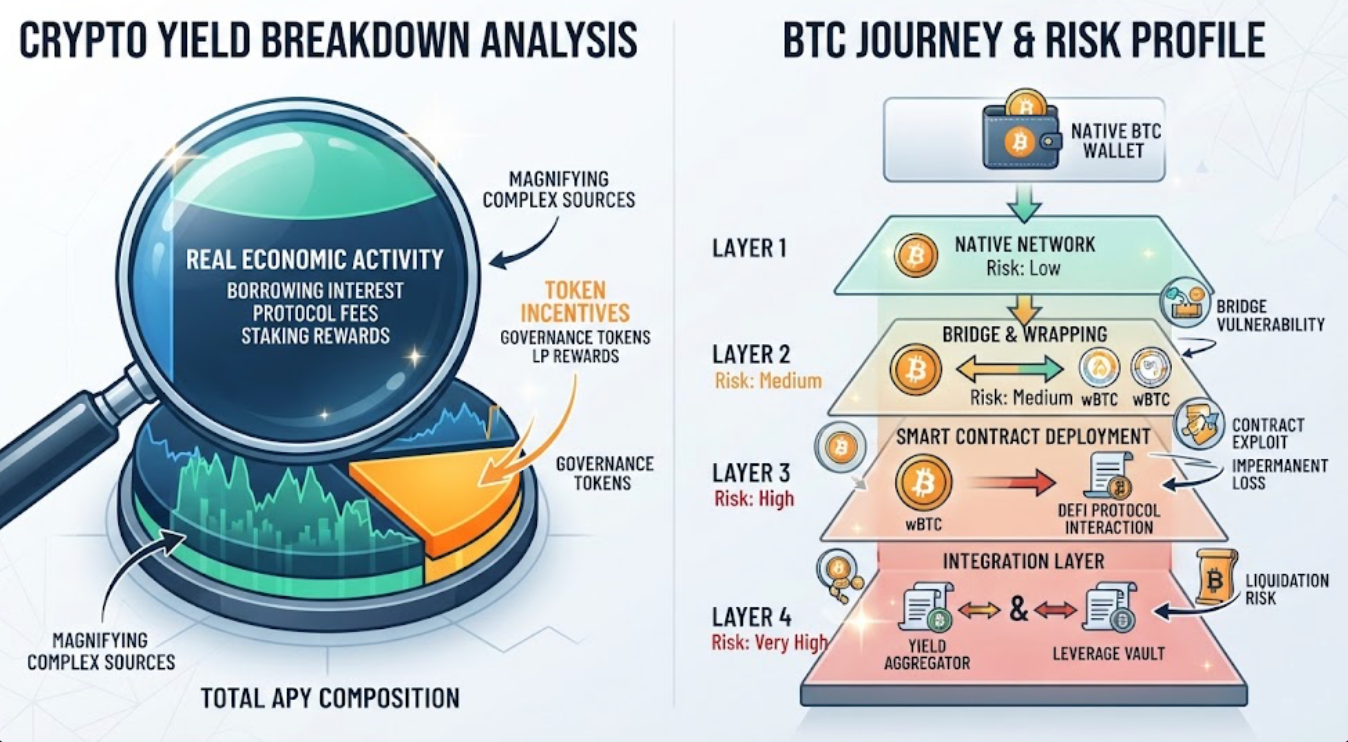
“Earn yield on Bitcoin” can describe very different financial arrangements.
A lending protocol may pay depositors using interest collected from borrowers. A staking system may distribute fees or security rewards. A liquidity pool may earn trading fees, while a newly launched protocol may use token emissions or points to attract deposits.
These sources do not carry the same risk.
Borrower interest and transaction fees come from identifiable economic activity. Token incentives depend partly on the market value of the reward asset. Points may have no guaranteed value at all. Some strategies combine several sources, making the headline annual percentage yield difficult to evaluate without examining the underlying mechanism.
Before using a BTCFi product, it is worth asking who pays the return, what happens if incentives stop and whether the position can be withdrawn under stressed market conditions.
The Security Question Starts After Bitcoin Leaves the Wallet
Bitcoin’s security record is one reason investors are willing to hold it for years. BTCFi creates additional layers around that asset.
Depending on the product, those layers may include custodians, signer groups, bridges, synthetic tokens, smart contracts, lending markets and liquidation systems. A failure at any one of these points may affect withdrawals or the value of a BTC-backed token even when the Bitcoin network continues to operate normally.
Liquidity matters as much as code. A token may be fully backed but still trade below its intended value if market makers withdraw, redemption slows or users rush toward the same exit.
This is why the strongest BTCFi projects will not be identified by the highest advertised yield. They will be identified by reliable redemptions, transparent collateral, durable demand and the ability to withstand difficult market conditions.
BTCFi’s Next Phase Will Be Measured by Use
BTCFi has moved beyond a niche experiment. More than $4 billion is now recorded across Bitcoin-linked DeFi protocols, and the sector is developing clearer product categories around staking, liquid Bitcoin and collateralized borrowing.
Capital alone does not settle the investment case.
Babylon still needs to prove that Bitcoin-backed borrowing can attract lasting demand. Lombard needs to turn deposited capital into meaningful activity and revenue. Stacks must show that its next staking system can operate securely outside a limited pilot.
The most useful signals will be borrowing demand, protocol fees, redemption performance, active users and the share of yield generated by real economic activity rather than incentives.
BTCFi may give Bitcoin a larger role in decentralized finance. Whether it creates a durable market will depend on something less exciting than TVL headlines: people consistently paying to use the products.
Market research, crypto education and current trading information are available through Tapbit. Users can access an existing account or register with Tapbit to explore the platform.
Frequently Asked Questions
What is BTCFi?
BTCFi, or Bitcoin DeFi, refers to financial applications that use Bitcoin or BTC-backed assets for activities such as lending, borrowing, staking, liquidity provision and collateralized trading.
How large is the Bitcoin DeFi market?
DefiLlama recorded approximately $4.11 billion in Bitcoin DeFi TVL as of September 1, 2026. The figure changes with Bitcoin’s price, deposits, withdrawals and the data provider’s classification method.
Where does BTCFi yield come from?
BTCFi yield may come from borrower interest, protocol fees, staking rewards, liquidity incentives or project token emissions. Users should verify the source because each model has a different risk profile.


