

Lululemon entered its September earnings report with expectations already subdued. It still managed to disappoint.
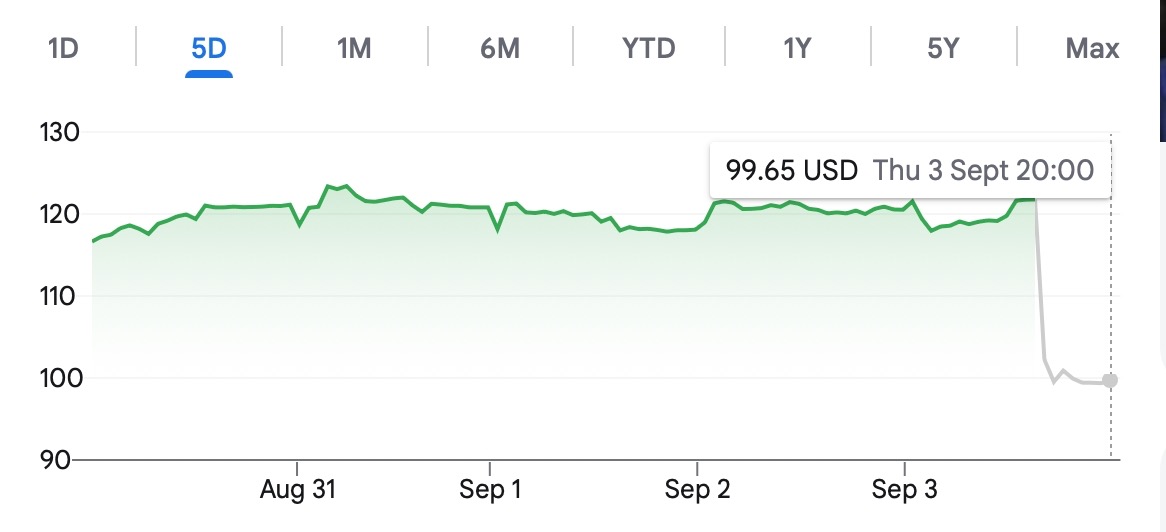
LULU closed at $121.77 on September 3, then fell to roughly $100 in extended trading — a drop of nearly 18%. The immediate causes: a weak second-quarter sales report and another downward revision to the 2026 outlook.
The deeper concern is that Lululemon no longer looks like it's in a temporary slowdown. Sales are contracting in its largest market, international growth is losing momentum, and a leadership transition looms while product strategy remains under pressure.
The Headline EPS Beat Was Misleading
Lululemon reported diluted earnings of $2.92 per share for the quarter ended August 2. That was well above Wall Street’s expectations, but it included an unusual benefit.
The company received $134.5 million in tariff refunds and another $4.1 million in related interest. Together, these items added $0.86 to quarterly earnings per share.
The same refund lifted reported gross margin by 560 basis points. Lululemon’s gross margin officially increased 200 basis points to 60.5%, but without that benefit, the underlying result would have been considerably weaker.
Revenue told a cleaner story. It fell 4% from a year earlier to $2.42 billion and missed the market consensus of approximately $2.46 billion. Comparable sales declined 9%.
Investors therefore looked past the EPS beat. It came partly from a refund that will not necessarily repeat, while the operating business continued to lose sales.
The Americas Business Is Losing Ground

The Americas remain Lululemon’s largest and most important market. Revenue in the region fell 8% during the quarter, while comparable sales dropped 12%.
That decline is difficult to explain through weak consumer spending alone. Athletic and lifestyle apparel remains a competitive category, but shoppers now have more alternatives. Alo Yoga and Vuori have expanded their visibility, while Nike, Adidas and other established brands continue to compete for the same discretionary spending.
Lululemon has acknowledged inconsistency in its product assortment. Some newer women’s bottoms performed well, but those gains were not broad enough to offset weakness across the wider range.
This matters because Lululemon built its premium valuation on strong full-price demand and unusually loyal customers. If the company needs heavier promotions to protect volume, both its brand position and margins could suffer.
International Growth Is No Longer Enough
International expansion once gave investors a straightforward answer to slower North American growth. That argument has weakened.
International revenue increased 4% in the second quarter, but comparable sales fell 3%. On a constant-currency basis, comparable sales declined 6%.
The difference suggests that new store openings contributed to reported revenue while existing locations were less productive. Lululemon opened nine net new stores during the quarter and finished with 825 company-operated locations.
Opening more stores can support top-line growth, but it does not solve declining demand at stores already operating. The market wants evidence that customers are buying more, not simply that the company has added more selling space.
Guidance Delivered the Real Shock
Lululemon now expects third-quarter revenue of $2.29 billion to $2.32 billion, representing a year-over-year decline of 10% to 11%. Earnings are projected at only $0.93 to $0.98 per share, compared with $2.59 in the same period last year.
Management also cut its full-year revenue forecast to between $10.35 billion and $10.50 billion. The company had previously expected $11.00 billion to $11.15 billion.
Full-year EPS guidance fell from $10.95–$11.15 to $9.48–$9.73, even though the new range includes the $0.86 benefit recognized from tariff refunds.
The revised outlook implies that management does not expect a quick sales recovery during the second half of the year. It also explains why Lululemon stock sold off despite the apparent earnings beat.
Heidi O’Neill Inherits a Turnaround
Heidi O’Neill is due to take over as Lululemon’s CEO shortly after the earnings report. Her long career at Nike gives her experience in product, merchandising and global brand management, but she will be judged on decisions rather than credentials.
Lululemon does not need a cosmetic rebranding exercise. It needs stronger products in its core categories, a clearer reason for customers to pay premium prices and better execution in North America.
The company still has financial room to make those changes. It ended the quarter with approximately $1.4 billion in cash, while inventory declined 1% in value and 7% in units. Lululemon also spent $330 million repurchasing 2.7 million shares during the quarter.
Those figures reduce immediate balance-sheet concerns. They do not answer the central question facing LULU stock: can the brand return to organic growth?
Is Lululemon Stock Cheap After the Fall?
A sharp decline can make a stock look inexpensive, especially when the company remains profitable and continues buying back shares. That does not automatically make it undervalued.
Lululemon’s previous valuation assumed durable growth, pricing power and strong customer loyalty. With revenue now expected to decline and Americas comparable sales down by double digits, investors must use lower earnings expectations and allow for a longer turnaround.
The bullish case rests on the possibility that product improvements, new leadership and international expansion eventually stabilize sales. A smaller share count could then make an earnings recovery more valuable to each remaining shareholder.
The bearish case is that Lululemon has lost part of its cultural position in North America. If competitors continue taking attention and the company relies on promotions to defend volume, the stock may deserve a permanently lower valuation.
At around $100 in extended trading, the market is no longer pricing Lululemon as a reliable growth company. It is beginning to price it as a turnaround.
LULU Now Has to Earn Back Its Growth Valuation
The second-quarter report did more than push Lululemon stock lower. It changed the burden of proof.
Investors once assumed that temporary product problems would be corrected while international markets carried the business forward. The latest numbers no longer support that assumption. Americas sales are falling sharply, international comparable sales have turned negative, and the full-year forecast has been cut again.
Lululemon remains profitable, cash-generative and widely recognized. That gives the new management team something meaningful to rebuild. But the next recovery in LULU stock will need to come from stronger demand, not another accounting benefit or share buyback.
Tapbit readers can follow developments across equities, digital assets and macro markets through Tapbit Learn. Market access and available trading products can be explored on the Tapbit platform.
Frequently Asked Questions
Why did Lululemon stock fall after Q2 2026 earnings?
LULU fell because quarterly revenue missed expectations, Americas comparable sales declined 12%, and management sharply reduced its third-quarter and full-year forecasts. Investors looked beyond the reported EPS beat because it included a large tariff refund.
What was Lululemon’s Q2 2026 revenue?
Lululemon reported approximately $2.42 billion in revenue, down 4% from the previous year. Comparable sales declined 9%.
Did Lululemon beat earnings expectations?
Reported diluted EPS of $2.92 exceeded market expectations. However, tariff refunds and associated interest contributed $0.86 per share, making the headline result stronger than the underlying operating performance.


