
Ollama built its reputation on a straightforward value proposition: download an open model, run it locally, and keep your data out of the cloud.
That description still holds, but it no longer captures the full picture.
On August 31, 2026, Ollama introduced cloud plans based on per-token pricing. Days earlier, it added support for running Ollama models via Claude Desktop. The platform now offers cloud inference, web search, coding‑agent integrations, and paid team accounts alongside the original local software.
Ollama hasn't walked away from local AI — it's building a business around the point where local hardware no longer meets all user needs.
Local Ollama Is Still Free
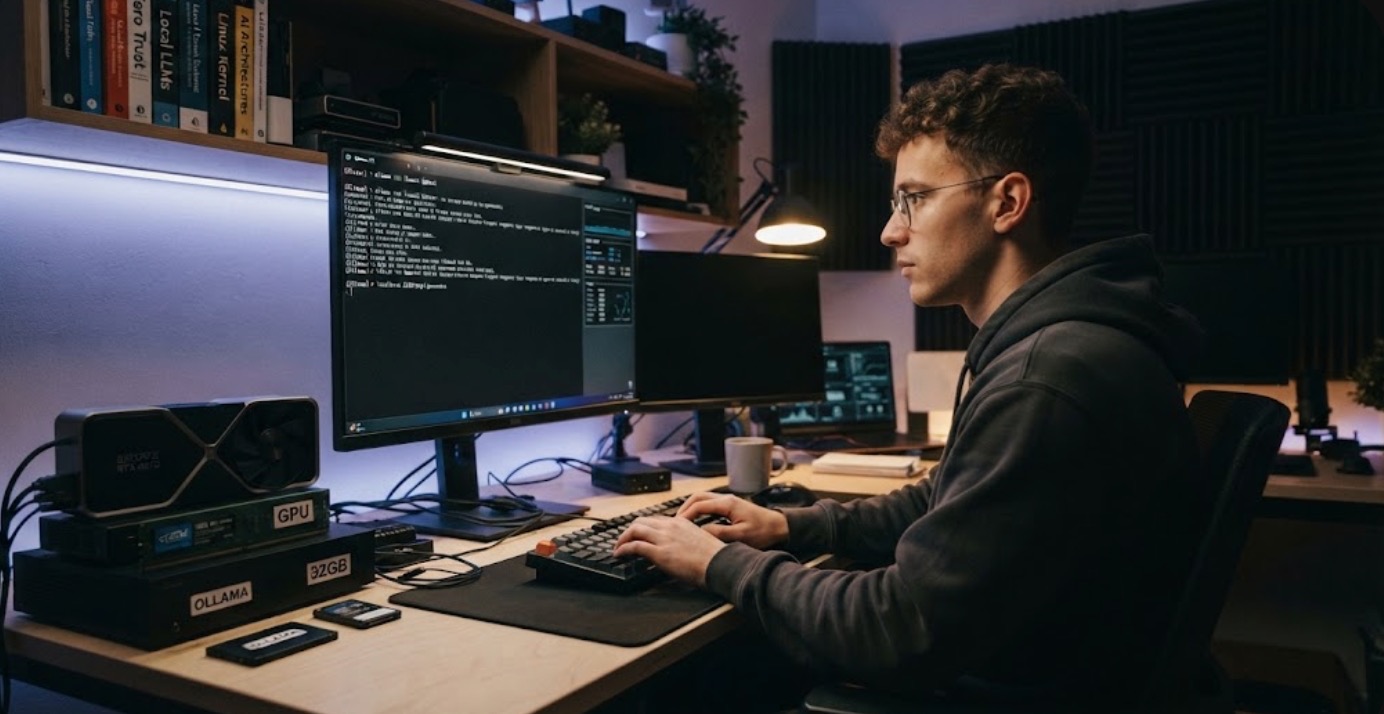
The core Ollama software remains available under the MIT licence. Users can download models and run them on their own hardware without paying Ollama for each prompt.
The application handles model downloads, storage and hardware detection. It also exposes a local API, so other applications can use the installed model.
This approach works well for private document analysis, offline assistants, software development and experiments that would become expensive through a metered API. Running a model locally also gives users more control over model selection, system prompts and storage.
There is still a cost, just not an Ollama usage bill. Larger models require more memory, storage and electricity. A small model may run on an ordinary laptop, while a large reasoning or multimodal model can demand an expensive GPU or workstation.
Local AI shifts the cost from cloud tokens to hardware.
Ollama Cloud Changes the Calculation
Ollama Cloud was created for models that do not fit comfortably on personal computers. It lets users keep the same command-line tools and APIs while moving inference to data-center hardware.
That convenience changes two important parts of the original proposition: price and data location.
Cloud usage is measured in tokens. Once the included allowance is exhausted, users can purchase more usage at the published rate for each model. Unused monthly credits do not roll over.
Ollama says the change replaces less predictable GPU-time billing and removes the previous five-hour and weekly limits. Running models on personal hardware remains unlimited.
The result is a hybrid product. Ollama can be free local software, a pay-as-you-go model API or a monthly cloud subscription depending on how it is used.
Does Ollama Keep Data Local?
Only local models keep the full inference process on the user’s device. When a model name carries a cloud designation, the request is processed by Ollama’s infrastructure. The company says cloud prompts and responses are not logged, retained or used for training. Its published documentation states that compute is hosted primarily in the United States and Europe, with Singapore used for a limited group of Qwen models.
That is a zero-data-retention policy, not local processing.
The distinction matters for businesses working with source code, legal material, customer records or internal research. A request can be protected by a provider’s privacy policy and still cross a company’s network boundary.
Ollama allows users to disable its cloud functions through configuration settings. Doing so also removes access to cloud models and Ollama’s web-search service. Teams that require a local-only environment should verify this setting rather than assuming every request stays on the machine.
Claude Desktop Can Now Run Ollama Models
Ollama added Claude Desktop support on August 25. Users can configure Ollama as a third-party gateway and choose either a local model or one hosted on Ollama Cloud.
This arrangement can be misunderstood.
A model running inside the Claude Desktop interface is not necessarily a Claude model. Anthropic provides the application interface, while Ollama supplies the selected model and inference route. Output quality, context handling and tool support therefore depend on the Ollama model being used.
The update is important because it separates the AI interface from the AI provider. Users can keep a familiar workspace while changing the model underneath it.
A similar pattern is appearing across the developer market. Ollama now works with Codex, Claude Code, OpenCode and other coding agents. Its ollama launch command helps configure these tools without requiring developers to rebuild their workflows around each model provider.
OpenAI Compatibility Makes Switching Easier, Not Perfect
Ollama supports parts of the OpenAI API format. Existing applications can point supported requests toward an Ollama endpoint and use local or cloud open models.
The compatibility layer includes chat completions, streaming, embeddings, vision input, tool calls and parts of the Responses API. Ollama has also introduced an experimental image-generation endpoint.
“Compatible” does not mean identical. Some OpenAI fields and stateful functions are not fully supported, and model behaviour can differ substantially. Developers still need to test tool calling, structured output, context length and error handling before replacing a production endpoint.
The practical advantage is lower migration friction. A company can test an open model without rewriting its entire application.
The Model Library Has Moved Beyond Llama 3
Older explanations of Ollama often focus on Llama 3, Gemma 2, Phi-3 and Qwen 2.5. Those models remain available, but the library has expanded.
Recent additions include Gemma 4, Qwen 3.8, GLM 5.3, NVIDIA Nemotron 3.5 Lightning, Muse Glimmer and newer DeepSeek and Kimi models. Some are designed for coding agents, multimodal input or long-running tool use rather than simple chat.
Not every model can be downloaded and run locally. Some of the largest releases are available only through Ollama Cloud. Users should check the model tag, download size and licence instead of assuming everything in the library is both local and unrestricted.
Ollama’s own software uses the MIT licence, but individual models retain the licences chosen by their creators. Open weights do not automatically grant unrestricted commercial use.
Ollama’s Business Model Is Becoming Clearer
Ollama announced an $88 million funding round in July 2026. The company says it now serves 8.9 million developers and is used within 85% of Fortune 500 companies. These adoption figures come from Ollama and have not been independently audited, but they show the scale of its commercial ambitions.
The strategy has several parts: Local software brings developers into the ecosystem. API compatibility makes Ollama easier to adopt. Integrations connect it to established coding tools. Cloud inference monetizes users who need more compute than their own hardware can provide.
This is not unusual. Open-source infrastructure companies often keep the core software accessible while charging for hosting, scale and administrative features.
The tension lies in positioning. Ollama became popular as an alternative to metered cloud AI. It must now convince users that its own cloud offers enough performance, privacy and model choice to justify another token bill.
What Ollama Has Become
Ollama still makes local AI easier. That remains its strongest product advantage.
What changed is the path available after local hardware runs out of room. Users no longer have to leave the Ollama environment to access larger models, web search or cloud compute. They can move between local and hosted inference while keeping many of the same tools.
That convenience comes with choices the original local-only story did not require. Users now need to know where each model runs, how cloud tokens are billed and which privacy policy applies to each request.
Ollama is no longer simply a way to avoid the AI cloud. It is trying to become the layer that decides when the cloud is necessary.
Readers following the overlap between AI infrastructure, cloud computing and digital markets can find more research on Tapbit. Tapbit users can sign in, while those exploring the platform can create an account.
Frequently Asked Questions
Is Ollama free?
Ollama is free when models run on the user’s own hardware. Ollama Cloud has free starter usage but charges for additional cloud inference.
Does Ollama charge per token?
Local inference does not carry a per-token Ollama fee. Cloud models use published per-token prices, with monthly usage credits included in paid plans.
How much does Ollama Pro cost?
Ollama Pro costs $20 per month or $200 per year under the pricing published on August 31, 2026. It includes $60 in monthly cloud usage credits.


