

Arbitrum’s ARB token jumped about 30% after Robinhood Chain reported a sharp increase in activity and revenue. The move turned a familiar Layer 2 token into one of the day’s most watched altcoins. It also created a more useful question than “why is ARB going up?”: how much of Robinhood Chain’s success can actually reach Arbitrum’s network, and how much is simply a short-term trading reaction?
Market data showed ARB trading near $0.11 on September 2 after the late-August breakout. CoinDesk reported that Robinhood Chain generated a 24-hour revenue record of about $1.9 million as ARB rallied. A separate market report estimated roughly $5.92 million in 30-day revenue, with more than two-thirds generated during the latest week. These figures are snapshots, not a promise of recurring income, so traders should refresh the quote and revenue data before publication.
Why Is ARB Up 30%?
The immediate catalyst was the market’s attempt to connect Robinhood Chain’s growth with Arbitrum’s infrastructure. Robinhood Chain is built using Arbitrum technology. Under the Arbitrum Expansion Program, part of the chain’s revenue is paid into the Arbitrum ecosystem. That gives ARB traders a new fundamental narrative: if Robinhood attracts more users, transactions and tokenized-asset activity, Arbitrum’s technology could become more economically relevant.
That connection does not mean every dollar earned by Robinhood Chain is automatically distributed to ARB holders. The benefit may appear through ecosystem funding, network demand, governance relevance, developer activity or expectations about future value capture. Markets often price that expectation before the accounting is fully visible. This is why ARB can move much faster than the underlying revenue line.
How Robinhood Chain Revenue Connects to Arbitrum
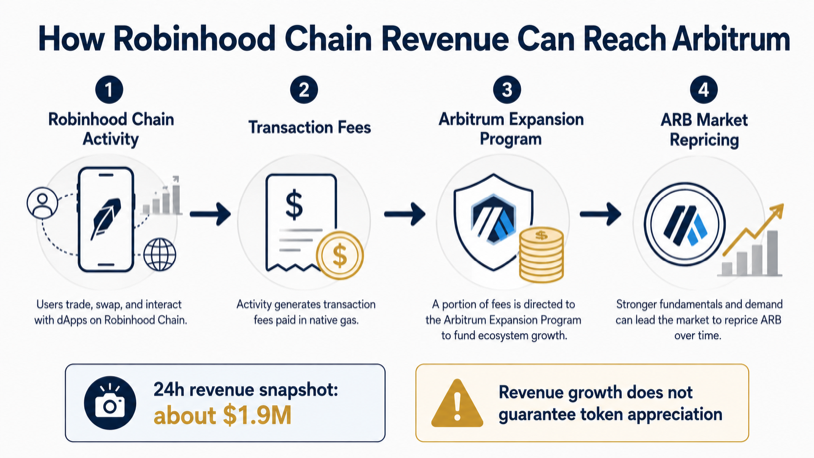
A Layer 2 network earns attention when it handles real transactions rather than only speculative announcements. Robinhood Chain’s reported revenue is linked to the fees paid by users and applications using the network. The chain’s relationship with Arbitrum matters because it uses the Arbitrum technology stack and participates in an expansion arrangement designed to connect downstream chains with the broader Arbitrum ecosystem.
The economic path is easier to understand as a chain of events:
- Robinhood brings users and trading activity to its Layer 2.
- Transactions create fees and revenue for the chain.
- Part of that value may flow through the Arbitrum expansion framework.
- Investors reassess Arbitrum’s ecosystem activity and ARB’s future demand narrative.
The final step is an expectation, not a mechanical conversion. ARB remains a governance and ecosystem token, and its market price is also affected by supply, unlocks, liquidity, Bitcoin direction and the relative strength of other Layer 2 networks.
Why Revenue Growth Does Not Guarantee ARB Appreciation
There are three reasons to separate Robinhood Chain revenue from ARB value. First, revenue can be volatile. A single day of high activity may be caused by a launch, incentive program, tokenized-stock demand or temporary speculation. Second, the terms of value sharing determine how much of that revenue benefits Arbitrum and when. Third, even genuine ecosystem growth can be outweighed by token issuance or a weak broader market.
For that reason, a stronger confirmation would be several weeks of healthy fees, stable active users, rising transaction quality and continued application growth. Traders should also watch whether ARB holds its breakout after the first wave of momentum buyers exits. A price move that survives a pullback is usually more informative than the first vertical candle.
ARB Price Outlook: Levels and Scenarios
With ARB near $0.11, the first question is whether the token can remain above its former trading range. Recent market data placed the nearby support area around $0.10, while the next resistance zone was near $0.12–$0.13. These are observation zones rather than guaranteed turning points.
Bull scenario: Robinhood Chain revenue remains elevated, Arbitrum ecosystem activity expands and ARB closes above the $0.12–$0.13 resistance area with improving volume. In that case, traders may look for a broader repricing of Layer 2 tokens.
Base scenario: Revenue stays positive but normalizes, while ARB consolidates between approximately $0.10 and $0.13. This would suggest that the market is waiting for more evidence before extending the move.
Bear scenario: Robinhood Chain activity cools, the breakout fails and ARB loses the $0.10 area. A return to the previous range would show that the rally was driven more by positioning and narrative than by durable fee growth.
What ARB Traders Should Watch Next
- Robinhood Chain daily and 30-day revenue, not only one record day.
- Transaction count, active users and the mix between genuine applications and short-term incentives.
- Arbitrum governance decisions and the details of ecosystem value capture.
- ARB unlocks, circulating supply and liquidity during the rally.
- Bitcoin and the wider altcoin market, because a strong project can still fall in a broad risk-off session.
Readers can review Tapbit’s crypto trading guides for background on market structure and use the crypto wallet safety guide before moving funds between networks.
How to Trade ARB-USDT Futures
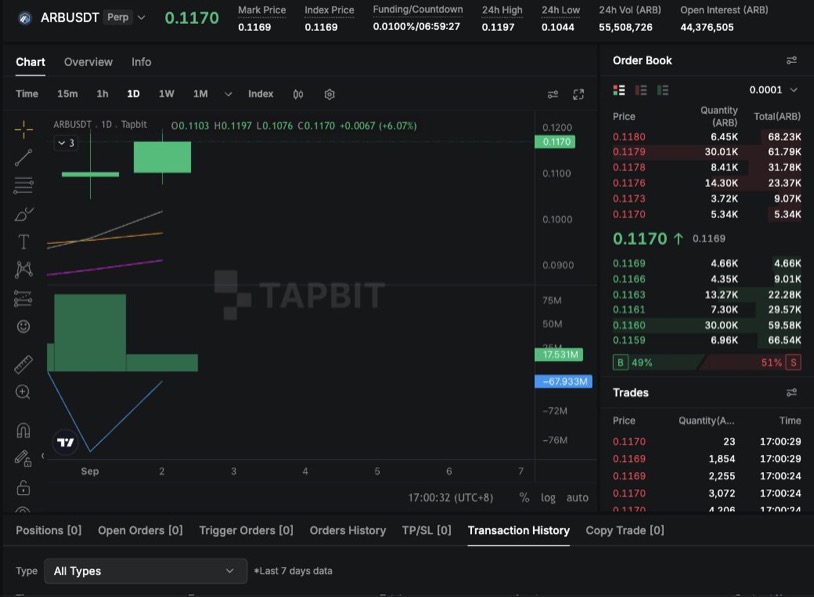
Tapbit offers ARB-USDT perpetual futures for traders seeking leveraged long or short price exposure. A perpetual contract is a derivative, not custody of ARB. It does not give the trader governance rights, on-chain utility or the ability to withdraw ARB from the position.
Before trading, check the mark price, index price, funding rate, margin mode and liquidation price. A high-leverage position can be liquidated even if the long-term thesis later proves correct. New users can create an account and review the contract specifications before placing an order.
Bottom Line
ARB’s 30% rally reflects a compelling link between Robinhood Chain’s reported revenue and Arbitrum’s technology ecosystem. The connection is meaningful, but it is not a guaranteed cash flow to token holders. The next test is whether revenue, users and fees remain strong after the news-driven burst. Until that evidence appears, ARB should be treated as a high-volatility ecosystem trade rather than a risk-free expression of Robinhood’s growth.
FAQ
Why did ARB rise about 30%?
ARB rallied after Robinhood Chain reported strong revenue and activity. Because Robinhood Chain uses Arbitrum technology, traders reassessed Arbitrum’s ecosystem value and future fee narrative.
Does Robinhood Chain revenue go directly to ARB holders?
No. The relationship may support the Arbitrum ecosystem through its expansion framework, but it does not guarantee a direct distribution to ARB holders.
What is the key ARB support level?
Recent market data placed the nearby observation area around $0.10, with resistance near $0.12–$0.13. These levels can change as liquidity and volatility shift.
What is ARB-USDT futures trading?
ARB-USDT perpetual futures provide derivative price exposure. They do not transfer ARB ownership or governance rights and carry funding, leverage and liquidation risk.


