

UNI rose more than 13% in the latest market move as traders focused on Uniswap’s activity on Robinhood Chain, the protocol’s fee framework and a broader rotation into DeFi assets. Price data showed UNI near $6.24 on September 2, after a strong advance across several sessions. The move is important because it ties a familiar governance token to a newer Layer 2 venue, but it does not prove that higher network activity will automatically create lasting value for UNI holders.
Several forces appear to be working together: Robinhood Chain has become a visible distribution channel for crypto and tokenized assets; Uniswap is one of its primary automated market makers; and the Unification framework gives protocol fees a route into a UNI burn mechanism. The safest interpretation is that these developments improve the narrative around UNI. The price still needs to confirm that the narrative is becoming durable demand.
Why Is UNI Up More Than 13%?
Market coverage attributed the latest UNI move to a combination of Robinhood Chain fee growth, the Uniswap protocol fee and burn design, DeFi sector rotation and a technical breakout. These are related but separate catalysts. Robinhood Chain activity can raise expectations for fee generation. The Unification framework can make those fees more relevant to UNI. DeFi rotation can then bring marginal buyers into the token.
That is different from saying that Robinhood Chain alone caused every percentage point of the rally. Crypto prices often move when several narratives line up at the same time. Short covering, momentum trading and thin liquidity can amplify the first move, while real usage determines whether the market can hold it.
What Is Uniswap Doing on Robinhood Chain?
Uniswap launched on Robinhood Chain with its v2, v3, v4 and UniswapX products available through its interfaces and APIs. Robinhood Chain is an Arbitrum-based Layer 2 designed to connect a large retail platform with on-chain activity. Uniswap’s role is to provide familiar liquidity and swapping infrastructure inside that environment.
The relationship matters for two reasons. First, users can interact with decentralized liquidity without leaving the Robinhood Chain ecosystem. Second, more swaps can create protocol fees if the relevant fee settings are enabled. The size and persistence of that activity are more important than the launch headline itself. A network can attract an initial burst of transactions and still struggle to retain users later.
How the UNI Fee and Burn Mechanism Works
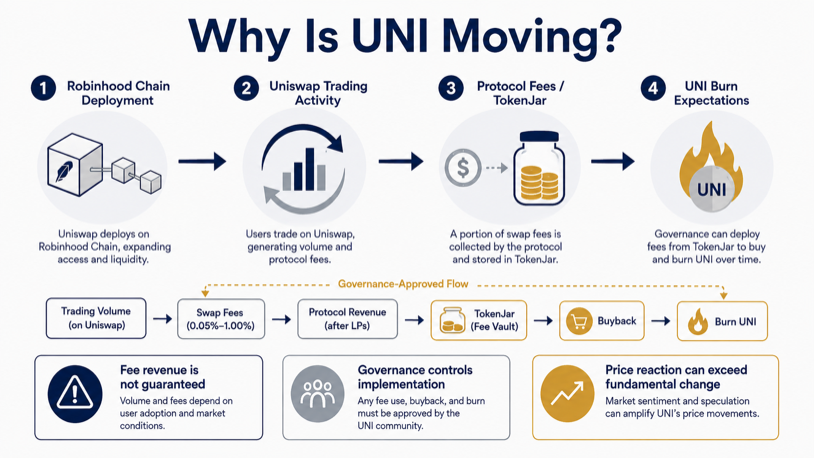
Uniswap’s fee architecture routes protocol fees into TokenJars on supported chains. Searchers can claim accumulated fees by paying UNI, and the bridged UNI is then sent to a burn address on Ethereum mainnet. The mechanism creates a possible link between protocol activity and token supply: more eligible fees can increase the amount of UNI used in the process.
There are important conditions, however. Fees must be enabled on the relevant pools and chains. Trading activity must be genuine and large enough to matter. Governance must maintain the contracts and parameters. Finally, the amount burned must be meaningful compared with circulating supply and daily market demand. A burn mechanism is an economic design, not a guaranteed price floor.
UNI Price Outlook: Support, Resistance and Scenarios
UNI was trading near $6.24 in the latest available price snapshot. The immediate task for bulls is to hold the recent breakout area rather than give back the entire move. A practical framework is to watch the prior consolidation zone as first support and the recent intraday high as nearby resistance. Because crypto markets move quickly, exact levels should be refreshed immediately before publication.
Bull scenario: Robinhood Chain volume remains healthy, Uniswap fees continue to accumulate and UNI closes above its recent high with rising spot volume. That would support a move toward a higher trading range, especially if Bitcoin remains stable.
Base scenario: UNI consolidates after the sharp advance, with traders waiting for fee data and governance follow-through. A sideways range would not invalidate the long-term protocol story, but it would show that short-term momentum has cooled.
Bear scenario: UNI loses the breakout area as DeFi flows reverse, Robinhood Chain activity normalizes or the wider market turns risk-off. In that case, the latest rise could become a momentum spike rather than the start of a sustained trend.
What Could Invalidate the UNI Bullish Thesis?
- Robinhood Chain users or swap volume fall after the initial launch effect.
- Protocol fees remain too small or inconsistent to create meaningful burns.
- Governance execution is delayed or fee parameters change.
- Competing decentralized exchanges capture liquidity and volume.
- Smart-contract, bridge or oracle risks reduce user confidence.
Readers can use Tapbit’s crypto trading guides to review basic market mechanics and the wallet safety guide before interacting with DeFi applications or moving assets across networks.
How to Trade UNI-USDT Futures
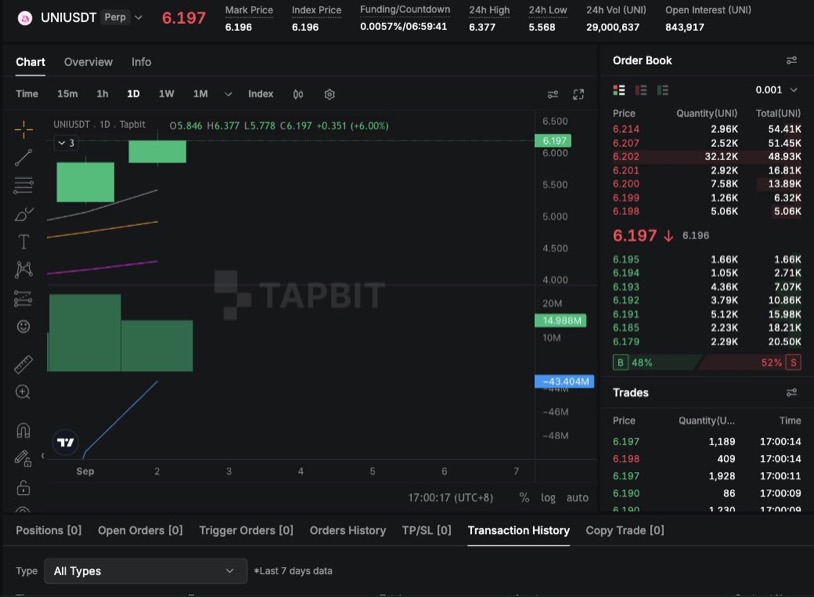
Tapbit offers UNI-USDT perpetual futures for traders seeking long or short price exposure. The contract is a derivative and does not give the trader custody of UNI, Uniswap governance rights, fee distributions or access to the protocol’s on-chain applications.
Before opening a position, review the mark price, index price, funding rate, margin mode and liquidation price. A strong headline can produce rapid reversals, and leverage can turn a normal pullback into a forced liquidation. New users can create an account and inspect the contract details before trading.
Bottom Line
UNI’s rise of more than 13% reflects a mix of Robinhood Chain activity, Uniswap’s fee-and-burn design and renewed DeFi momentum. The most constructive sign would be persistent usage and fee generation after the initial price reaction. Until that is confirmed, UNI remains a high-volatility token whose burn narrative can support expectations but cannot guarantee a specific price target.
FAQ
Why is UNI going up?
UNI rose as traders focused on Uniswap’s Robinhood Chain deployment, protocol fees, the UNI burn mechanism and a broader DeFi rotation.
Does Robinhood Chain activity directly guarantee a UNI price increase?
No. Activity can support fee expectations, but sustained usage, governance execution, market liquidity and broader risk sentiment still determine price.
What is the UNI burn mechanism?
On supported deployments, accumulated protocol fees can be claimed by paying UNI, with the paid UNI routed through the design toward a burn address. The amount depends on actual fee generation and governance settings.
What are UNI-USDT perpetual futures?
They are leveraged derivative contracts that track UNI price exposure. They do not provide UNI ownership, governance rights or protocol access and carry funding and liquidation risk.


