
SpaceX has become one of the most valuable private companies globally, making how to buy SpaceX tokenized stock a question for investors seeking private equity exposure. Unlike traditional stock ownership, tokenized SpaceX products operate on blockchain infrastructure and represent various claim structures—not direct share ownership. Before you invest, understanding product mechanics, platform options and verification steps is essential.
What Is SpaceX Tokenized Stock Before You Buy?
Tokenized SpaceX products operate through several distinct mechanisms, and confusing these structures can lead to purchasing instruments that don't match your investment goals.
Tokenized equity claims represent blockchain-issued tokens backed by contractual rights to SpaceX equity or equity-linked returns. These are issued by private platforms and typically do not grant voting rights or legal ownership of shares.
SPV (Special Purpose Vehicle) interests pool investor capital into a legal entity that holds private shares or equity agreements. Tokens represent your percentage stake in the SPV, not direct SpaceX ownership.
Pre-IPO exposure instruments attempt to track anticipated future IPO valuation without direct equity. These often function as structured notes or derivative contracts that settle based on estimated company value.
Synthetic derivatives use pricing algorithms to mirror SpaceX equity movements without underlying asset backing. These are purely price-tracking instruments and carry counterparty risk.
Important note: None of these products is issued or endorsed by SpaceX unless explicitly verified through SpaceX's official channels. Distinguish between tokenized instruments created by third-party platforms and any official company action.
Where Can You Buy Tokenized SpaceX?
Tokenized SpaceX products are available through several platform types, though geographic restrictions and product availability vary significantly.
Blockchain-native platforms list tokenized equity tokens for trading on decentralized or hybrid exchanges. These typically serve global audiences but may exclude specific jurisdictions due to regulatory frameworks.
Traditional fintech platforms increasingly offer tokenized pre-IPO access through structured products or equity-linked notes, often with regulated custody and clearer legal frameworks.
Decentralized protocols enable peer-to-peer trading of tokenized claims but offer minimal regulatory oversight and variable liquidity.
Regional exchanges in specific jurisdictions may list tokenized SpaceX instruments under local securities or alternative asset classifications.
Platform availability depends on your country, residency status and regulatory category. US resident restrictions, for example, apply to many tokenized equity offerings due to securities regulations. Research both the product issuer and the trading platform's compliance framework before opening an account.
Understanding the broader landscape of crypto and stocks helps clarify why tokenized equity occupies a distinct category between cryptocurrency trading and traditional stock ownership.
Can You Purchase Real SpaceX Stock Through These Products?
Not all tokenized SpaceX products represent real underlying shares. Compare the actual claims you receive:
| Product Type | Underlying Asset | Redemption Rights | Ownership Status | Risk Profile |
|---|---|---|---|---|
| Tokenized Equity Claim | Contractual right to returns | Platform-dependent | Contractual only | Issuer credit risk |
| SPV-Backed Token | Legal equity interest in fund | Subject to fund terms | SPV membership | Liquidity/valuation risk |
| Structured Note | Reference index or company valuation | At maturity or platform terms | Debt claim on issuer | Issuer insolvency |
| Synthetic Price Tracker | None (algorithmic pricing) | Platform discretion | No ownership | Full counterparty risk |
Real private shares grant legal ownership recorded on SpaceX's cap table, provide voting rights and enable direct redemption. These are rarely offered through retail tokenized products because SpaceX equity transfer involves private company consent and legal documentation.
Most tokenized SpaceX instruments sold to retail investors represent indirect claims or synthetic exposure, not equity ownership. Verify the product's actual backing before assuming you've purchased real shares.
How to Verify a SpaceX Tokenized Stock Product
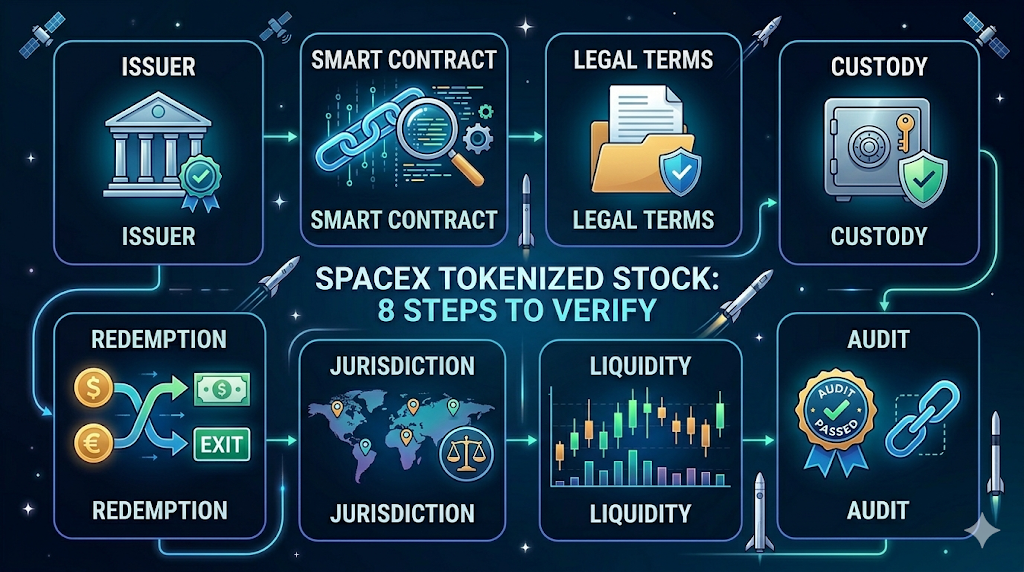
Before purchasing, independently verify these product characteristics:
Issuer and Legal Entity – Research the company issuing the tokenized product. Confirm registration, regulatory licenses and operational history. Check whether the issuer is registered with financial authorities in its jurisdiction.
Smart Contract Address and Code – Request the blockchain contract address if trading on-chain. Review code for features, permissions and custody mechanisms. Some contracts allow the issuer to restrict withdrawals or modify terms unilaterally.
Legal Terms and Documentation – Read the offering document, terms of service and risk disclosure. Clarify whether you own the underlying asset, have redemption rights and receive voting participation.
Custody and Safeguarding – Determine where assets are held. Does the issuer self-custody, use a regulated custodian, or employ multi-signature security? Self-custody creates issuer default risk.
Redemption and Settlement Process – Understand how you exit. Can tokens be redeemed for fiat currency, underlying equity or only traded on the platform? What timeframe and fees apply?
Jurisdiction and Regulatory Status – Confirm where the product is domiciled and whether it's registered as a security, commodity or alternative asset. Regulatory classification affects your legal protections.
Liquidity and Trading Volume – Check real trading volume and bid-ask spreads. Low liquidity can force you to sell at unfavorable prices or lock capital for extended periods.
Independent Audit or Attestation – Some issuers publish reserve audits or smart contract audits. These add credibility but do not eliminate risk.
How to Buy SpaceX Tokenized Stock in 4 Steps
Step 1: Verify Product and Eligibility
Choose a specific SpaceX tokenized product and review all documentation. Confirm your residency is not excluded and you meet minimum investment requirements. Check the SPACEX price information page to understand current market data—note that a price page does not confirm trading availability, legal rights or redemption terms.
Step 2: Create an Account and Fund It
Create an account with the platform offering the product. Complete identity verification and residency certification. Fund your account through accepted payment methods, understanding any minimum deposit thresholds and transfer times.
Step 3: Verify Pair Details and Place an Order
Confirm the token pair, contract address, current price and available liquidity. Understand whether you're placing a market order (immediate execution) or limit order (price-conditional). Review the exact settlement method and any holding period requirements.
Step 4: Confirm Custody, Redemption and Settlement Records
After purchase, verify your position in your account or wallet. Record the transaction hash, settlement confirmation and issuer contact details. Note the redemption process and any conditions requiring future action. Keep documentation for tax and compliance purposes.
What Fees, Liquidity and Order Types Should You Check?
Trading Fees vary by platform and product. Expect percentage-based fees (0.1–1% typical) on purchase and sale, plus any spread between buy and sell prices. Some platforms charge flat transaction fees instead.
Spreads and Slippage occur when market prices move between order submission and execution. Bid-ask spreads (the difference between the highest buyer price and lowest seller price) widen during low-liquidity periods. Market orders execute immediately but at the best available price; limit orders wait for your specified price.
Liquidity Conditions determine how quickly you can sell. High-volume products trade tightly; illiquid tokens may have wide spreads or require extended timeframes to find a buyer. Always check view market data to assess real trading activity.
Price Premiums frequently appear on pre-IPO or tokenized equity products. The token price may significantly exceed estimated underlying asset value due to scarcity, locked-in demand or synthetic pricing models. Understand whether the premium is justified by unique features or represents overvaluation.
Understanding traditional asset categories like the S&P 500 index provides context for comparing tokenized equity valuation and liquidity to public markets.
How to Store, Track or Settle the Position
Exchange Custody vs. Self-Custody – If the platform offers withdrawal to a personal blockchain wallet, you assume self-custody and full responsibility for security. If the platform holds your tokens in exchange custody, you rely on their security and insurance. Neither approach is inherently safer; both involve distinct risks.
Position Tracking – Record your purchase details, average cost and quantity. Monitor price movements through the issuer's platform interface. Some platforms provide portfolio dashboards; others require manual tracking.
Corporate Events – Tokenized equity instruments may be affected by company milestones, funding rounds or (eventually) IPO. Understand how the product adjusts value or terms in response. Some tokens automatically redeem, while others require manual action.
Redemption Process – If your product allows redemption, familiarize yourself with the mechanics. Does it redeem for cash, different tokens or real shares? What notice period applies? Are there minimum or maximum redemption amounts?
Settlement and Tax Records – Keep all transaction confirmations and settlement statements. Tokenized assets trigger capital gains tax obligations and may require specific reporting depending on your jurisdiction. The real-world asset tokenization space, explained through ONDO and RWA tokenization, illustrates how regulatory and tax frameworks continue evolving.
Conclusion
Buying SpaceX tokenized stock begins with understanding that tokenized instruments differ fundamentally from direct share ownership. By distinguishing product types, verifying issuer credentials, assessing platform liquidity and following systematic purchase steps, you reduce the risk of misaligned expectations. Always consult the product's complete legal documentation and consider how tokenized equity fits within your broader investment strategy. For comparative context on traditional equity analysis, review our Palantir stock analysis guide to understand fundamental evaluation approaches applicable across public and tokenized equities.
FAQ
What ticker is used for SpaceX tokenized stock?
Ticker symbols vary by platform. Common abbreviations include SPACEX, SPX or product-specific codes. Always verify the exact contract address and product name rather than relying on abbreviations, as multiple products may use similar tickers.
Can US residents buy SpaceX tokenized products?
Most tokenized SpaceX products are not available to US residents due to securities regulations. US-based platforms offering similar exposure typically structure them differently (as notes or derivatives). Verify your residency against the product's terms before attempting purchase.
Do buyers need a crypto wallet?
Not always. If you purchase through an exchange that custodies your tokens, no personal wallet is required. If the platform offers or requires self-custody, you'll need a compatible blockchain wallet and understand private key management.
Can SPACEX tokens be redeemed for real shares?
Rarely. Most tokenized products allow redemption for cash or platform credits, not direct SpaceX equity. Check the specific product's terms to confirm redemption options. Real share redemption would require SpaceX's approval and transfer of registered securities.


