
What Is the S&P 500 Index?
What is the S&P 500 index? The S&P 500 Index is a U.S. stock market index that tracks 500 leading large-cap public companies listed on U.S. exchanges. It is maintained by S&P Dow Jones Indices, a joint venture majority-owned by S&P Global.
The S&P 500 index is widely regarded as one of the best single gauges of large-cap U.S. equity performance. It covers a broad range of sectors, including technology, healthcare, financials, consumer companies, energy, industrials, and communication services.
The index launched in its current 500-stock form in 1957. Since then, it has become one of the most watched benchmarks in global finance.
Think of it as a scoreboard. It does not show every company in the U.S. market, but it shows a large and important part of it.
How Does the S&P 500 Work?
The S&P 500 is float-adjusted and market-cap weighted.
Float-adjusted means the index focuses on shares available to public investors, not shares tightly held by insiders, founders, or other restricted holders.
Market-cap weighted means larger companies have more influence on the index. A company worth trillions of dollars can move the index more than a smaller member, even though both are included.
| Term | Simple Meaning |
|---|---|
| Float-adjusted | Only publicly available shares are counted |
| Market-cap weighted | Larger companies carry more weight |
| Index level | A calculated number, not a single stock price |
| Ticker references | SPX, .INX, GSPC depending on platform |
This is why the largest companies matter so much. When mega-cap stocks move sharply, the index can move even if many smaller members are flat.
How Do Companies Get Into the S&P 500?
Companies do not enter the S&P 500 automatically just because they are large. A committee at S&P Dow Jones Indices selects constituents using eligibility rules.
Common criteria include:
- The company must qualify as a U.S. company under S&P Dow Jones Indices rules.
- It must trade on a major U.S. exchange.
- It must meet minimum market-cap requirements.
- It must have adequate liquidity.
- It must meet profitability-related requirements.
The exact thresholds can change over time. For example, market-cap requirements are reviewed periodically. That is why readers should check official S&P Dow Jones Indices materials for the latest eligibility details.
Companies can also leave the index. They may be removed after mergers, acquisitions, financial changes, or if they no longer meet the criteria.
Why Is the S&P 500 Important?
The S&P 500 matters because it is a primary benchmark for large-cap U.S. stocks.
Fund managers, analysts, financial media, and policymakers all watch it. When people say "the market is up" or "the market is down," they often mean the S&P 500.
It is also used as a benchmark for many investment products. But the index itself is not something you can buy directly. Investors can gain exposure through products designed to track it, such as funds or derivatives, but those products have their own structures, costs, and risks.
The S&P 500 is powerful because it gives a quick view of broad U.S. market sentiment. Still, it is not the whole economy. It does not include every public company, private business, small-cap stock, or global market.
S&P 500 vs Dow Jones vs Nasdaq
The S&P 500, Dow Jones Industrial Average, and Nasdaq Composite are often mentioned together. They are not the same.
| Index | Companies | Weighting | Main Idea |
|---|---|---|---|
| S&P 500 | 500 | Float-adjusted market cap | Broad large-cap U.S. benchmark |
| Dow Jones | 30 | Price-weighted | Blue-chip stock average |
| Nasdaq Composite | 3,000+ | Market cap | Nasdaq-listed stocks, tech-heavy |
The Dow is older and narrower. It tracks 30 companies and gives more weight to stocks with higher share prices.
The Nasdaq Composite includes many more companies, but it is heavily influenced by technology and growth stocks.
The S&P 500 sits between them in a useful way. It is broader than the Dow and less exchange-specific than the Nasdaq Composite.
Can You Gain Exposure to the S&P 500?
You cannot buy the S&P 500 index directly. It is a calculation.
However, investors can gain exposure through products that seek to track the index, such as index funds, ETFs, futures, and some retirement products. These products are not identical to the index itself. Fees, tracking error, tax treatment, and product structure can affect real returns.
This article is educational only. It does not recommend any product or strategy.
The key point: the S&P 500 is a benchmark first. Products linked to it are separate financial instruments.
Why Crypto Traders Pay Attention to the S&P 500
The S&P 500 does not track crypto. It does not include Bitcoin, Ethereum, stablecoins, or digital asset companies by default.
But crypto traders still watch it because it reflects broad risk appetite. When large-cap U.S. stocks rise, investors may be more willing to take risk. When they fall sharply, traders may become more cautious across many markets.
This does not mean the S&P 500 predicts crypto prices. Correlations change. Sometimes crypto follows stock-market sentiment. Sometimes it moves on its own drivers.
Still, understanding the S&P 500 helps crypto traders read the macro environment. You can view market data on Tapbit to compare crypto conditions across major assets.
How to Track Stock-Linked TradFi Products on Tapbit
Tapbit does not offer direct trading of the S&P 500 index itself. However, traders can use Tapbit's TradFi perpetual products to follow stock-linked market moves that often influence broader U.S. equity sentiment.
For example, users can monitor stock-linked pairs such as NVDA futures, GOOGL futures, AMZN futures, and PLTR futures. These products are not the S&P 500 index, but they can help traders observe major U.S. equity themes inside the TradFi section.
Here is a 4-step workflow:
- Open Tapbit Futures and select TradFi.
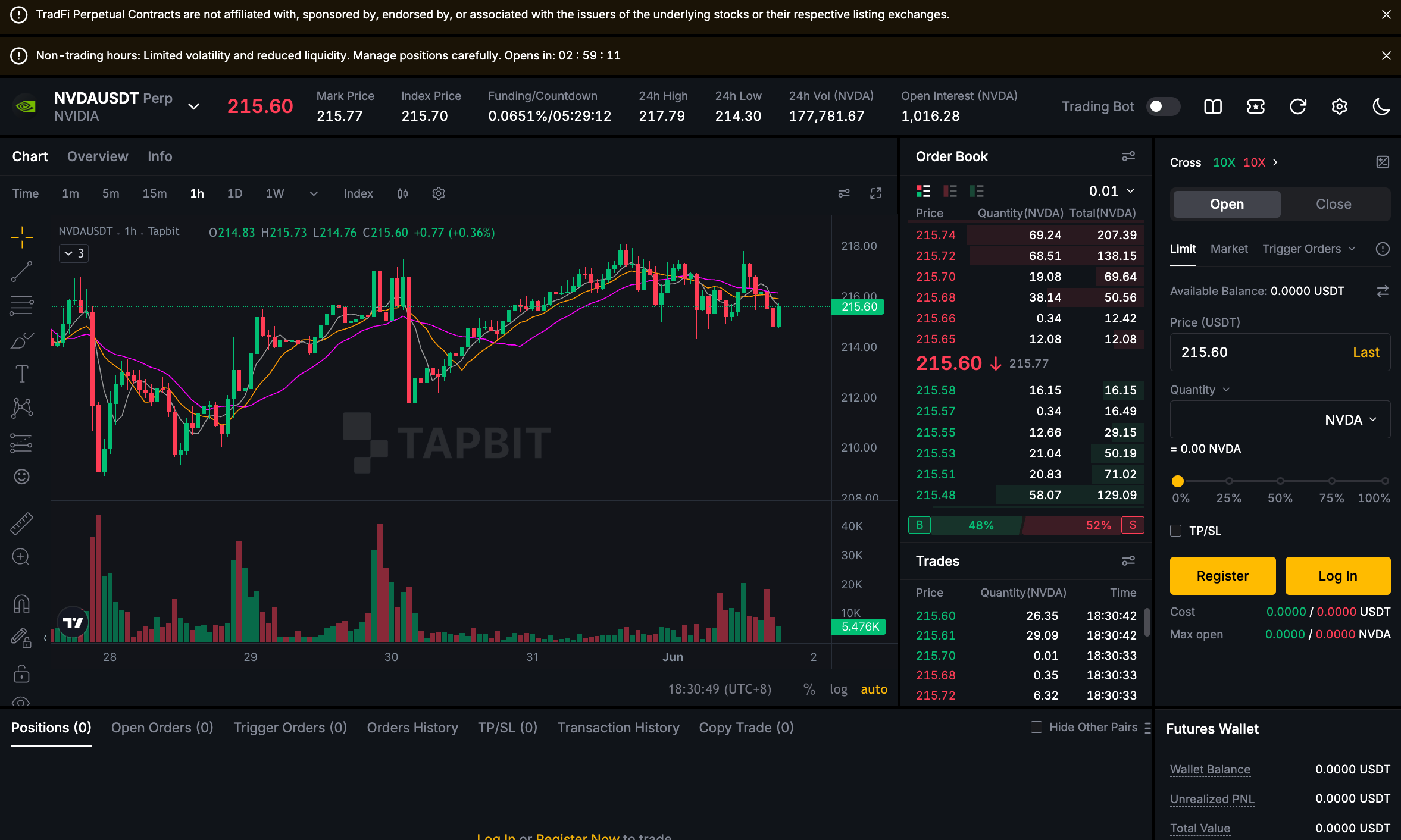
- Choose a stock-linked pair such as NVDA, GOOGL, AMZN, or PLTR.
- Check price, 24H change, 24H volume, and the order book.
- Set margin, leverage, order type, and TP/SL before opening a position.
⚠️ Stock-linked perpetual products are derivatives. They are not the same as holding the underlying stock or buying the S&P 500 index.
Closing
What is the S&P 500 index in simple terms? It is a benchmark that tracks 500 leading large-cap U.S. companies. The S&P 500 index matters because it is widely used to understand broad U.S. stock-market performance, risk sentiment, and macro conditions. It does not tell the whole market story, but it tells a large and important part of it.
FAQ
What does S&P stand for?
S&P stands for Standard & Poor's. The S&P 500 is maintained today by S&P Dow Jones Indices.
Is the S&P 500 the same as the total U.S. stock market?
No. It covers a large portion of available U.S. market capitalization, but it does not include every U.S. stock.
How often does the S&P 500 change its members?
There is no fixed annual schedule. A committee reviews eligibility, and companies can be added or removed when conditions change.
Why do crypto traders watch the S&P 500?
Crypto traders watch it as a broad risk-sentiment signal. It does not predict crypto prices, but it can help show whether investors are taking more or less market risk.
What affects the S&P 500's value?
Company earnings, interest rates, inflation data, employment reports, geopolitical events, and investor sentiment can all affect the index.
Is the S&P 500 dominated by technology stocks?
Technology has become a large part of the index because major tech companies have high market capitalizations. But the S&P 500 still includes many sectors.


