

Tokenized USO sits at the intersection of oil markets, real-world assets, and DeFi. The idea is simple on the surface: create an on-chain asset that gives traders price exposure linked to USO, one of the best-known oil exchange-traded products in traditional finance. In practice, the structure is much more complicated.
Tokenized USO aims to bring oil ETF exposure on-chain, letting users trade or use oil-linked assets inside DeFi. But traders must understand that USO itself tracks crude oil mainly through futures contracts, while tokenized versions depend on issuer credibility, custody, redemption rules, smart contracts, and regulatory access.
For users researching new RWA narratives, tokenized commodities, and crypto market tools, the Tapbit registration page offers a broad entry point to follow digital asset markets. This does not mean every tokenized USO-like asset is listed or endorsed by Tapbit; investors should verify availability, contract details, and issuer disclosures before taking any action.
What Is USO?
USO usually refers to the United States Oil Fund LP, a traditional exchange-traded oil product. It is designed to give investors exposure to changes in the price of light sweet crude oil, mainly through futures contracts and other oil-related investments rather than through direct ownership of physical oil barrels.
This distinction matters. USO is not the same as buying spot crude oil, storing oil, or owning energy infrastructure. It is a financial product that follows oil futures markets, which means performance can be affected by futures curve structure, rolling contracts, management costs, market liquidity, and broader commodity volatility.
Investors can review the official USO fund page for fund-specific details. For general education on exchange-traded funds and exchange-traded products, users can also consult Investor.gov's ETF overview.
What Is Tokenized USO or USOS?
Tokenized USO, sometimes described with ticker-like names such as USOS, refers to an on-chain asset that attempts to mirror, reference, or represent exposure related to USO. Depending on the issuer, it may be structured as a tokenized security, a synthetic asset, a wrapped exposure product, or a DeFi instrument that tracks USO-like pricing through an oracle.
The key point is that “tokenized USO” is not automatically the same thing as the official USO product. A token can use oil or USO-related branding without having direct legal rights to the underlying ETF, without redemption access, and without audited proof of backing. That is why the structure behind the token matters more than the name.
| Asset Type | What It Represents | Main Question to Ask |
|---|---|---|
| Traditional USO | Exchange-traded oil exposure through futures-based fund structure | How does the fund track oil futures? |
| Tokenized USO | On-chain claim, wrapper, or synthetic exposure linked to USO | Who issues it and is it redeemable? |
| Spot crude oil | Physical commodity market exposure | Who stores, delivers, and settles the oil? |
| Oil meme token | Speculative crypto narrative using oil branding | Is there any verified backing at all? |
How Commodity-Backed RWAs Work
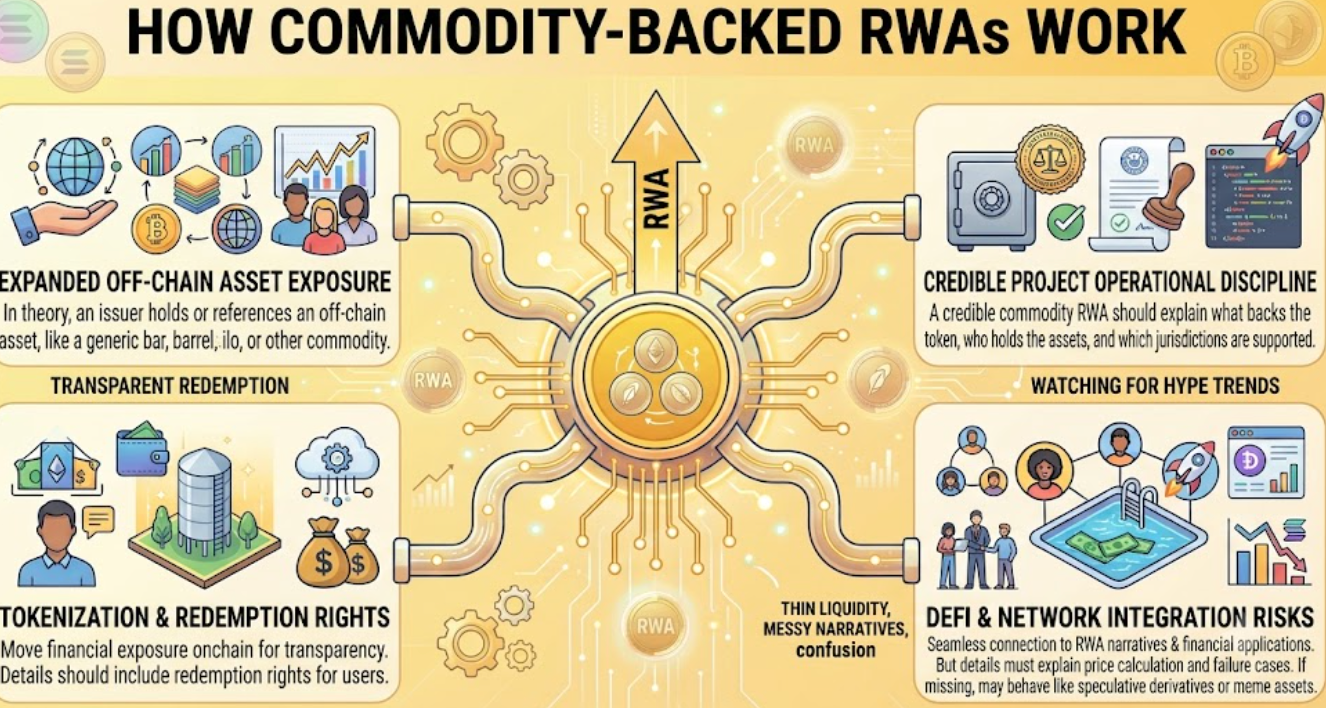
Commodity-backed RWAs bring real-world asset exposure into blockchain markets. In theory, an issuer holds or references an off-chain asset, then issues tokens that represent a claim, a tracking instrument, or a synthetic exposure to that asset. In practice, the quality of the product depends on legal design and operational discipline.
A credible commodity RWA should explain what backs the token, who holds the assets, whether users have redemption rights, which jurisdictions are supported, how prices are calculated, and what happens if the issuer, custodian, or oracle fails. Without those details, the token may behave more like a speculative derivative or meme asset than a transparent RWA product.
Why Oil Exposure Is Moving On-Chain
Oil is one of the world's most actively watched commodities. It reacts to supply cuts, refinery demand, shipping disruptions, inflation expectations, interest rates, and geopolitical risk. Crypto traders are increasingly interested in assets that connect traditional markets with DeFi because they can add new forms of collateral, hedging, and directional trading.
Tokenized oil assets also fit the broader RWA trend. Stablecoins brought cash-like assets on-chain. Tokenized Treasuries brought yield-bearing government debt into DeFi. Tokenized commodities may become another step in that direction, especially if traders want exposure beyond Bitcoin, Ethereum, and crypto-native tokens.
Tokenized USO vs Traditional USO ETF
The biggest difference is legal and operational structure. Traditional USO trades through regulated brokerage channels and follows established fund documentation. Tokenized USO depends on a blockchain issuer and may have different investor eligibility, custody, redemption, and market access rules.
| Feature | Traditional USO ETF/ETP | Tokenized USO or USOS |
|---|---|---|
| Trading venue | Traditional securities markets | Blockchain apps, exchanges, or DeFi venues |
| Exposure source | Oil futures and related fund holdings | Issuer-defined backing or synthetic tracking |
| Custody | Handled through traditional market infrastructure | Depends on issuer, smart contracts, and wallets |
| Redemption | Governed by fund and market rules | May be limited, restricted, or unavailable |
| Risk profile | Commodity, futures, and fund risk | Commodity risk plus issuer, smart contract, oracle, and liquidity risk |
How DeFi Traders May Use Tokenized Oil Assets
If a tokenized USO product is credible and liquid, DeFi traders may use it in several ways. It could be traded against stablecoins, used as collateral in lending markets, paired in liquidity pools, or included in structured products that combine crypto and commodity exposure.
For example, a trader who believes oil prices may rise during a supply shock could prefer an oil-linked token instead of holding only crypto assets. A DeFi protocol could also use tokenized commodities to diversify collateral beyond volatile crypto-native tokens. These ideas are promising, but they rely heavily on accurate pricing and reliable settlement.
Key Risks: Issuer, Custody, Liquidity, Oracle, and Regulation
The main risk is not simply whether oil rises or falls. The bigger question is whether the token actually delivers the exposure investors think they are buying. A tokenized commodity can fail even if the underlying commodity performs well, especially when issuer controls, custody arrangements, or redemption mechanisms are weak.
| Risk | What to Verify | Why It Matters |
|---|---|---|
| Issuer risk | Company identity, legal registration, disclosures | The token depends on the issuer's promises |
| Custody risk | Where assets are held and who audits them | Backing claims need independent verification |
| Redemption risk | Whether users can redeem tokens for underlying exposure | Without redemption, pricing can detach from USO |
| Oracle risk | How USO or oil prices are fed on-chain | Bad data can trigger wrong liquidations or mispricing |
| Liquidity risk | Depth, spreads, volume, and market makers | Thin markets can cause slippage and exit problems |
| Regulatory risk | Eligibility rules and securities or commodities compliance | Access may be restricted by region or investor type |
Is Tokenized USO a Good Investment in 2026?
Tokenized USO may be interesting for traders who understand both commodity markets and DeFi mechanics. It can offer oil-linked exposure in a blockchain-native format, but it should not be evaluated like a simple spot token. The product's legal structure, issuer quality, and redemption design are just as important as the oil price outlook.
A stronger investment case would require transparent documentation, reliable third-party audits, clear redemption rules, deep liquidity, reputable market makers, and well-tested smart contracts. A weaker case would include anonymous teams, vague “oil-backed” language, no proof of assets, no redemption path, and low liquidity.
Final Thoughts
Tokenized USO could become a useful bridge between oil markets and DeFi, but investors should treat every USO-like token as issuer-dependent rather than assuming it is automatically backed, redeemable, or linked to the official USO fund.
The safest research approach is to separate three things: the official USO product, the token issuer's legal claims, and the on-chain market where the token trades. If any one of those layers is unclear, the tokenized USO thesis becomes much more speculative.
FAQ
What is tokenized USO?
Tokenized USO is an on-chain asset designed to provide exposure related to USO or oil-linked markets. Its exact rights depend on the issuer and token structure.
Is tokenized USO the same as USO?
No. USO is a traditional oil fund, while tokenized USO is a blockchain-based asset that may track, wrap, or reference USO exposure.
Does USO hold physical oil?
USO is mainly designed around crude oil futures exposure, not direct ownership of physical oil barrels.
Can tokenized USO be used in DeFi?
Potentially yes, if supported by DeFi protocols. It may be used for trading, collateral, liquidity pools, or hedging, depending on integration and liquidity.
What is the biggest risk of tokenized USO?
The biggest risk is assuming the token is fully backed or redeemable without verifying issuer documentation, custody, redemption rules, oracle design, and legal access.
Is tokenized USO suitable for beginners?
Beginners should be cautious. Tokenized commodity products combine commodity risk, crypto risk, issuer risk, and smart contract risk.
Disclaimer: This article is for educational purposes only and does not constitute financial, investment, legal, or tax advice.


