

Google's Q2 2026 earnings report gave investors two stories at once. The growth story looked strong: Alphabet beat consensus expectations, Google Cloud accelerated, Search remained resilient, and AI continued to shape the company's product roadmap. The cost story was harder to ignore: the company's 2026 capital expenditure guide moved higher again as the AI infrastructure race became more expensive.

For traders watching AI-linked equities, Alphabet's earnings matter beyond one stock. Google sits at the center of search, advertising, cloud computing, consumer AI, enterprise AI, chips, and data center demand. Users who want to follow GOOGL price action can access the GOOGL-USDT contract market on Tapbit while managing leverage and market risk carefully.
The headline result was not simply “good earnings” or “bad earnings.” It was a more complicated signal: AI is helping Alphabet grow, but the cost of competing in AI is rising fast.
Google Q2 2026 Earnings Overview
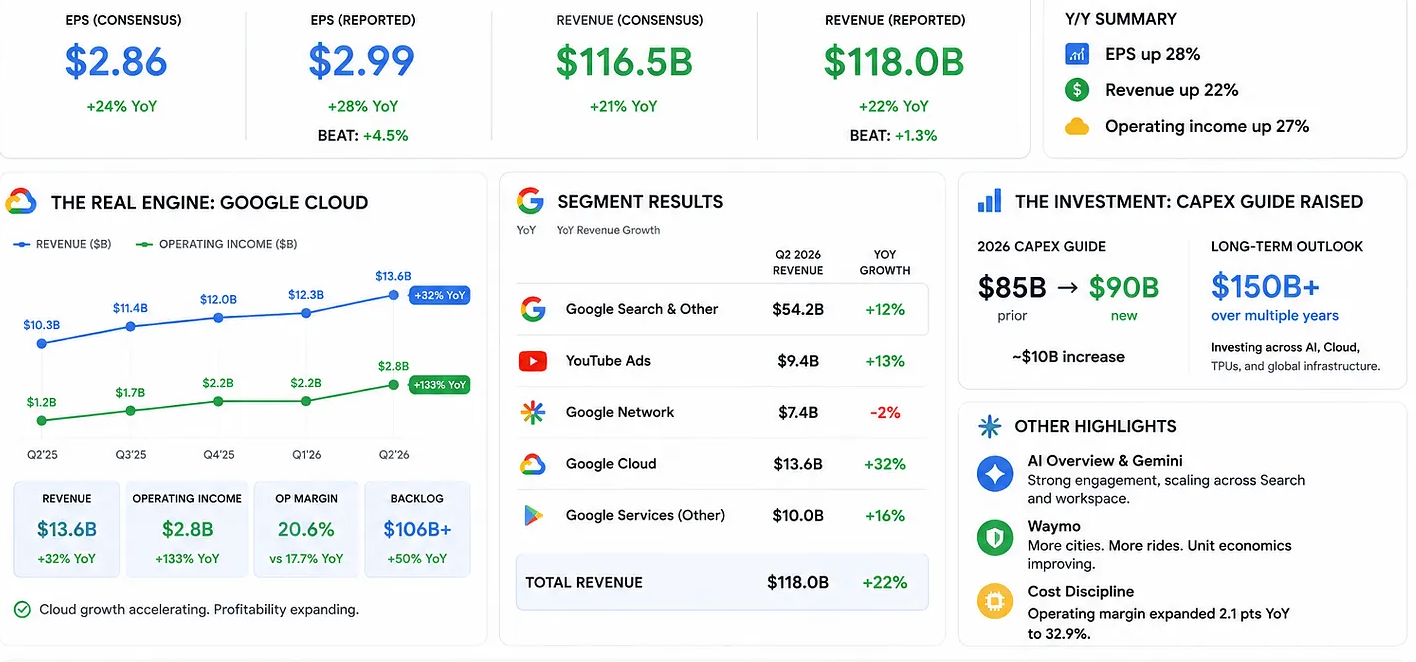
Based on the provided earnings chart, Alphabet reported Q2 2026 revenue of $118.0 billion, above the $116.5 billion consensus estimate. Reported EPS came in at $2.99, above the $2.86 consensus estimate, while revenue increased 22% year over year and operating income rose 27% year over year.
Those numbers explain why the quarter looked strong at first glance. Google is not just defending its existing businesses; it is still growing across several large revenue lines. However, investors quickly focused on the second part of the story: how much Alphabet must spend to keep that AI momentum alive.
| Metric | Consensus | Reported | Signal |
|---|---|---|---|
| EPS | $2.86 | $2.99 | Beat by about 4.5% |
| Revenue | $116.5B | $118.0B | Beat by about 1.3% |
| Revenue growth | - | +22% YoY | Strong top-line expansion |
| Operating income | - | +27% YoY | Profitability still improving |
| CapEx guide | $85B prior | $90B new | AI spending concern |
Google Cloud Was the Real Growth Engine
Google Cloud was the standout segment in the quarter. The chart shows Cloud revenue of $13.6 billion, up 32% year over year, with operating income of $2.8 billion. Cloud operating margin also expanded to 20.6%, suggesting that the business is becoming more profitable as it scales.
This matters because Cloud is one of Alphabet's clearest AI monetization channels. Enterprises need compute capacity, data tools, model infrastructure, cybersecurity, and cloud migration support to build AI products at scale. If that demand continues, Google Cloud could become a larger profit engine rather than a secondary business behind Search.
The backlog figure shown in the chart, above $106 billion, also points to longer-term demand. Backlog does not guarantee perfect future execution, but it shows that customers are committing to Google Cloud services at scale.
Search and YouTube Still Look Resilient
One of the biggest questions facing Google is whether AI answer engines will weaken Search. The Q2 segment breakdown suggests that this has not happened in a dramatic way. The chart shows Google Search & Other revenue of $54.2 billion, up 12% year over year. YouTube Ads reached $9.4 billion, up 13% year over year.
That resilience matters because Search still funds much of Alphabet's AI expansion. If the core advertising business remains healthy, Google can afford to invest aggressively. If Search monetization weakens, the same CapEx plan could look much more dangerous.
Google Network was the weaker line, down 2% year over year, but it was not large enough to change the broader message of the quarter: the company's main advertising engines are still performing.
Why CapEx Fears Hit Investor Sentiment
The biggest concern in Alphabet's Q2 2026 report was capital expenditure. The provided chart shows the 2026 CapEx guide moving from $85 billion to $90 billion, with a long-term outlook above $150 billion over multiple years. That is a major spending signal.
The market is no longer asking whether AI is important. It is asking whether the return on AI spending will justify the scale of investment. That question is especially relevant for mega-cap technology stocks, where expectations are already high.
Heavy CapEx can be bullish when it creates defensible infrastructure, stronger products, and future revenue. It can be bearish when spending rises faster than monetization, compresses free cash flow, or forces companies into an endless arms race.
AI Growth vs Free Cash Flow Pressure
Google's AI strategy requires massive investment before all revenue benefits are fully visible. That creates a timing gap. Investors see the spending now, but the payoff may arrive gradually through Cloud growth, better ad tools, consumer subscriptions, enterprise AI products, and productivity improvements.
This is why free cash flow matters. If AI spending keeps expanding, the market will want evidence that margins and cash generation can remain strong. Alphabet has the balance sheet to absorb large spending, but investors still want discipline.
What Could Push Google Stock Higher?
Google stock could benefit if Cloud growth remains strong, Search monetization proves durable, AI products gain adoption, and management shows that CapEx will create measurable returns. Investors may also reward Alphabet if AI improves ad targeting, automation, and enterprise productivity without damaging margins.
Another possible catalyst is clarity. If management can explain when AI infrastructure spending may normalize, or how current spending maps to future revenue, investors may become more comfortable with the investment cycle.
What Could Pressure Google Stock?
The main risk is that AI costs rise faster than AI revenue. Competition from Microsoft, OpenAI, Meta, Amazon, Anthropic, and other AI players remains intense. If every major technology company keeps raising infrastructure spending, returns could become harder to predict.
Regulatory pressure is another risk. Google continues to face antitrust scrutiny in multiple areas, and any structural changes to Search, ads, or app distribution could affect investor confidence.
What Google Earnings Mean for AI Stocks and Crypto Traders
Alphabet's Q2 earnings also matter for broader risk sentiment. AI spending affects semiconductor demand, cloud providers, energy infrastructure, data center construction, and high-growth technology stocks. It can also influence crypto market sentiment, especially AI tokens and high-beta digital assets.
For crypto traders, the lesson is that narratives need numbers. AI remains one of the strongest market themes in 2026, but investors are increasingly focused on revenue, cash flow, margin durability, and real adoption.
Final Verdict
Google Q2 2026 earnings showed real AI momentum, especially in Cloud and core product integration. Alphabet remains one of the strongest companies in the AI race, with distribution, infrastructure, data, talent, and financial resources that few competitors can match.
Still, the market's reaction shows that AI leadership is not free. CapEx fears are likely to remain a central issue until investors see clearer evidence that Google's AI spending can produce durable returns. For long-term investors, Alphabet still has a powerful AI story. For short-term traders, volatility may stay elevated as the market weighs growth against spending.
FAQ
Did Google beat Q2 2026 earnings expectations?
Based on the provided earnings chart, yes. Reported EPS and revenue both came in above consensus estimates.
Why were investors worried after Google earnings?
Investors focused on rising AI-related capital expenditure and whether future returns will justify the scale of infrastructure spending.
Why is Google Cloud important?
Google Cloud is one of Alphabet's clearest AI monetization channels, driven by enterprise demand for AI infrastructure, data tools, and cloud services.
Is AI good for Google stock?
AI is a major long-term growth driver, but it also requires heavy spending. The investment case depends on whether AI revenue and margins can scale faster than costs.
What is the biggest risk for Alphabet after Q2 earnings?
The biggest risk is that AI CapEx keeps rising while investors wait for clearer proof of long-term returns.


