
GMGN built its reputation on a simple premise: identify new memecoins before broader market attention arrives.
In its early phase, that meant tracking Solana launches, flagging active wallets, and helping traders move quickly when a token started gaining traction. The platform now operates differently. Robinhood Chain has become its largest source of trading volume, BSC has overtaken Solana, and GMGN is providing AI agents with direct access to its market data and trading tools.
The shift is driving real volume — and also reshaping the risk factors traders need to understand
Solana Is No Longer GMGN’s Main Growth Engine
GMGN still supports Solana, but its recent numbers are being driven elsewhere. GMGN processed approximately $3.31 billion in DEX volume over the latest 30-day period. Robinhood Chain contributed about $1.53 billion, while BSC accounted for another $1.36 billion. Solana generated roughly $220 million.
To put it simple, Robinhood Chain and BSC represented close to 87% of GMGN’s tracked monthly volume.
The speed of this change matters. Robinhood Chain launched on July 1, 2026, and GMGN says it added trading support within days. When tokens such as CASHCAT attracted speculative demand, traders could use GMGN’s existing charts, wallet labels and execution interface without learning a new terminal.
That ability to follow liquidity from one chain to another is becoming GMGN’s main advantage. Memecoin activity rarely stays in one ecosystem for long. A terminal that depends entirely on Solana risks losing users when attention moves to BSC, Base or a newly launched network.
GMGN is trying to remain useful regardless of where the next speculative cycle appears.
The Business Model Is Working
GMGN does not need a native token to generate revenue. It charges a 1% handling fee on trades executed through the platform.
DefiLlama tracked approximately $37.96 million in GMGN fees and $30.96 million in protocol revenue over 30 days. The difference largely reflects referral commissions, although DefiLlama estimates part of the EVM referral data using the rate observed on Solana.
The volume figure has limitations as well. DefiLlama counts swaps it can decode and associate with GMGN’s fee collectors. Transactions routed through venues that its data system cannot identify may be excluded, meaning the reported volume should be treated as a tracked minimum rather than a complete audit.
Even with that caveat, the numbers show that traders are willing to pay for faster discovery and a more convenient interface. GMGN’s challenge is keeping that activity when the current Robinhood Chain and BSC trading wave cools.
GMGN Is Turning Its Data Into AI Infrastructure
The “AI” in GMGN originally felt secondary to its trading terminal. That is becoming less true.
GMGN now offers an Agent API and a public set of GMGN Skills that allow compatible AI agents to query on-chain data through natural-language instructions. The tools can retrieve trending tokens, price charts, liquidity information, wallet holdings and recent Smart Money activity.
An authorized agent can also submit swaps, place limit orders and manage take-profit or stop-loss instructions. Market data queries currently cover Solana, BSC, Base and Ethereum, while the documented trading functions mainly support Solana, BSC and Base.
This turns GMGN from a screen traders watch into infrastructure other software can call.
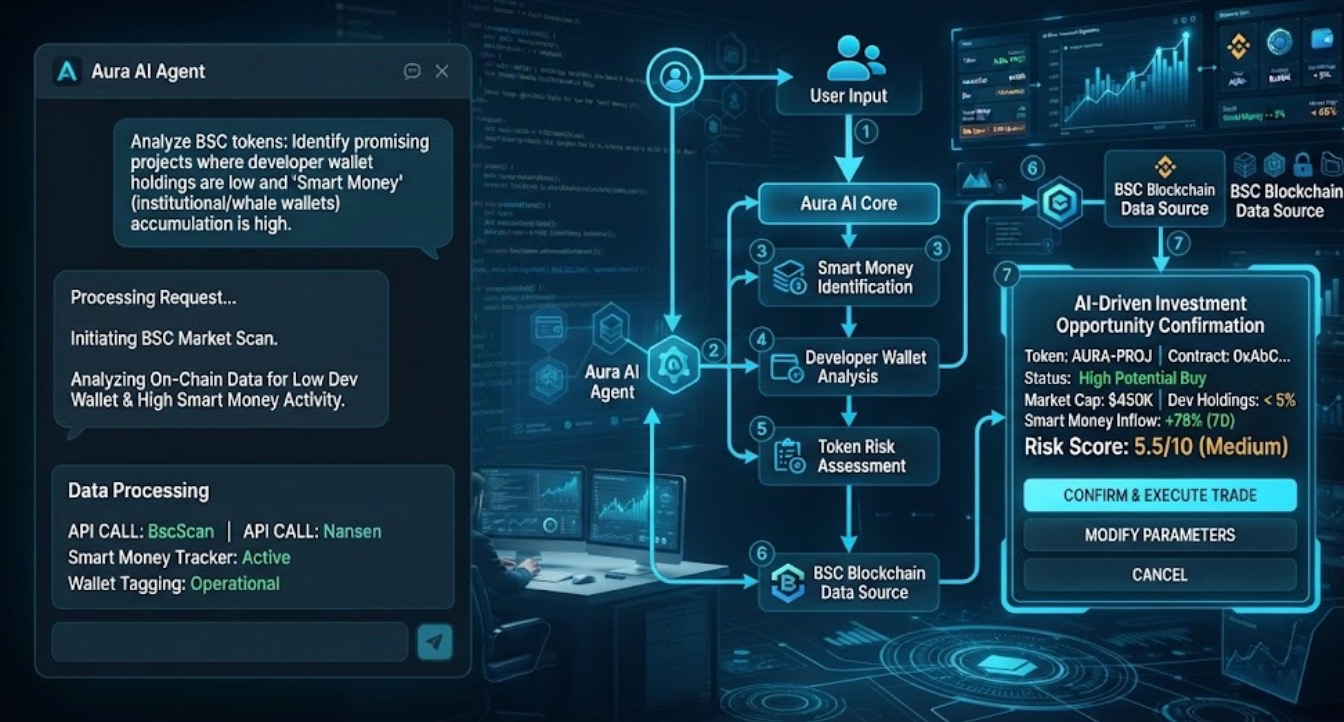
A user could ask an agent to find recently launched BSC tokens with rising volume, low developer holdings and several Smart Money buyers. The agent could then compare holders, check common contract warnings and prepare an order.
That process is faster than checking each signal manually. It is not necessarily more accurate.
GMGN’s own documentation warns that AI agents can make mistakes. Before approving a trade, users are expected to verify the network, token contract, order size and slippage. An agent that misreads one field can execute a valid blockchain transaction for the wrong asset, and valid transactions are usually irreversible.
Smart Money Is a Lead, Not a Verdict
Wallet labels are still central to the GMGN experience. The platform analyzes public transaction histories and classifies addresses as Smart Money, KOL, Sniper, Developer, Insider or other categories. Traders can inspect a wallet’s holdings, win rate, realized profit and recent transactions before deciding whether its activity is meaningful.
That is more useful than treating every social-media post as evidence. It still leaves important gaps.
A wallet may distribute activity across several addresses. Its visible position may be hedged elsewhere. Historical profits may come from early access that followers cannot reproduce. A trader who knows an address is being copied may also buy a thinly traded token and sell into the demand generated by followers.
The label tells users what an address did. It cannot establish why the trade was made or whether copying it later offers the same risk and reward.
Security Tools Cannot Verify the People Behind a Token
GMGN displays contract warnings, holder concentration, developer activity, suspected insider wallets and possible honeypot behavior. Depending on the network, some of this information comes from external security providers.
These checks can catch common technical problems. They cannot confirm that a project team is honest, that liquidity will remain available or that large holders will not sell.
GMGN has launched a public vulnerability bounty covering its website and mobile applications through HackenProof. The program offers rewards for qualifying security reports, including vulnerabilities affecting user funds or private keys.
A bug bounty is a useful security measure, but it is not a guarantee. Users granting trading permissions to an AI agent should consider using a separate wallet with limited funds instead of exposing their main holdings.
Phishing remains another practical threat. The official platform uses the gmgn.ai domain. Lookalike websites, unofficial Telegram accounts and supposed support agents should not be trusted with wallet credentials.
GMGN Has Not Announced an Official Token
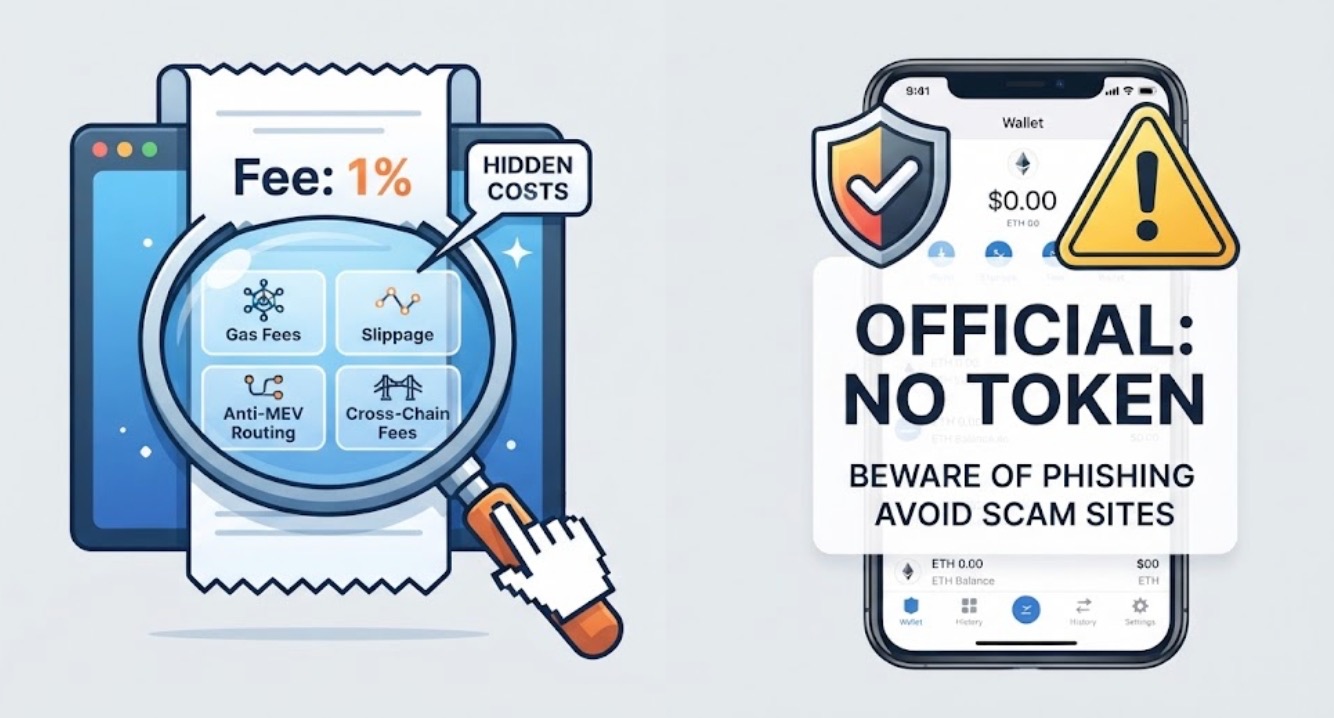
No official GMGN token, token generation event or airdrop was found in the platform’s current website, documentation or public Agent Skills repository at the time of writing.
Tokens using the GMGN name already exist on decentralized markets, but a familiar name does not establish a connection with GMGN.AI. Until an announcement appears through the platform’s verified channels, claims involving an official GMGN token or claim page should be treated as unverified.
This distinction matters because interest in a successful trading platform often creates opportunities for impersonators.
GMGN’s Next Test Comes After the Current Memecoin Wave
The latest figures show that GMGN is no longer just a Solana analytics tool. It has become a multichain execution business with meaningful fee revenue and a growing role in AI-assisted trading.
Its expansion also makes the company more dependent on speculative activity. Most recent volume came from Robinhood Chain and BSC, while individual Memecoin cycles can fade quickly. If liquidity moves again, GMGN will need to follow it without sacrificing execution quality or data accuracy.
The Agent API could give the platform a more durable role. Developers and traders may continue using reliable wallet and market data even when one chain loses momentum. But allowing agents to execute trades introduces a harder standard: a data error is no longer just a bad chart. It can become an on-chain transaction.
GMGN has proved that traders will pay to move faster. The longer-term question is whether it can make that speed dependable.
Tapbit Learn follows the tools, networks and market structures shaping on-chain trading. Readers can explore more research through Tapbit and review current market access after creating an account.
Frequently Asked Questions
What is GMGN.AI used for?
GMGN.AI is a multichain trading terminal focused on discovering new tokens, tracking wallets, analyzing holders, checking common contract risks and executing on-chain trades.
How much trading volume does GMGN process?
DefiLlama recently tracked approximately $3.31 billion in GMGN DEX volume over 30 days. The figure is not a financial audit and may exclude transactions that its methodology cannot decode.
Which chain generates the most GMGN activity?
Robinhood Chain was the largest source of tracked GMGN volume in the latest 30-day snapshot, followed by BSC. Solana represented a much smaller share despite its importance to GMGN’s earlier growth.


