

The September 2026 Fed decision looks closely contested in the supplied prediction-market snapshot. Polymarket displays a 54% probability for a 25-basis-point increase and 46% for no change, with cuts and a larger increase below 1% each. That is a narrow market preference for a hike, not confirmation of what the Federal Reserve will do.
For Bitcoin and Ethereum, the important question is how the announcement changes expectations for borrowing costs beyond September. A widely anticipated hike can produce a smaller reaction than a surprise in the statement. A hold can still unsettle crypto markets if officials leave the door open to further tightening.
When Is the September Fed Decision?
The Federal Reserve’s September calendar schedules the FOMC meeting for September 15–16, 2026. The decision is scheduled for September 16 at 2:00 p.m. U.S. Eastern time, followed by a press conference at 2:30 p.m. In UTC+8, those times fall at 02:00 and 02:30 on September 17.
The screenshot selects September 16 but also displays September 15 in its lower event metadata. The official Fed calendar should determine when readers expect the policy announcement; a prediction platform’s date label should not replace it. Traders also need to distinguish the initial decision from the subsequent explanation, which can change the market’s interpretation.
What the 54% Hike Probability Actually Means
The supplied Polymarket image shows a near-even split between a quarter-point increase and unchanged rates. A basis point is one hundredth of a percentage point, so 25 basis points means a 0.25-percentage-point move. These figures describe the market shown in the image. Its capture time is not provided, and the numbers should not be presented as continuously updated odds.
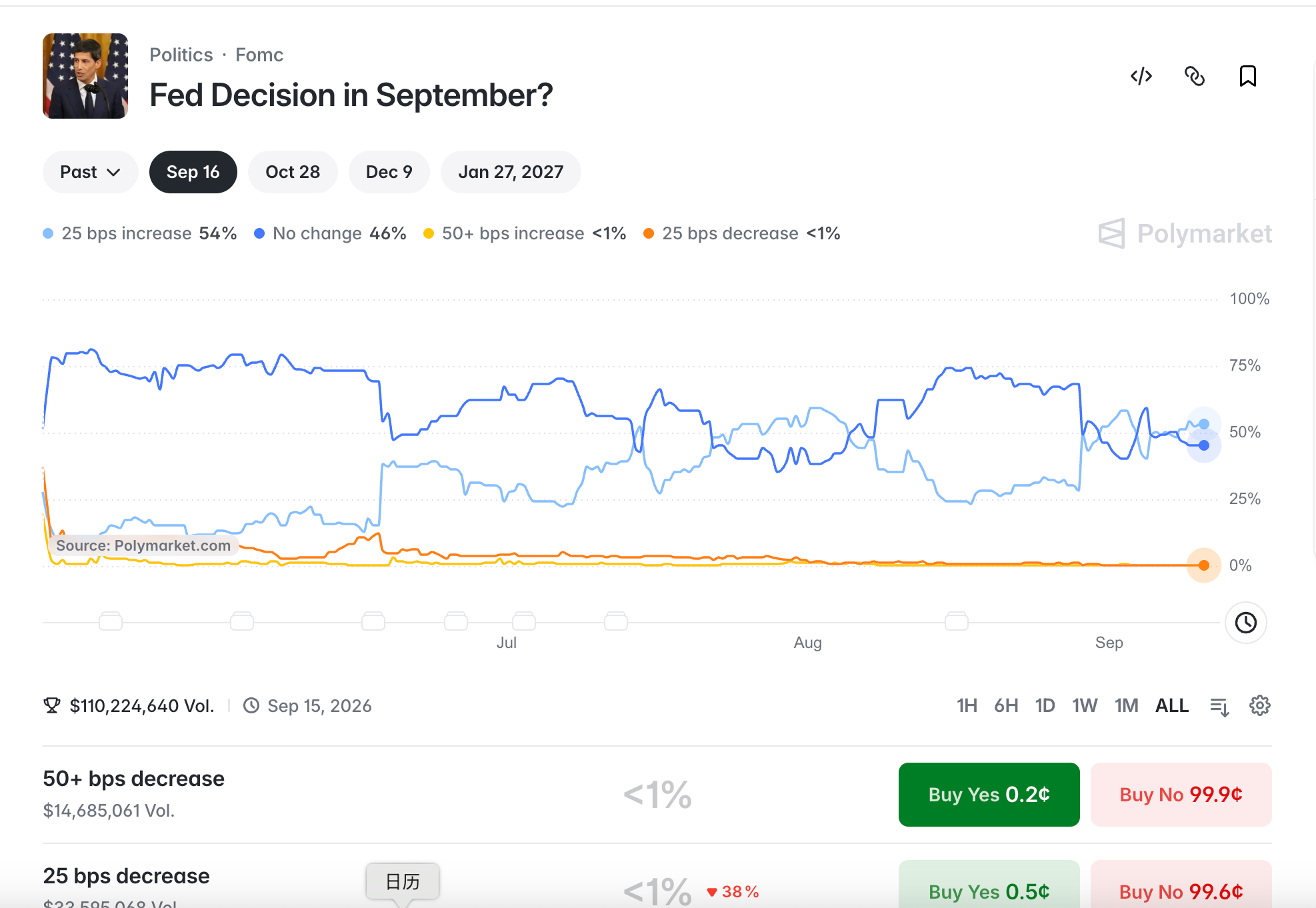
Source: user-supplied Polymarket screenshot. Probabilities and trading volume are a point-in-time snapshot, not an official Fed forecast.
| Decision outcome | Displayed probability |
|---|---|
| 25 bps increase | 54% |
| No change | 46% |
| 50+ bps increase | Below 1% |
| 25 bps decrease | Below 1% |
| 50+ bps decrease | Below 1% |
Prediction prices reflect participants’ positioning and the contract’s settlement rules. They are not a representative survey of economists or a direct reading of policymakers’ intentions. The image also reports $110,224,640 in event volume. Cumulative turnover is different from available liquidity: it does not show how much a trader could buy or sell at the quoted price. Rounded probabilities may not add neatly to 100%.
What Would Strengthen the Case for a Hike or a Hold?
A hike would be easier to justify if inflation pressures were proving persistent, demand remained resilient and policymakers judged existing restrictions insufficient. A stronger-than-expected inflation release could shift expectations even without changing the broad economic picture. The key distinction is between one noisy observation and evidence of a sustained trend.
The case for holding would strengthen if inflation were easing or employment and spending were cooling enough to warrant patience. Keeping rates unchanged would allow officials to observe the delayed effects of earlier policy decisions. These are conditional scenarios, not claims about the latest economic releases. The supplied odds alone do not establish which inflation, employment or financial-stability argument is driving the debate.
Why Bitcoin and Ethereum May React Differently Than Expected
Higher expected interest rates can make cash and interest-bearing assets more competitive, raise financing costs and reduce investors’ willingness to take risk. Crypto can be sensitive to that repricing because sentiment and leveraged positioning can move quickly. But the rate decision is only one input alongside spot demand, fund flows and asset-specific developments.
A 25-basis-point hike accompanied by reassurance that further increases are unlikely could be received less negatively than an unchanged rate paired with a tougher outlook. Likewise, an unexpected cut would not automatically be bullish if investors interpreted it as a response to deteriorating economic conditions. Ethereum may also respond to changes in on-chain demand and its own market positioning, so Bitcoin’s reaction is not a reliable template for every token.
Three Ways the Announcement Could Unfold
In a hike-and-tightening scenario, both the decision and the guidance point toward restrictive policy lasting longer. Rising Treasury yields and a stronger dollar would be consistent with that interpretation. Crypto could face pressure, particularly if leveraged buyers had positioned for a hold. This is a risk scenario, not a forecast of a specific Bitcoin price.
In a hold-with-caution scenario, officials leave rates unchanged but remain concerned about inflation. An initial relief rally could fade if the press conference suggests a hike has merely been postponed. In a hold-with-softer-guidance scenario, less concern about further tightening could support risk appetite, provided the message does not simultaneously signal a sharper growth slowdown. The distinction is the expected path of policy, not just the September number.
What to Watch Beyond the First Price Move
The first reaction can reflect automated trading and thin order books before investors have absorbed the full message. Comparing the policy statement with the press conference helps separate a headline-driven move from a more durable reassessment. Treasury yields, the dollar and crypto spot activity can offer context, although agreement across those markets does not guarantee that a trend will continue.
For derivatives traders, volatility adds execution risk to directional risk. A stop order may fill away from its trigger, funding costs may change, and liquidation can occur before an expected reversal. Prediction-market odds do not reveal where those liquidation levels sit. A small probability attached to an outcome also does not make the potential loss from that outcome small.
Conclusion
The September Fed decision is a hike-versus-hold question in the supplied snapshot, with 54% assigned to a quarter-point increase and 46% to unchanged rates. The official announcement is scheduled for September 16. Neither the odds nor the headline decision alone settles the outlook for crypto.
The stronger framework is to compare the outcome and guidance with expectations, then assess whether broader markets confirm the initial interpretation. This article is for informational purposes only and does not constitute financial advice. Crypto assets and derivatives are volatile; verify current information and assess risk before trading.
FAQ
Will the Fed raise rates in September 2026?
The supplied snapshot slightly favors a 25-basis-point hike, but it does not establish the outcome. The decision remains uncertain before the announcement.
Does 54% mean the Fed has confirmed a hike?
No. It is a displayed prediction-market probability, not an official commitment or a guarantee.
Would unchanged rates be good for Bitcoin?
Possibly, but the reaction depends on expectations and guidance. A hold accompanied by a warning about future increases could still weigh on sentiment.
Is prediction-market volume the same as liquidity?
No. Volume measures trading over a period. Liquidity concerns the size and prices currently available for execution.


