

The CLARITY Act can still pass in 2026, but the September Senate vote will not decide the bill’s fate by itself. The immediate question is whether senators can assemble enough support to begin formal consideration of H.R. 3633. That procedural hurdle matters because it will show whether a bipartisan market-structure deal exists, yet several additional steps would remain before the legislation could become law.
For crypto traders, the distinction is important. A successful vote could improve sentiment around regulatory clarity, while a failed vote could delay the bill without necessarily killing it. Anyone reacting to the headlines should focus on the vote being taken, the amendment process and the final text rather than treating every procedural win as enactment.
Readers who want to follow crypto-market reactions can create a Tapbit account, but political-event volatility can be sharp and should not be mistaken for a guaranteed trading opportunity.
The September 15 Vote Is Not Final Passage
The Senate schedule indicates that the cloture motion on the motion to proceed to H.R. 3633 is set to ripen on September 15, 2026. In plain English, senators are expected to vote on whether to limit debate and move toward considering the bill. This is a gateway vote, not a vote that sends the CLARITY Act to the president.
Cloture generally requires 60 votes in the Senate. That threshold makes bipartisan support essential. Even if cloture succeeds, senators may still debate amendments, negotiate provisions and hold a later vote on passage. If the Senate approves a version that differs from the House bill, the two chambers would also need to resolve those differences.
Where the CLARITY Act Stands Now
The House passed H.R. 3633 in 2025. The Senate Banking Committee later released its market-structure text and advanced the measure by a 15–9 vote in May 2026. That committee result demonstrated meaningful support, but it did not prove that 60 senators would support the procedural motion or that a majority would back the final package after amendments.
The difficult issues are no longer limited to whether the United States needs crypto rules. Senators disagree over how those rules should be written and enforced. Democratic committee members have raised concerns involving consumer protection, ethics, national security and financial stability. Supporters argue that defined jurisdiction and registration paths would replace regulation through uncertainty. Those disagreements can influence both the vote count and the time needed to finish the bill.
What the Bill Would Change for Crypto Markets
The CLARITY Act is designed to create a clearer federal framework for digital-asset markets. Its central purpose is to divide responsibilities between the Securities and Exchange Commission and the Commodity Futures Trading Commission, while establishing disclosure, registration and market-conduct requirements for covered assets and intermediaries.
For exchanges, brokers, token issuers and investors, clearer classifications could reduce some legal uncertainty. That does not mean every token would automatically become a commodity or receive regulatory approval. The practical effect would depend on the final definitions, agency rulemaking and how individual projects satisfy disclosure and decentralization tests.
A durable framework could encourage institutions that have waited for clearer rules. On the other hand, strict compliance obligations could increase costs, restrict some listings or pressure projects that cannot meet the new standards. The bill is therefore not simply “pro-crypto” or “anti-crypto”; the details determine which business models benefit.
What Polymarket’s 15% Odds Actually Mean
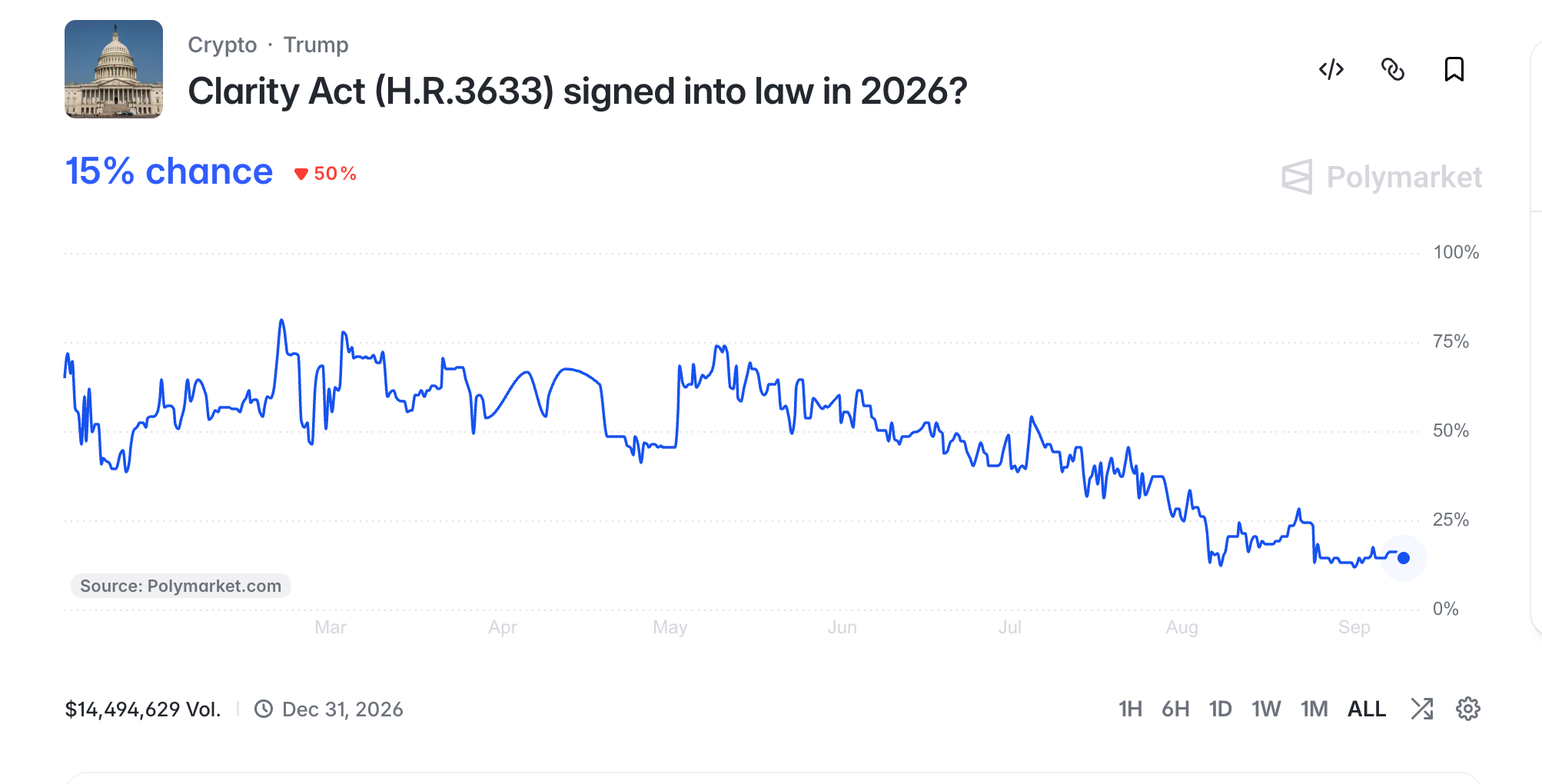
The supplied Polymarket chart showed a 15% market-implied chance that the CLARITY Act would be signed into law during 2026. It also showed that the probability had fallen sharply. That number represents the prices and expectations of prediction-market participants at the time of the screenshot. It is not an official Senate forecast, a polling average or proof that the bill has only a 15% chance of clearing the September procedural vote.
The market asks about enactment by year-end, a much harder outcome than winning one cloture vote. Traders must account for Senate debate, possible amendments, reconciliation with the House, presidential action and the limited legislative calendar. Prediction-market odds can also swing on relatively small pieces of news and should be read as sentiment, not certainty.
The chart below captures that market view ahead of the September vote.
Three Paths From the September Vote
Cloture succeeds and negotiations accelerate
This would be the clearest positive signal. It would show that at least 60 senators are willing to move the measure forward. The market could interpret that as progress, but passage would still depend on amendment votes, the final coalition and the remaining calendar.
Cloture fails but talks continue
A failed procedural vote would expose gaps in the coalition. Leadership could revise the text, negotiate another agreement or schedule a later attempt. The bill would face a tighter timetable, although failure on September 15 would not automatically end the legislative effort.
The bill slips beyond 2026
If negotiations consume too much time, enactment could move into a later Congress. That outcome would create additional uncertainty because committee leadership, political priorities and the bill text could change. This timing risk helps explain why the prediction market can assign low odds to year-end enactment even when the proposal remains active.
What Crypto Traders Should Watch
The first signal is the cloture vote count. A result near or above 60 would reveal the size of the coalition; a narrow failure would look different from broad opposition. The second is the amendment list, especially changes involving SEC and CFTC authority, token classifications, custody, disclosure rules, anti-money-laundering obligations and consumer protections.
Traders should also watch whether the Senate text matches the House version closely enough to avoid a prolonged reconciliation process. Finally, the calendar matters. Every additional negotiation reduces the time available for both chambers to approve identical language before the end of the year.
Bitcoin and large-cap altcoins may react first because they are the most liquid expressions of crypto-market sentiment. Smaller tokens can move more violently, but the legislation’s long-term effect will vary by asset and business model. A headline-driven rally or selloff does not establish the bill’s final economic impact.
Conclusion
The CLARITY Act remains alive, and the September 15 vote is a meaningful test of Senate support. It is not the finish line. Reaching the president in 2026 would require a successful procedural vote, workable amendments, final Senate passage and agreement with the House on identical text.
The most defensible conclusion is that passage is possible but uncertain. Polymarket’s 15% reading reflects the difficulty of completing the entire process before year-end, not a definitive judgment on the bill or the September vote. Investors should separate legislative milestones from political headlines and avoid treating any single probability or vote as a guaranteed market signal.
FAQ
When is the CLARITY Act Senate vote?
The Senate schedule lists September 15, 2026, for the cloture motion on the motion to proceed to H.R. 3633. Scheduling can change, so readers should check the official Senate calendar for updates.
Does a successful cloture vote mean the bill has passed?
No. It would allow the Senate to advance toward consideration while limiting debate. Amendments and a separate passage vote could still follow.
How many Senate votes are needed?
Cloture generally requires 60 votes. Final passage is usually decided by a simple majority, although the exact path can depend on Senate procedure and any agreements reached by leadership.
Could the CLARITY Act still pass after September?
Yes. A September vote is one stage of the process. Negotiations and later votes could continue, but the remaining 2026 calendar becomes a larger constraint as delays accumulate.
What could the bill mean for Bitcoin and altcoins?
Clearer federal rules could reduce uncertainty for compliant market participants, but the effect would not be uniform. The final definitions, agency authority and implementation rules would determine which assets and businesses benefit or face higher costs.
This article is for informational purposes only and does not constitute legal, financial or investment advice. Crypto assets and prediction markets involve substantial risk.


