
Ethereum's developer lead is facing new pressures. Solana is attracting new builders, Layer 2 networks are developing distinct identities, and several senior figures have left the Ethereum Foundation. Those developments have fed talk of an "Ethereum developer exodus."
It's a catchy phrase, but the data tells a more nuanced story.
Ethereum remains the center of the largest smart contract ecosystem. What has changed is how developers operate — they're working across multiple chains, moving applications to Layer 2s, and choosing infrastructure based on product needs. Ethereum isn't losing developers. It's losing the assumption that those developers would stay exclusively within its ecosystem.
Ethereum’s Developer Base Is Still Growing
The latest available figures do not show a collapse in Ethereum-compatible development.
The broader EVM ecosystem recorded approximately 10,514 monthly active developers and 3,646 full-time developers as of August 5, 2026. The dashboard showed year-over-year growth of roughly 53% in monthly developers and 43% among full-time contributors.
These numbers cover the EVM stack rather than Ethereum mainnet alone. That distinction matters because the category includes developers working on Ethereum-compatible networks and Layer 2 ecosystems.
Even so, the figures make one point clear: development around Ethereum technology has not dried up.
Developer counts also overlap. A programmer contributing to Ethereum, Base and Arbitrum may appear in several ecosystem datasets. Electric Capital previously found that about one-third of crypto developers worked across multiple chains. Comparing headline totals without checking the methodology can therefore create a misleading picture.
Developers Are Diversifying, Not Simply Leaving

Ethereum once served as the default destination for smart contract developers. That position is no longer automatic.
Solana has become a serious competitor, particularly among developers building trading applications, consumer products, payments and memecoin infrastructure. Networks such as Sui and Aptos are also competing through different programming models and integrated execution environments.
The decision is increasingly practical. Teams go where they can find users, liquidity, funding, fast transactions and suitable development tools. Many no longer see blockchain selection as a permanent commitment.
A project may issue assets on Ethereum, handle frequent transactions on a Layer 2 and expand to Solana to reach another group of users. That is a multichain strategy, not necessarily a rejection of Ethereum.
The shift still creates a challenge. Ethereum can retain technical influence through the EVM while losing part of the user activity, fee revenue and brand recognition generated by the applications built on top of it.
Moving to Layer 2 Is Not the Same as Leaving Ethereum
Some claims about an Ethereum developer exodus treat activity on Base, Arbitrum or Optimism as activity lost to Ethereum. That interpretation is too simple.
These networks execute transactions away from the main chain but still rely on Ethereum for settlement or data availability to varying degrees. Developers working on them remain connected to Ethereum’s technical and economic system.
Yet Layer 2 growth has introduced a different problem: fragmentation.
Users encounter separate networks, bridges, gas requirements, liquidity pools and application environments. A developer may still be building within the Ethereum ecosystem, but the resulting product can feel detached from Ethereum mainnet.
The Ethereum Foundation acknowledged this issue in its March 2026 L1 and L2 roadmap. Its priorities include better interoperability, shared liquidity, faster confirmation and infrastructure that allows users to move between Layer 2 networks more easily.
That response matters because Ethereum’s long-term position will not be decided by developer numbers alone. The ecosystem must also make its different networks work like parts of one system.
The Harder Question Is Value Capture
Layer 2 networks have helped Ethereum scale, but they have also complicated the investment case for ETH.
When activity moves away from mainnet, transaction fees can fall. Layer 2 operators may build their own communities, generate their own revenue and issue their own tokens. This leaves traders asking how much of their growth ultimately benefits ETH.
The answer depends on several factors: how much data Layer 2 networks post to Ethereum, how ETH is used within their economies, whether settlement demand grows and whether improved capacity produces enough new activity to offset lower fees.
Ethereum can remain important infrastructure without every successful application creating equal demand for ETH. Developer growth, network usage and token value capture are related, but they are not interchangeable.
What the Ethereum Foundation Restructuring Tells Us
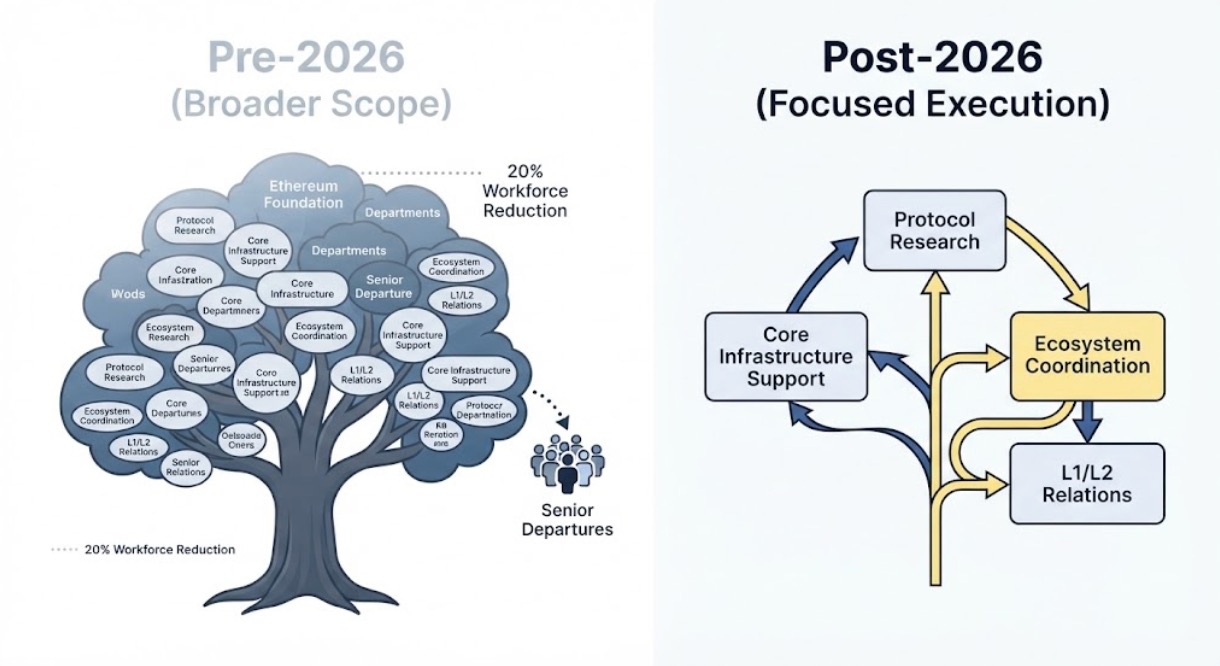
Concern about the ecosystem intensified after the Ethereum Foundation reduced its workforce in June 2026.
The Block reported that the foundation eliminated 54 positions, or about 20% of its staff, while reorganizing its operations. CoinDesk also reported a planned budget reduction and several senior departures.
These are significant changes, but they do not prove that the wider Ethereum developer community contracted by the same amount. The foundation does not employ every Ethereum developer. Independent client teams, DeFi protocols, infrastructure companies and Layer 2 organizations account for a large share of development.
The restructuring is better understood as an attempt to narrow priorities and speed up execution. The real test is whether that smaller organization can coordinate upgrades, support core infrastructure and improve relations between Ethereum and its Layer 2 networks.
The Signals That Matter Now
Monthly developer totals are useful, but they cannot answer every question about Ethereum’s competitive position.
The quality of activity matters. A network can attract thousands of short-term contributors without producing applications that retain users. It can also have fewer developers working on infrastructure that handles substantial economic activity.
For Ethereum, the important signals now include the number of full-time and established developers, retention of new contributors, application revenue, stablecoin activity, Layer 2 interoperability and demand for Ethereum settlement.
It is also worth separating three different movements: development leaving Ethereum mainnet for an Ethereum Layer 2, development expanding to another chain, and a team abandoning the Ethereum ecosystem entirely. Calling all three an exodus hides more than it explains.
Ethereum Is Losing Exclusivity, Not Relevance
Ethereum no longer has the developer market largely to itself. Solana and other Layer 1 networks have become credible alternatives, while Layer 2 platforms are building their own products, communities and economic models.
That competition is real. The claim that Ethereum development is collapsing is not.
The available data shows continued growth across the EVM stack. The more difficult issue is whether Ethereum can turn that broad technical reach into a coherent user experience and lasting demand for ETH.
For traders, this makes developer activity a useful structural indicator rather than a short-term price signal. The question is not simply how many people are writing Ethereum-compatible code. It is where applications are gaining users, where economic activity settles and which part of the stack captures the resulting value.
Market participants can follow digital asset research and broader market coverage on Tapbit. Tapbit users can access their accounts, while new users can register here.
Frequently Asked Questions
Is Ethereum really experiencing a developer exodus?
Current data does not show a broad collapse. The EVM stack still has more than 10,000 monthly active developers, according to Electric Capital. Ethereum is facing stronger competition, but “developer diversification” is more accurate than “developer exodus.”
Why are developers building outside Ethereum?
Developers consider transaction costs, speed, available users, liquidity, programming tools and funding. Solana and newer Layer 1 networks may suit certain consumer or high-frequency applications, while multichain tools have made expansion easier.
Does moving to a Layer 2 mean leaving Ethereum?
Not necessarily. Networks such as Base, Arbitrum and Optimism remain connected to Ethereum for settlement or data availability. However, they can develop separate users, liquidity and revenue, which complicates Ethereum’s value-capture model.


