
Buying STONK crypto safely begins with one rule: do not buy by ticker alone. Several unrelated tokens use STONK, STONKS or similar names across different blockchains. Before swapping, identify the exact project, network and contract address from a source controlled by that project, then compare it with the token displayed in your wallet or trading interface.
The supplied screenshot makes the naming risk clear. It shows an asset called “Stonks (stonkseth.com)” with the ticker STONKS, while the search topic refers to STONK. Those may not be the same token. Treating them as interchangeable can send funds into a copycat contract or an illiquid market.
Start by Identifying the Exact STONK Token
A token name is not a unique identifier. The contract address is. Write down the asset's full name, ticker, blockchain and complete contract address before you open a decentralized exchange. Confirm the information on at least two project-controlled or chain-level sources, such as the project's official website and the relevant block explorer.
Be careful with search ads, copied social profiles and token-listing pages. They can rank for a legitimate project's name while pointing to another contract. A market-data profile is useful for orientation, but it should not replace contract verification. If the project does not publish a clear address or its social channels disagree, stop rather than guessing.
What the Supplied STONKS Chart Actually Shows
The screenshot displays “Stonks (stonkseth.com),” ticker STONKS, with a quoted price near $0.0000003412, an estimated market capitalization of about $143,560 and 2,690 holders. It also displays $0 in 24-hour volume. All of these figures are point-in-time observations, and some are marked or described as self-reported.
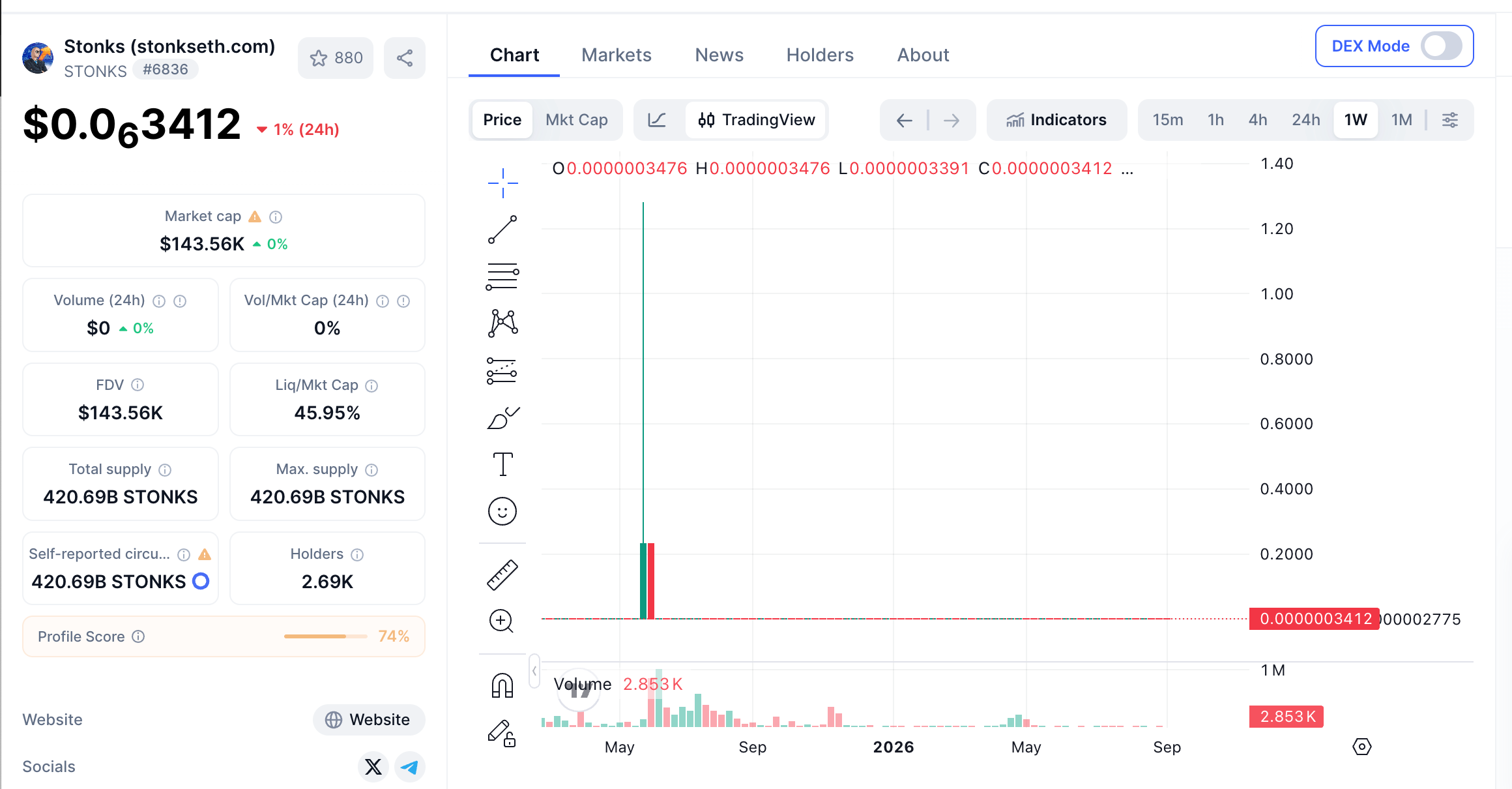
The zero-volume reading matters more than the tiny unit price. A chart can display a last price even when little or no recent trading has occurred. Market capitalization is usually price multiplied by circulating supply; it is not the amount of cash available to holders. If liquidity is thin, selling even a modest position may move the price sharply.
How to Verify the Contract Before Buying
Open the appropriate block explorer and paste the complete contract address. Check that the token name and symbol match, but continue beyond those labels. Review the creation date, verified source code where available, total supply, holder distribution and recent transfers. A newly created copy with few holders may be impersonating an older project.
Contract permissions deserve special attention. Depending on the network and token design, an owner may be able to mint more supply, pause transfers, blacklist addresses, change fees or upgrade the contract. These functions are not automatic proof of fraud, but they create control and dilution risks. Look for an audit or a clear technical explanation rather than relying on “renounced” or “safe” badges.
Check Liquidity, Slippage and Sellability
On a decentralized exchange, locate the pool that contains the verified token contract. Confirm the paired asset, pool address and liquidity value. Then examine how much your intended order changes the quoted price. High price impact is a warning that the position may be difficult to exit.
A practical sequence is to buy a very small amount, wait for the transaction to settle and attempt a small sale. This can reveal transfer restrictions, unusually high taxes or a honeypot-style contract that permits purchases but blocks sales. A successful test does not guarantee future liquidity, yet it can catch obvious problems before more capital is exposed.
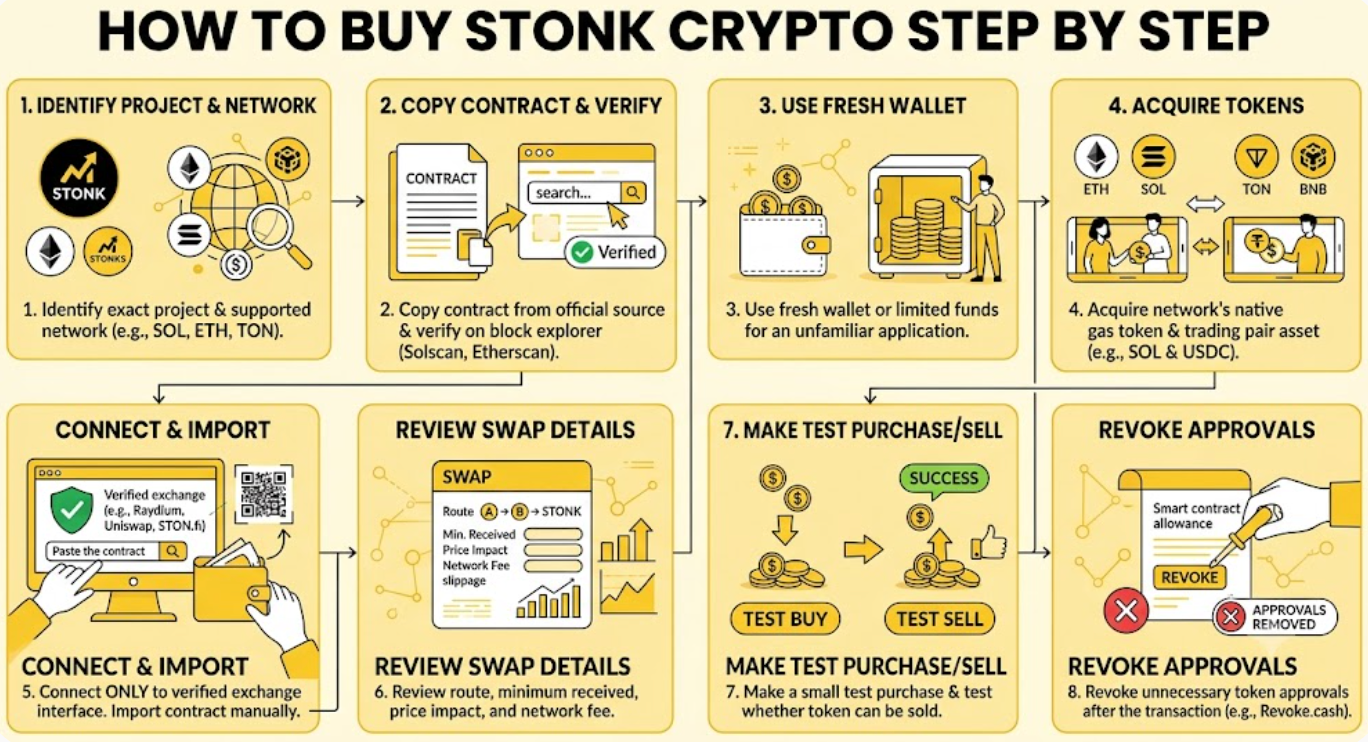
How to Buy STONK Crypto Step by Step
- Identify the exact STONK or STONKS project and supported network.
- Copy the contract from an official project channel and verify it on the block explorer.
- Use a fresh wallet or a wallet with limited funds for an unfamiliar application.
- Acquire the network's native gas token and the asset needed for the trading pair.
- Connect only to the verified exchange interface and import the contract manually.
- Review the route, minimum received amount, price impact and network fee.
- Make a small test purchase and test whether the token can be sold.
- Revoke unnecessary token approvals after the transaction.
If the asset is not available on Tapbit, do not interpret a general platform account as access to that token. Users who want to explore other supported markets can create a Tapbit account and check the current market list separately.
How Fake STONK Tokens Trap Buyers
Copycats often reuse a logo, website wording or ticker while changing one character in the account name. Others create a pool with a familiar token name and seed it with enough liquidity to make the market look active. Fake “migration” notices and direct messages may tell holders to swap into a new contract or approve an unlimited token allowance.
Common warning signs include no verifiable team or documentation, conflicting contract addresses, concentrated supply, unlocked liquidity, sudden changes to official links, blocked sales and claims of guaranteed returns. Screenshots of profits or a rapidly rising chart do not resolve these issues.
Risks to Consider Before You Buy
Micro-cap meme tokens can lose most of their value quickly. Thin liquidity creates slippage and exit risk; concentrated ownership lets a few wallets move the market; contract controls can alter trading conditions; and inactive volume can make a quoted valuation largely theoretical. Wallet phishing and malicious approvals add a separate security risk.
Use an amount you can afford to lose, avoid borrowing to trade and keep long-term holdings away from wallets used to test unknown applications. This article is for informational purposes only and does not constitute financial advice. Crypto assets are volatile, and users should verify current data and assess their own risk tolerance before trading.
Conclusion
There is no safe shortcut for buying an ambiguous token such as STONK. The decisive checks are the complete contract address, the correct network, real pool liquidity and the ability to sell. The supplied chart appears to show STONKS rather than STONK, so it should not be used as proof that another similarly named asset is genuine.
FAQ
Are STONK and STONKS the same token?
Not necessarily. Similar names and tickers may represent unrelated contracts. Compare the full contract address and network before buying.
Why can a token show a price with no trading volume?
A platform may display the last recorded trade or a pool-derived quote even when recent activity is negligible. That price may not be achievable for a meaningful order.
How can I check whether STONK is a honeypot?
Review the contract and recent transactions, use reputable analysis tools, and make a very small purchase followed by a test sale. No single automated score is conclusive.
What matters more: market cap or liquidity?
Both matter, but liquidity determines how readily an order can execute. A token can show a large market cap while offering very little exit liquidity.
Should I copy a contract from a search result?
No. Search results and advertisements can be manipulated. Verify the address through official project channels and the correct block explorer.


