

Space and Time has an operational mainnet, a staking mechanism, and a product focused on verifiable data. Its network is also generating fees from actual usage. None of that, however, has lifted the SXT price.
As of September 7, SXT is trading near $0.0089 — roughly 94.5% below its May 2025 peak. That disconnect between product development and token price suggests a more relevant question than whether Space and Time is still building: can the network generate demand for SXT faster than new tokens enter circulation?
SXT Price Remains Close to Its Lows
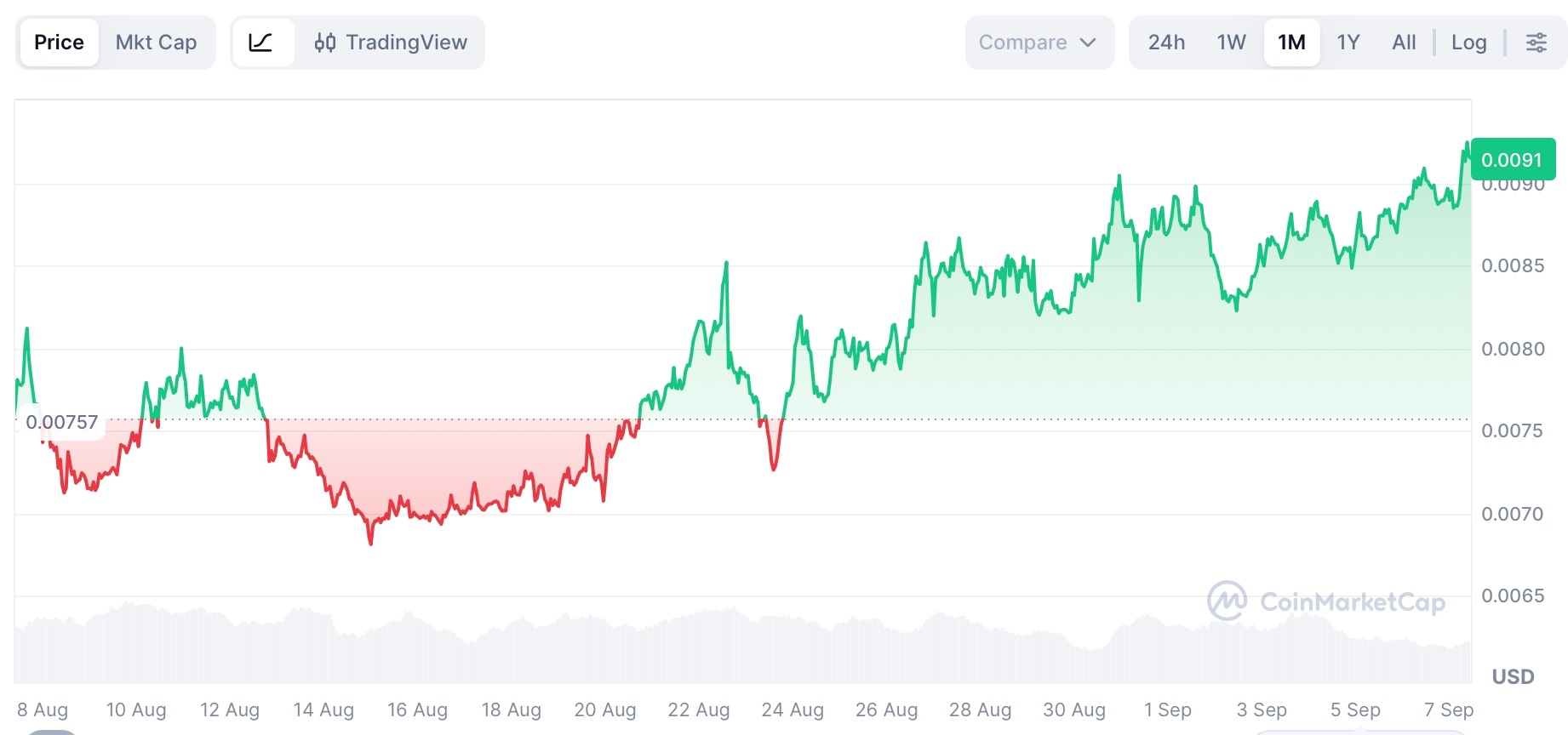
SXT has a market capitalization of approximately $41.3 million and a 24-hour trading volume of about $2 million. Its total and maximum supply are both fixed at five billion tokens.
The token has recovered modestly from its August lows, but the move remains small compared with the decline since launch. SXT briefly traded around $0.16 in May 2025, when a limited liquid supply and strong interest in AI, zero-knowledge technology and blockchain data infrastructure pushed its valuation higher.
That launch price proved difficult to maintain. More tokens became available while speculative demand weakened, leaving SXT with a much larger circulating supply and a substantially lower market value.
Space and Time Has a Real Product
Space and Time is designed to give smart contracts access to information they cannot process efficiently on their own.
A lending application, for example, may need to examine months of wallet activity, compare positions across several blockchains and verify that the resulting calculation is correct. Performing that work directly inside a smart contract would be slow and expensive.
Space and Time handles the calculation through a database and attaches a cryptographic proof to the result. Its Proof of SQL technology allows applications to verify that a query was executed correctly without reproducing the entire computation onchain.
The network indexes blockchain data, accepts custom datasets and processes queries for financial applications, analytics tools and other services. SXT is used for network fees, staking and rewards paid to infrastructure participants.
The technology therefore has a clear purpose. The unresolved issue is scale.
Network Fees Are Real, but Still Small
DefiLlama’s Space and Time dashboard reported approximately $6,700 in fees over the latest 30-day period. Cumulative fees stood near $172,500, while cumulative protocol revenue was roughly $72,600.
Those figures are evidence that Space and Time is processing paid activity. They are not yet evidence of large commercial adoption.
The dashboard also recorded more than 120,000 transactions in 24 hours but only 14 active addresses. This unusual combination suggests that much of the activity may consist of automated queries, data insertions or protocol operations rather than a large population of individual users.
Automated activity is not inherently negative for a data network. A small number of applications could generate frequent and economically valuable workloads. What matters is how much they pay and whether that revenue continues growing.
At present, the fee base remains modest relative to SXT’s market capitalization and incoming token supply.
Staking Yield Needs Context
Space and Time currently advertises an estimated staking rate of approximately 9.7%. Token holders can delegate SXT to validators, with a minimum stake of 100 SXT and a seven-day unbonding period.
The project connects staking rewards to network workloads such as data insertion and verified queries. Its validator documentation, however, shows that rewards can also include temporary foundation subsidies used to support the network during its early stage.
This distinction matters. A staking yield funded entirely by customer fees would demonstrate one type of demand. A yield partly supported by protocol incentives represents a different economic model.
The key number is not the headline staking rate. It is the share of validator rewards that can eventually be sustained by paying users after temporary subsidies decline.
Space and Time Is Targeting Institutional Finance

The project’s recent strategy has moved toward institutional lending, tokenized assets and compliance infrastructure.
In May 2026, Space and Time introduced Virtual Vaults, a system designed to help lenders verify collateral held across exchanges, DeFi protocols and other venues. The aim is to give institutions a continuously updated view of a borrower’s financial position without relying solely on self-reported records.
Space and Time expanded this theme in July with material addressing compliance, market surveillance and the verification of tokenized assets. These are credible use cases for a system that combines offchain information with onchain proofs.
They remain early commercial propositions. Public announcements explain what the products are designed to do, but provide limited evidence of recurring institutional revenue or named customers using Virtual Vaults at scale.
A partnership announcement may attract attention. For SXT, the more valuable disclosure would be workload growth, fees paid by customers and the amount of demand those services create for the token.
Why Product Progress Has Not Lifted SXT
SXT’s performance makes more sense when the product and the token are examined separately.
Space and Time can release useful software while SXT falls because the market is pricing several unresolved questions. Network fees remain limited, supply figures are inconsistent across trackers, additional tokens continue to unlock and the link between product adoption and lasting SXT demand has not yet been demonstrated at scale.
Its competition is also substantial. Developers can choose established blockchain indexers, centralized data APIs, oracle networks and other zero-knowledge coprocessors. Space and Time must offer enough technical or economic value to persuade customers to move important workloads onto its network.
Proof of SQL gives the project a recognizable technical position. Sustainable token demand will depend on customers paying to use it repeatedly.
What Would Change the SXT Outlook?
A durable improvement would be easier to support if paid network fees began growing faster than token supply. More named production customers, recurring institutional workloads and clearer circulation reporting would also strengthen the case.
Price alone would be weaker evidence. A low-cap token can rally sharply when liquidity is thin, even when its underlying economics have not changed.
SXT is no longer valued near the ambitious levels seen at launch. That lowers market expectations, but a 94% decline does not automatically make a token undervalued. The next phase depends on whether Space and Time can turn technically interesting infrastructure into measurable, recurring demand.
Tapbit’s market platform provides access to digital asset markets alongside educational coverage of emerging crypto sectors. Account holders can log in, and new users can register with Tapbit.
Frequently Asked Questions
What is SXT crypto?
SXT is the native token of Space and Time, a decentralized data and verifiable-compute network. It is used for network fees, staking and rewards paid to validators and other infrastructure participants.
Why is the SXT price still down about 94%?
SXT launched with strong demand and a relatively limited liquid supply. Its circulating supply later expanded, large token allocations began unlocking and buying demand weakened. Network usage has not yet grown enough to offset those pressures.
What is Proof of SQL?
Proof of SQL is Space and Time’s zero-knowledge technology for database queries. It allows a query to be processed outside a smart contract while producing cryptographic evidence that the result was calculated correctly.


