

The CLARITY Act has become one of the most watched policy catalysts for Bitcoin and the broader crypto market. For investors, the key question is simple: would clearer U.S. crypto regulation be bullish for Bitcoin?
The short answer is yes, but with an important caveat. Regulatory clarity can improve confidence, reduce compliance uncertainty, and make it easier for institutions to participate. But legislation is never automatic, and Bitcoin's price still depends on liquidity, ETF demand, macro conditions, and risk appetite.
Users following Bitcoin policy narratives and market sentiment can use Tapbit's crypto market tools to track broader digital asset trends alongside regulatory developments.
What Is the CLARITY Act?
The CLARITY Act, formally known as the Digital Asset Market Clarity Act, is a U.S. crypto market structure proposal designed to create clearer rules for digital assets.
For official legislative records and bill-status checks, readers can review updates through Congress.gov.
Its core goal is to reduce uncertainty over whether certain crypto assets should be treated as securities, commodities, or another category of digital asset. In practice, this matters because crypto companies, exchanges, custodians, and institutional investors need to know which regulator oversees which activity.
For Bitcoin, the issue is slightly different. Bitcoin is already widely viewed as a commodity-like asset rather than a security. But broader crypto regulation still matters because Bitcoin trades inside a larger digital asset ecosystem. If exchanges, market makers, ETF issuers, and institutions gain more legal certainty, Bitcoin liquidity and confidence could improve.
Why the CLARITY Act Matters for Bitcoin
Bitcoin does not need the CLARITY Act to prove its existence. It already has deep liquidity, spot ETFs, institutional custody infrastructure, and a long market history.
But regulatory clarity can still help Bitcoin in several ways.
First, clearer rules may reduce legal uncertainty for exchanges and trading platforms. If platforms understand registration, custody, disclosure, and market rules more clearly, institutional firms may feel more comfortable expanding crypto exposure.
Second, Bitcoin often benefits when the broader crypto industry moves from uncertainty toward formal regulation. Even if the rules are not perfect, a clearer framework can be better than years of enforcement-driven ambiguity.
Third, a market structure bill could support more product development around Bitcoin, including derivatives, structured products, custody services, and institutional allocation strategies.
Polymarket Shows Caution, Not Certainty
The provided Polymarket chart asks whether the CLARITY Act will be signed into law in 2026. The displayed probability is around 43%, down sharply from earlier levels.
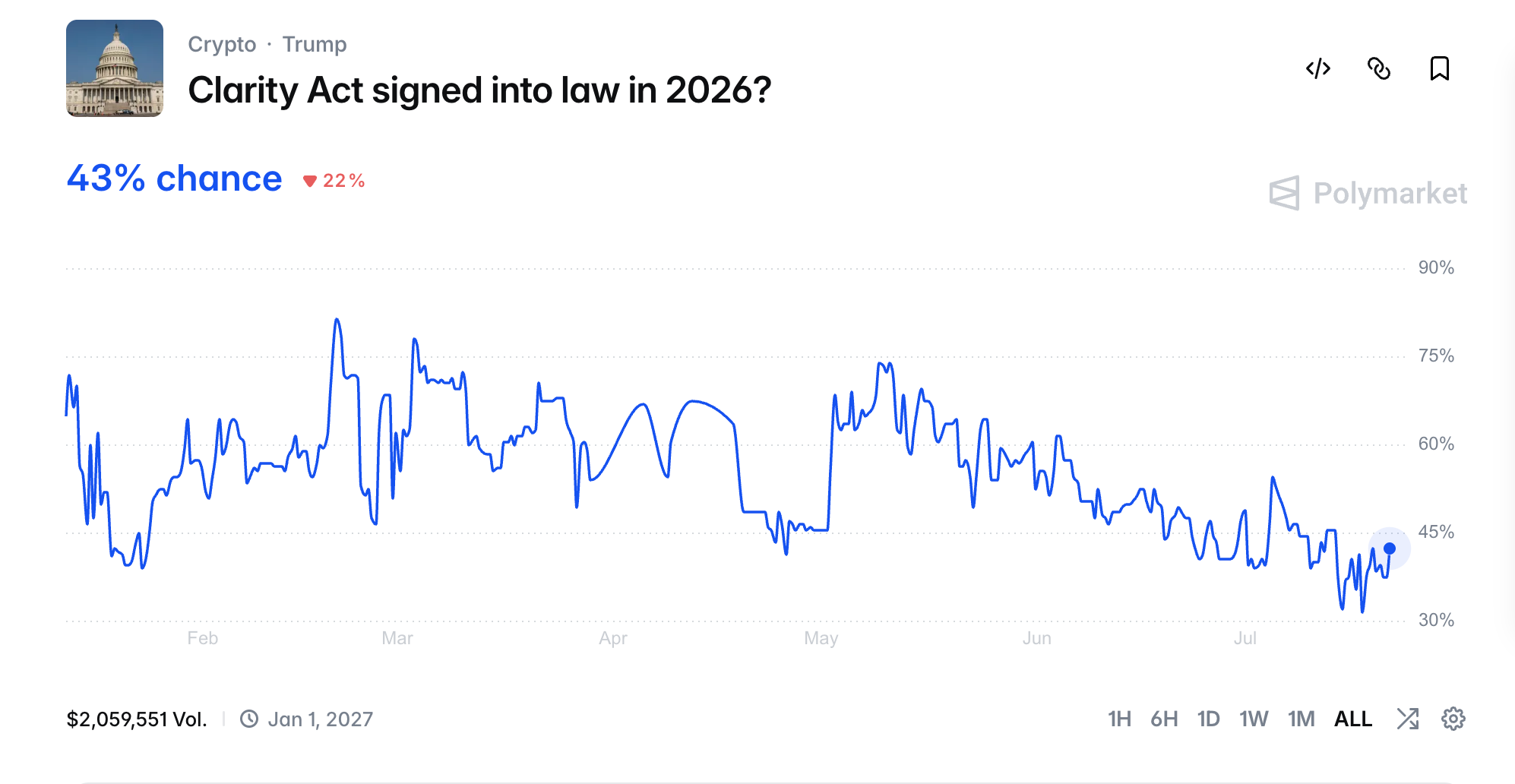
That matters because prediction markets reflect trader expectations, not official outcomes. A 43% probability does not mean the bill is dead. It means market participants see a difficult path.
The chart also shows that expectations have fallen over time. Earlier optimism appears to have faded as traders priced in political delays, Senate negotiation risk, and the challenge of turning committee momentum into final law.
Why Regulatory Clarity Is Bullish for Bitcoin
The bullish case is straightforward: Bitcoin performs best when uncertainty falls and access improves.
If the CLARITY Act becomes law, the market could interpret it as a sign that Washington is moving from hostile ambiguity toward structured oversight. That could encourage more financial institutions to treat Bitcoin as a legitimate asset class rather than a regulatory headache.
A clearer framework may also support better market infrastructure. Exchanges could have more predictable compliance standards. Custodians could operate with more confidence. Market makers could provide deeper liquidity. Asset managers could build more products around Bitcoin and crypto exposure.
For Bitcoin, that does not automatically mean a price surge. But it could improve the long-term investment environment.
Why the Bullish Case Is Not Guaranteed
The problem is that regulation is rarely simple.
Even if the CLARITY Act advances, the final version may change. A bill that passes through Congress may contain compromises, exemptions, compliance burdens, or restrictions that the market does not fully like.
There is also timing risk. A bill can pass committee, gain media attention, and still fail to become law before a key deadline. The Polymarket probability in the provided chart reflects that uncertainty.
Bitcoin also trades on more than regulation. ETF inflows, interest rates, liquidity conditions, dollar strength, risk appetite, miner behavior, and macro shocks can all overpower a policy catalyst.
What Could Push Bitcoin Higher?
The CLARITY Act could support Bitcoin if it arrives alongside other positive conditions.
A stronger bullish setup would include continued spot Bitcoin ETF inflows, improving macro liquidity, lower interest-rate pressure, stronger institutional demand, and rising confidence across crypto markets.
If regulatory clarity combines with those factors, Bitcoin could respond more strongly. In that scenario, the CLARITY Act would not be the only driver, but it could become part of a broader bull narrative.
What Could Limit Bitcoin Upside?
The biggest risk is that the market has already priced in part of the policy optimism. If traders expect progress and the bill stalls, Bitcoin could face disappointment-driven selling.
Another risk is that final legislation may not be as crypto-friendly as expected. Compliance costs, strict disclosure requirements, or political conflict over conflicts of interest could reduce enthusiasm.
There is also a broader risk: Bitcoin can rally on policy headlines and then quickly return to macro-driven trading. If liquidity tightens or ETF demand weakens, regulatory optimism may not be enough.
CLARITY Act and Bitcoin Market Outlook
The CLARITY Act is best viewed as a medium-term sentiment catalyst for Bitcoin, not a guaranteed price trigger.
If passed, it could strengthen the case for Bitcoin as a regulated, institutionally accessible digital asset. If delayed, Bitcoin may still perform well, but the market would need support from ETF demand, macro conditions, and broader crypto momentum.
The provided Polymarket chart makes the key point: traders see real upside, but not certainty. A 43% chance suggests that regulatory clarity remains possible, while political risk remains high.
Conclusion
The CLARITY Act could be bullish for Bitcoin because clearer U.S. crypto rules may support institutional adoption, exchange confidence, product development, and long-term market legitimacy.
But investors should not treat regulatory clarity as guaranteed. The bill still faces political, procedural, and market risks. Even if it becomes law, Bitcoin's price will continue to depend on liquidity, ETF flows, macro conditions, and investor sentiment.
In short, the CLARITY Act is a meaningful Bitcoin catalyst, but not a magic switch for a bull market.
FAQ
What is the CLARITY Act?
The CLARITY Act is a U.S. digital asset market structure bill designed to create clearer rules for crypto assets and define regulatory roles more precisely.
Is the CLARITY Act bullish for Bitcoin?
It can be bullish because clearer rules may support institutional confidence, exchange compliance, and broader crypto market legitimacy.
Has the CLARITY Act been signed into law?
Based on current market expectations and available legislative status, investors should not assume it has already become law.
Why does Polymarket matter here?
Polymarket reflects market expectations. The provided chart shows a 43% chance of the CLARITY Act being signed into law by January 1, 2027, suggesting uncertainty remains.
Can Bitcoin rise if the CLARITY Act fails?
Yes. Bitcoin can still rise due to ETF inflows, macro liquidity, institutional demand, and broader market sentiment, even without the CLARITY Act.
What is the biggest risk for Bitcoin investors?
The biggest risk is assuming one regulatory event guarantees price upside. Bitcoin remains volatile and can be affected by macro, liquidity, and market sentiment shifts.


