

AKE could mathematically reach $0.10, but that is a demanding bullish scenario, not a reliable base-case forecast. From the supplied AKEDO chart price of $0.02763, the target requires approximately a 3.62x increase in price, equivalent to a 261.9% gain. At the project’s stated 100 billion token supply, it would imply a $10 billion fully diluted valuation.
This AKE price prediction for 2026–2030 focuses on what would need to change: sustained adoption of AKEDO’s AI creation platform, measurable demand for its token, sufficient liquidity and absorption of new circulating supply. A steep rally alone does not establish those conditions.
What the Supplied AKE Chart Shows
The supplied weekly chart displays an open of $0.01508, high of $0.02932, low of $0.01467 and close or latest candle value of $0.02763, with a displayed gain of 82.95%. These are point-in-time screenshot values, not a live quotation or proof that the weekly candle has finished. The screenshot also shows a rapid advance after a prolonged period near the bottom of the chart.
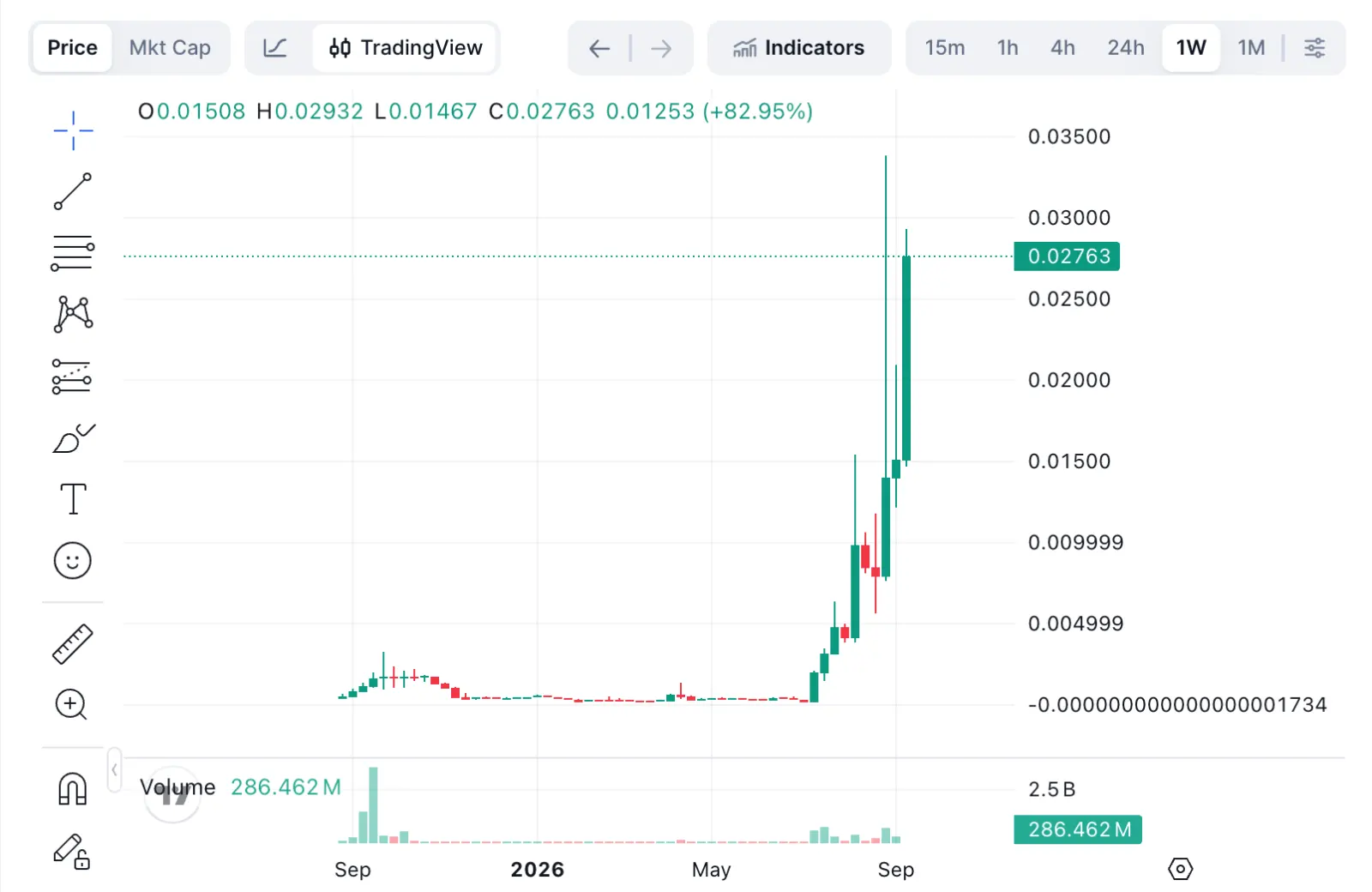
The visible $0.02932–$0.03000 area is an immediate reference zone above the quoted price. The $0.01467–$0.01508 area marks the displayed candle’s lower region. These are chart reference points, not proven support or resistance: a short, fast-moving price history provides limited evidence that either zone will hold.
Readers comparing broader crypto services can create a Tapbit account and check available markets and regional eligibility. This link does not imply that AKE is listed on Tapbit.
What Is AKEDO, and Why Could AKE Have Demand?
AKEDO describes its platform as a multi-agent AI framework for content and game creation. Its proposed workflow uses specialized agents for tasks such as map construction, game rules, balancing and storytelling. The investment narrative combines AI tools with creator-led gaming rather than treating AKE as a claim on a traditional game publisher.
The economic question is whether that workflow attracts repeat paying users. A creator trying a free demo is different from a creator publishing successful games repeatedly. Likewise, token incentives can generate activity without proving that users would return after subsidies decline.
Investors should look for evidence of retention, paid creation activity, published games with sustained audiences and transparent fee reporting. An attractive product narrative can support speculation, but durable token demand requires a mechanism connecting actual use to purchases, holdings or consumption of AKE.
Can AKE Reach $0.10? The Valuation Math
The project’s tokenomics documentation states a total supply of 100 billion AKE. The following calculations hold that supply constant. They are valuation comparisons, not annual price targets or estimates of how much cash must enter the market.
| AKE price | Multiple of $0.02763 | Valuation at 100B tokens |
|---|---|---|
| $0.01 | 0.36x | $1 billion |
| $0.02763 | 1.00x | $2.763 billion |
| $0.05 | 1.81x | $5 billion |
| $0.10 | 3.62x | $10 billion |
CoinMarketCap’s AKE listing, consulted for this analysis, reports approximately 22.796 billion circulating tokens and a 100 billion maximum supply. Using that circulating figure solely as an illustrative constant, $0.10 would imply about $2.280 billion in circulating market capitalization. The figure is not a forecast of 2030 circulation and may change.
Market capitalization is price multiplied by circulating supply, whereas fully diluted valuation uses a broader supply assumption. Neither equals money deposited into the token. Thin liquidity can produce a high quoted valuation without enabling large holders to exit near that price.
Token Unlocks and the Demand-versus-Supply Test
The whitepaper describes releases over four years and allocates 25% to investors, 15% to early contributors and 5% to advisers. It also describes AKE use for creation and publishing, liquidity pairing and fee-linked staking and burning mechanisms. These are documented design features, not verification of current revenue, executed burns or realized returns.
An unlock is not automatically a sale, but newly transferable tokens can increase potential supply. Conversely, staking does not permanently remove tokens, and a stated burn mechanism says little about scale without actual fee data. The key comparison is net token demand against tokens becoming available to trade.
If circulation doubled, price would need twice the circulating market capitalization merely to stay unchanged. That makes a multi-year forecast more demanding than drawing a straight line through the latest rally. Investors should verify current release schedules and on-chain supply instead of assuming today’s float remains fixed.
AKE Price Prediction 2026–2030: Three Conditional Paths
Bull case: During 2026–2027, the rally develops into a broader market with better depth while the platform demonstrates repeat paid usage. By 2028–2030, sustained creator activity and token-linked demand absorb supply growth. Under those conditions, $0.05 and eventually $0.10 become valuation milestones worth reassessing, not promised outcomes. A failure to translate activity into demand weakens this case.
Base case: Product adoption improves unevenly, while speculation and unlocks repeatedly interrupt rallies. AKE experiences wide swings rather than a smooth annual climb. The screenshot is insufficient to assign a defensible year-end price for each year; the sensible base-case framework is periodic reassessment of usage, liquidity and supply, with $0.10 remaining unproven.
Bear case: Momentum fades, incentives attract short-lived users or competing AI tools reduce the platform’s appeal. A fall back toward the screenshot’s $0.015 region would be roughly 45.7% below $0.02763; $0.01 would be approximately 63.8% lower. These illustrate downside severity, not guaranteed floors. A weak project can lose substantially more.
The longer horizon adds execution risk rather than making appreciation inevitable. By 2030, the relevant question is whether AKEDO has built a durable product economy, not whether enough time has passed for a round-number target to be reached.
What Would Confirm or Invalidate the Bullish Thesis?
Useful confirmation would combine improving paid-user retention, independently checkable fees, transparent supply reporting and deeper liquidity across legitimate markets. Price strength accompanied only by social attention is weaker evidence. Trading volume also differs from order-book depth: repeated turnover can coexist with poor execution for larger orders.
Warning signs include unexplained changes to token policy, unclear unlock reporting, concentrated holdings, security incidents and declining organic activity. Verify the chain and contract before transferring funds; a shared ticker does not establish that two assets are the same token.
Position sizing matters after an outsized weekly move. Limit orders can control price but may not fill, while stop orders may execute below the trigger during a gap. Leverage adds liquidation and funding risks and can turn a temporary reversal into a permanent loss before a long-term thesis plays out.
Conclusion
AKE reaching $0.10 would require about 261.9% appreciation from the supplied $0.02763 snapshot and imply a $10 billion valuation at 100 billion tokens. That is possible as a hypothetical outcome, but the evidence does not justify treating it as likely or inevitable. For 2026–2030, adoption quality, token demand, supply growth and executable liquidity matter more than a precise annual price table.
FAQ
How much must AKE rise to reach $0.10?
From $0.02763, it needs approximately a 3.62x price multiple, or a 261.9% gain.
Would $0.10 make AKEDO worth $10 billion?
It implies a $10 billion fully diluted valuation using 100 billion tokens. Circulating market capitalization depends on the circulating supply at that time.
Is the screenshot’s 82.95% move a daily gain?
No. The screenshot has the weekly timeframe selected. Its displayed candle change should not be described as a 24-hour return.
Do token unlocks always cause the price to fall?
No. Unlocks increase potential transferable supply, but the outcome depends on holder decisions, demand, liquidity and what the market already expected.
Is $0.10 a guaranteed 2030 target?
No. It is a conditional valuation scenario. The project could underperform, and the token could suffer substantial losses.


