
The Circle Arc blockchain is becoming a central part of Circle’s strategy to move stablecoin finance beyond simple token issuance. Arc is an open Layer-1 blockchain designed specifically for stablecoin payments, foreign exchange and capital markets. Rather than asking developers to adapt a general-purpose blockchain to institutional money movement, Circle is building the financial primitives directly into the network.
That design matters because Circle already operates one of the largest stablecoin ecosystems through USDC. Arc gives the company a dedicated settlement layer that can connect stablecoins, payments, FX and tokenized assets while remaining compatible with Ethereum development tools. For investors following Circle, the bigger question is whether Arc can turn USDC distribution into a broader financial-infrastructure network.
What Is Circle Arc Blockchain?
Arc is an independent Layer 1 developed by Circle. It is EVM-compatible, which means developers can use familiar Ethereum tooling, but it is not an Ethereum Layer 2. Circle built Arc as a standalone ecosystem optimized for stablecoin finance.
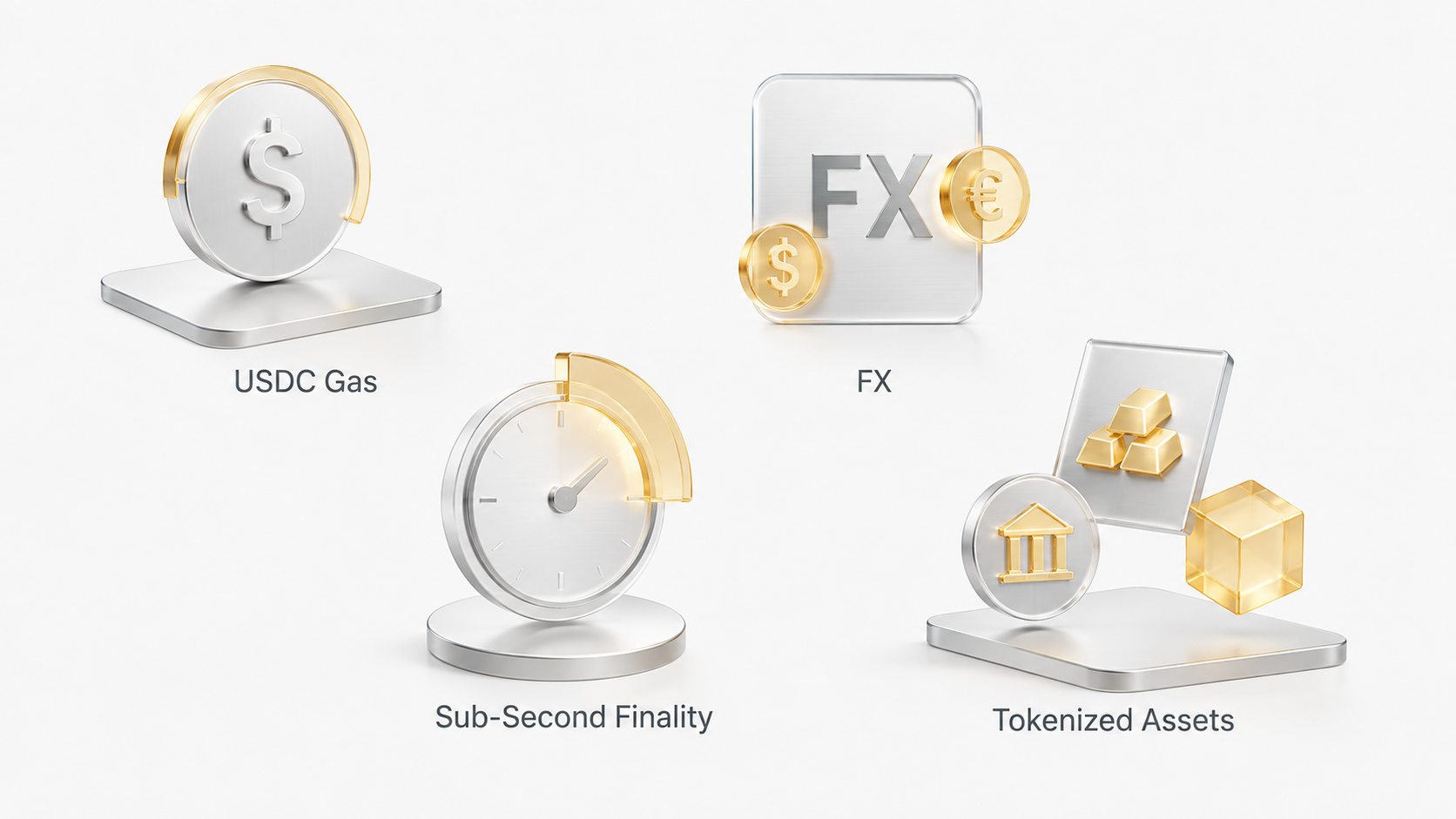
The network’s core features include USDC as native gas, an institutional-grade built-in FX engine, deterministic sub-second finality and opt-in privacy features. Circle also designed Arc to integrate with products such as Circle Payments Network, USDC, EURC, USYC, CCTP and Gateway.
Why Is Circle Building Its Own Blockchain?
Stablecoin companies depend heavily on third-party blockchains. That creates advantages because users can access many networks, but it also means fees, settlement times and user experience are controlled by infrastructure that was not necessarily designed for enterprise payments.
The Circle Arc blockchain attempts to solve that problem by making stablecoin requirements part of the base layer. Businesses can pay transaction fees in USDC rather than holding a volatile native token, while financial applications can access integrated FX and settlement features.
Circle’s strategy is therefore broader than “launch another chain.” Arc gives the company more control over the infrastructure surrounding digital dollars without abandoning the multichain distribution of USDC.
USDC as Native Gas
One of Arc’s most recognizable features is the use of USDC for transaction fees. On many blockchains, a company may receive stablecoins but still need to hold ETH, SOL or another token to pay gas. That creates treasury and operational complexity.
By denominating network fees in USDC, Arc aims to make costs easier for companies to understand and budget. The approach also aligns the network’s utility with Circle’s core stablecoin rather than requiring a separate volatile gas asset.
How Arc’s Built-In FX Engine Works
Circle designed Arc with an institutional-grade request-for-quote system for onchain foreign exchange. The goal is to support price discovery and payment-versus-payment settlement between stablecoins.
This could matter as more currencies become represented by regulated stablecoins. Instead of routing every conversion through fragmented exchanges, businesses could use onchain FX infrastructure designed for 24/7 settlement.
Circle has also introduced StableFX on Arc’s public-testnet ecosystem, reinforcing the idea that foreign exchange is not an afterthought but a core use case.
Why Sub-Second Finality Matters
Arc uses a consensus approach based on Malachite to target deterministic sub-second finality. Faster finality is especially important for payments and capital markets because institutions need certainty that a transaction is complete rather than waiting through long probabilistic confirmation windows.
For consumer crypto transfers, a difference of several seconds may not matter much. For high-value treasury, payment or FX flows, predictable settlement can materially affect operational risk.
Arc and Circle’s Bigger Stablecoin Strategy
The Circle Arc blockchain fits into a broader product stack. USDC provides dollar liquidity. EURC extends the model to euro-denominated stablecoins. Circle Payments Network connects financial institutions. CCTP and Gateway support crosschain movement, while Arc provides a stablecoin-native execution and settlement environment.
Circle also says Arc is designed for tokenized equities, commodities and real estate. That connects the chain with the broader tokenized-stock and RWA trend rather than limiting it to payments.
Could Arc Compete With Ethereum or Solana?
Arc does not need to replace Ethereum or Solana to succeed. Circle continues to distribute USDC across multiple blockchains and describes Arc as market-neutral and multichain-aligned.
The more useful comparison is specialization. Ethereum and Solana host broad application ecosystems. Arc is purpose-built around stablecoin payments, FX and capital markets. If institutions value predictable fees, integrated compliance features and native financial primitives, Arc could occupy a distinct niche.
What Could Arc Mean for Circle Stock?
For CRCL investors, Arc potentially expands Circle from a stablecoin issuer into a broader infrastructure platform. The upside case is that more payments, FX and tokenized assets flow through Circle-controlled products, creating stronger network effects around USDC.
The risk is that operating a blockchain adds new technical, regulatory and competitive burdens. Arc will need developers, liquidity and real transaction activity rather than announcements alone. Investors should watch adoption metrics, stablecoin flows and enterprise integrations.
How to Trade CRCL-USDT on Tapbit
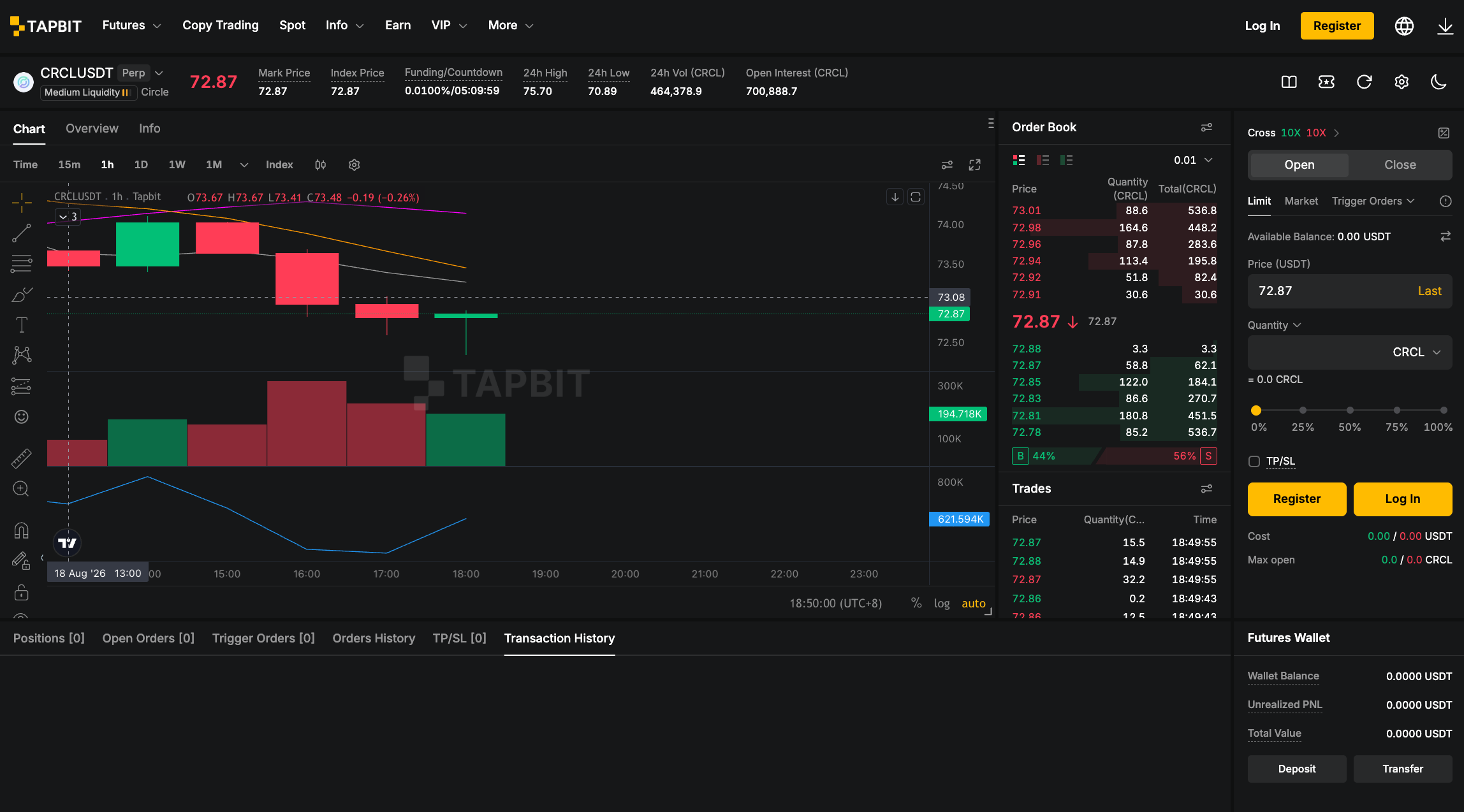
Tapbit offers CRCL-USDT perpetual futures for Circle-linked price exposure. This is a derivative, not direct ownership of Circle Internet Group shares, and it does not provide shareholder voting rights or dividends.
-
Create an account or log in to Tapbit.
-
Open CRCL-USDT and check the contract name, mark price, index price and funding countdown.
-
Select Limit, Market or Trigger, set quantity, leverage and margin mode, then choose Open Long or Open Short.
-
Add TP/SL and monitor margin, Positions, Open Orders, Trigger Orders and liquidation risk.
For investors, the Circle Arc blockchain should be evaluated through adoption rather than launch headlines alone. The strongest confirmation would be rising stablecoin settlement, institutional FX activity and real tokenized-asset usage. If the Circle Arc blockchain becomes a meaningful venue for enterprise payments, Circle could deepen the economics around USDC. If activity remains limited, the Circle Arc blockchain may remain strategically interesting without becoming a major revenue driver. The Circle Arc blockchain therefore needs measurable network effects, not only technical differentiation. For that reason, the Circle Arc blockchain is best judged by real financial activity.
Bottom Line
The Circle Arc blockchain is an attempt to build a stablecoin-native financial layer rather than another general-purpose chain. USDC gas, built-in FX, sub-second finality and Circle-platform integrations directly target the needs of payments and capital markets. The opportunity is significant if stablecoins become core financial infrastructure, but Arc still has to prove developer adoption, liquidity and transaction demand. For traders following the equity side of the story, CRCL-USDT on Tapbit provides derivative exposure to Circle’s share-price movements.
FAQ
What is Circle Arc?
Arc is an independent Layer-1 blockchain created by Circle for stablecoin payments, FX and capital markets.
Does Arc use USDC for gas?
Yes. Circle designed Arc so transaction fees can be paid in USDC.
Is Arc an Ethereum Layer 2?
No. Arc is its own Layer 1, although it is EVM-compatible.
Can I trade Circle on Tapbit?
Tapbit offers CRCL-USDT perpetual futures, which provide derivative price exposure rather than direct ownership of Circle shares.


