
Tokenized stocks are blockchain-based instruments designed to represent a security, an indirect claim on shares, or synthetic exposure to a stock price. That definition needs care. Two products can both carry an equity ticker while giving holders completely different legal rights.
What Are Tokenized Stocks?
A tokenized stock is a digital instrument recorded or transferred using blockchain technology and linked to a traditional equity. It may represent the stock itself, an indirect entitlement to shares held by a custodian, or a separate instrument whose return follows the referenced stock.
This makes tokenized stocks part of the broader real-world asset (RWA) market. The stock exists in traditional finance, while blockchain provides a new recordkeeping, transfer, or settlement layer.
The hidden question is always: What exactly does the token holder own?
Tapbit Learn's S&P 500 index guide and Dow Jones Completion Index guide explain the traditional equity benchmarks behind many stock-linked products.
Three Tokenized Stock Models
The SEC's January 2026 staff statement describes an important distinction between securities tokenized by or for the issuer and products created by unrelated third parties. Third-party structures can also differ substantially.
Issuer-Sponsored Tokenized Securities
The company or its authorized agent records ownership using blockchain-based infrastructure. A valid token transfer can update the company's official securityholder records.
This is the model closest to ordinary stock ownership because the tokenized format represents the security itself. Federal securities laws still apply. Putting the record on-chain does not remove registration, disclosure, or transfer requirements.
Custodial Tokenized Securities
A third party holds the underlying shares and issues a blockchain instrument representing a direct or indirect entitlement to those securities.
- Underlying shares may be held in custody
- The token may support fractional transfer or redemption
- Holder rights can differ from owning the stock through a broker
Users must examine who holds the shares, how bankruptcy is handled, and whether dividends or corporate actions are passed through.
Synthetic Stock-Linked Products
A third party creates an instrument whose value follows a stock without transferring rights in that company's shares. The product may use collateral, reference prices, derivatives, or smart contracts.
The holder receives price exposure, not equity ownership. Stock-linked perpetual contracts belong in this wider synthetic-exposure category, although they are derivatives rather than tokenized shares.
| Structure | Underlying Shares | Typical Holder Position | Main Question |
|---|---|---|---|
| Issuer-sponsored security | Issued by the company | Recorded security holder | Are full shareholder rights included? |
| Custodial entitlement | Held by a custodian | Direct or indirect claim | Who owns and safeguards the shares? |
| Synthetic instrument | May not be held | Price-linked contract holder | How is the price and settlement calculated? |
How Do Tokenized Stocks Work?
A custodial model generally follows this path:
- An issuer or vehicle acquires the underlying shares.
- A custodian safeguards those shares.
- Tokens are created under documented issuance rules.
- Blockchain records token transfers.
- Off-chain records, redemption rights, and corporate actions are reconciled.
A synthetic product works differently:
- The platform defines a reference stock and price source.
- Collateral supports the contract.
- An oracle or index supplies market data.
- Gains and losses settle according to the contract rules.
The difference is not cosmetic. In the first model, there may be an asset or entitlement behind the token. In the second, the product is primarily a contract tied to price movement.
Tokenized Stocks vs Real Stocks
Traditional stocks are legal ownership interests in companies. Tokenized instruments may reproduce some economic features, but the legal wrapper determines which rights survive.
| Feature | Traditional Stock | Custodial Token | Synthetic Derivative |
|---|---|---|---|
| Equity ownership | Yes | Depends on structure | No |
| Voting rights | Often available | May be absent or indirect | No |
| Dividends | Paid to eligible holders | May be passed through | Usually not included |
| Trading schedule | Exchange hours | May offer extended access | Platform schedule |
| Settlement | Traditional market infrastructure | Blockchain plus off-chain records | Contract settlement |
| Main added risk | Broker and market risk | Issuer and custodian risk | Leverage and counterparty risk |
Tokenization can improve fractional access and settlement efficiency. It can also add smart-contract, custody, issuer, oracle, and cross-jurisdiction risks.
Examples of Tokenization Beyond Stocks
Stocks are only one part of tokenization. Other examples include:
- Government bonds and Treasury-related instruments
- Real estate interests
- Commodities and precious metals
- Private credit
- Fund interests
- Intellectual-property or revenue claims
Each example requires a connection between the on-chain record and the off-chain legal asset. A token alone cannot create enforceable ownership if the contracts, custody, and records do not support it.
The same principle applies to individual equity narratives. Tapbit Learn's Palantir stock analysis and Nvidia outlook show why the underlying company still matters even when exposure is delivered through a crypto-native product.
The 2026 Regulatory Picture
The regulatory direction is becoming clearer, but access remains fragmented.
The SEC staff stated in January 2026 that changing a security's format does not change the application of federal securities laws. It also distinguished issuer-sponsored securities from third-party custodial and synthetic structures.
That distinction gives users a practical checklist:
- Who issued the instrument?
- Is the issuer connected to the public company?
- Are real shares held in custody?
- What rights does the token document provide?
- Which jurisdiction and regulations apply?
- What happens if the issuer or custodian fails?
Availability can change quickly. Never assume a product is approved for every retail user merely because it trades on-chain.
Tapbit Stock-Linked Perpetuals: Exposure Without Equity
Tapbit offers stock-linked perpetual products for NVDA futures, GOOGL futures, AMZN futures, and PLTR futures.
These are perpetual derivatives, not tokenized shares. They provide no company ownership, voting rights, dividend entitlement, or claim on custodied stock. They also involve leverage and liquidation risk.
How to Trade Stock-Linked Perpetuals
- Create a Tapbit account and open the Futures page
- Select TradFi, then choose NVDA, GOOGL, AMZN, or PLTR.
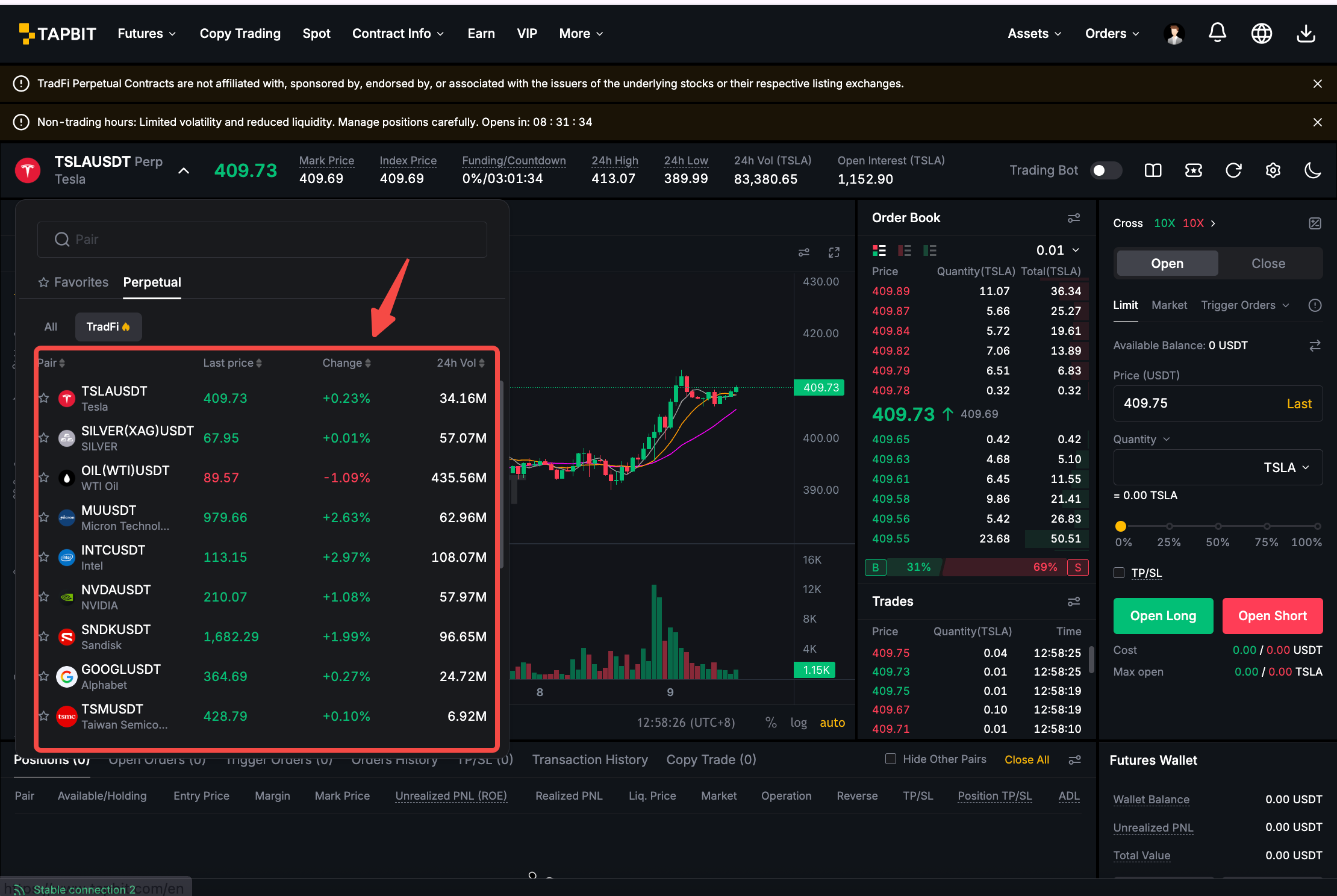
- Check the reference price, order book, margin mode, leverage, and order type.
- Set TP/SL and review the fee structure before opening the position.
FAQ
What is an example of a tokenized stock?
An example could be an issuer-sponsored on-chain share, a tokenized entitlement backed by custodied shares, or a synthetic instrument tracking a listed stock. The legal structure matters more than the ticker.
Do tokenized stocks pay dividends?
Some custodial or issuer-sponsored structures may pass through dividends. Synthetic products and stock-linked perpetuals generally do not.
What blockchains can support tokenized stocks?
Tokenized securities can use different public or permissioned blockchain networks. The network affects transfer and settlement, but not the product's underlying legal rights.
Are tokenized stocks available everywhere?
No. Availability depends on the issuer, platform, investor eligibility, and jurisdiction.
Is a stock-linked perpetual a tokenized stock?
No. A stock-linked perpetual is a derivative contract that tracks a reference price. It does not represent company shares.


