
Interest in 2026 FIFA World Cup winner Polymarket markets is rising as football fans and crypto traders look for a live view of tournament expectations. Unlike a static expert ranking, a prediction-market price changes whenever participants buy or sell an outcome.
That makes the market useful as a sentiment indicator, but not as a crystal ball. The leading teams, implied probabilities, and market volumes can change quickly throughout the tournament. Any live figure should therefore be checked directly at the time of reading.
This article explains how World Cup prediction markets work, what can move their prices, and how they differ from promotional prediction activities offered by crypto platforms.
How 2026 FIFA World Cup Winner Polymarket Markets Work
Polymarket is an on-chain prediction platform where participants trade shares linked to real-world outcomes. In a World Cup winner market, each eligible national team generally has a "Yes" outcome.
A winning share settles at $1 if that team becomes champion and at $0 if it does not. Before settlement, the share can trade at any price between those two values.
If a team's share trades near $0.20, the market is roughly assigning that team a 20% implied chance of winning. This probability is not produced by FIFA or a forecasting authority. It emerges from the prices that buyers and sellers accept.
Probability Pricing and Settlement
Settlement gives the contract its final value. After the tournament ends, the platform resolves the market according to its published rules and data sources. Shares linked to the winning outcome settle at $1, while the others settle at $0.
Participants should read the resolution criteria before trading. Details such as postponed matches, disqualification, cancellation, or disputed results can matter. A clear market question and reliable settlement source are essential.
Liquidity and Market Depth
Liquidity determines how easily a position can be opened or closed near the displayed price. Popular teams may attract deeper order books, while less-followed outcomes may have wide spreads.
A thin market can move sharply after one large order. That price movement may look like a major change in consensus even when it reflects only limited trading activity. Market depth, recent volume, and the gap between buy and sell prices provide useful context.
Regional Access
Prediction markets are not available in every jurisdiction. Local rules can restrict access, deposits, trading, or settlement. Users should independently confirm eligibility and legal requirements before interacting with any prediction platform.
What Moves World Cup Prediction Odds?
World Cup probabilities can reprice faster than traditional tournament previews because new information enters the market continuously.
Common drivers include:
- Match results: A surprise defeat, dominant win, or difficult knockout path can change expectations immediately.
- Player availability: Injuries, suspensions, and late squad changes may affect a team's perceived strength.
- Tournament bracket: The route to the final matters. A strong team facing a difficult side of the bracket may trade differently from one with a more favorable path.
- Tactical performance: Traders may revise assumptions after seeing how a team handles possession, pressing, penalties, or defensive transitions.
- Liquidity and concentrated orders: Large trades can temporarily move a thin market beyond what the underlying news justifies.
- Public narratives: Media attention and national fan bases can create momentum that is not always supported by fundamentals.
These influences resemble crypto markets, where positioning, news, and emotion can move prices together. Tapbit Learn's guide to why crypto markets rise offers useful context for separating a genuine catalyst from a sentiment-driven move.
Why Polymarket Odds Are Not the Same as Certainty
A market-implied probability describes a distribution of possible outcomes. It does not determine the result.
A team priced at a 30% probability still has a 70% implied chance of not winning. Markets can also be wrong, slow to process information, or distorted by low liquidity and highly concentrated positions.
Crowd psychology matters as well. The same fear, confidence, and momentum seen in digital-asset markets can appear in sports prediction markets. The crypto fear and greed index is not a football indicator, but it illustrates how quickly collective sentiment can swing between extremes.
A practical reading method is to ask three questions:
- What new information entered the market?
- Was the move supported by meaningful liquidity?
- Did the price change more than the underlying news appears to justify?
This approach treats prediction odds as information to analyze rather than an instruction to follow.
On-Chain Markets vs Exchange Events vs Sportsbooks
Several products let users engage with World Cup outcomes, but they do not create the same legal or economic exposure.
| Feature | On-Chain Prediction Market | Exchange Promotional Event | Traditional Sportsbook |
|---|---|---|---|
| What the user holds | Tradable outcome shares | Points, entries, or activity rights | A wager ticket |
| Pricing | Market-driven probability | Platform campaign rules | Operator-set odds |
| Exit before resolution | Often possible if liquidity exists | Usually unavailable | Sometimes offered through cash-out |
| Settlement | Published market resolution process | Platform reward calculation | Sportsbook payout rules |
| Main purpose | Forecasting and speculation | Engagement and rewards | Sports wagering |
The word "prediction" can therefore describe very different systems. Users should check whether they are trading an outcome, completing campaign tasks, or placing a conventional wager.
How to Join Tapbit's World Cup Prediction Event
Tapbit's World Cup Prediction event runs from June 1 to July 20, 2026 (UTC+8). It is a promotional points activity rather than a Polymarket-style tradable event contract.
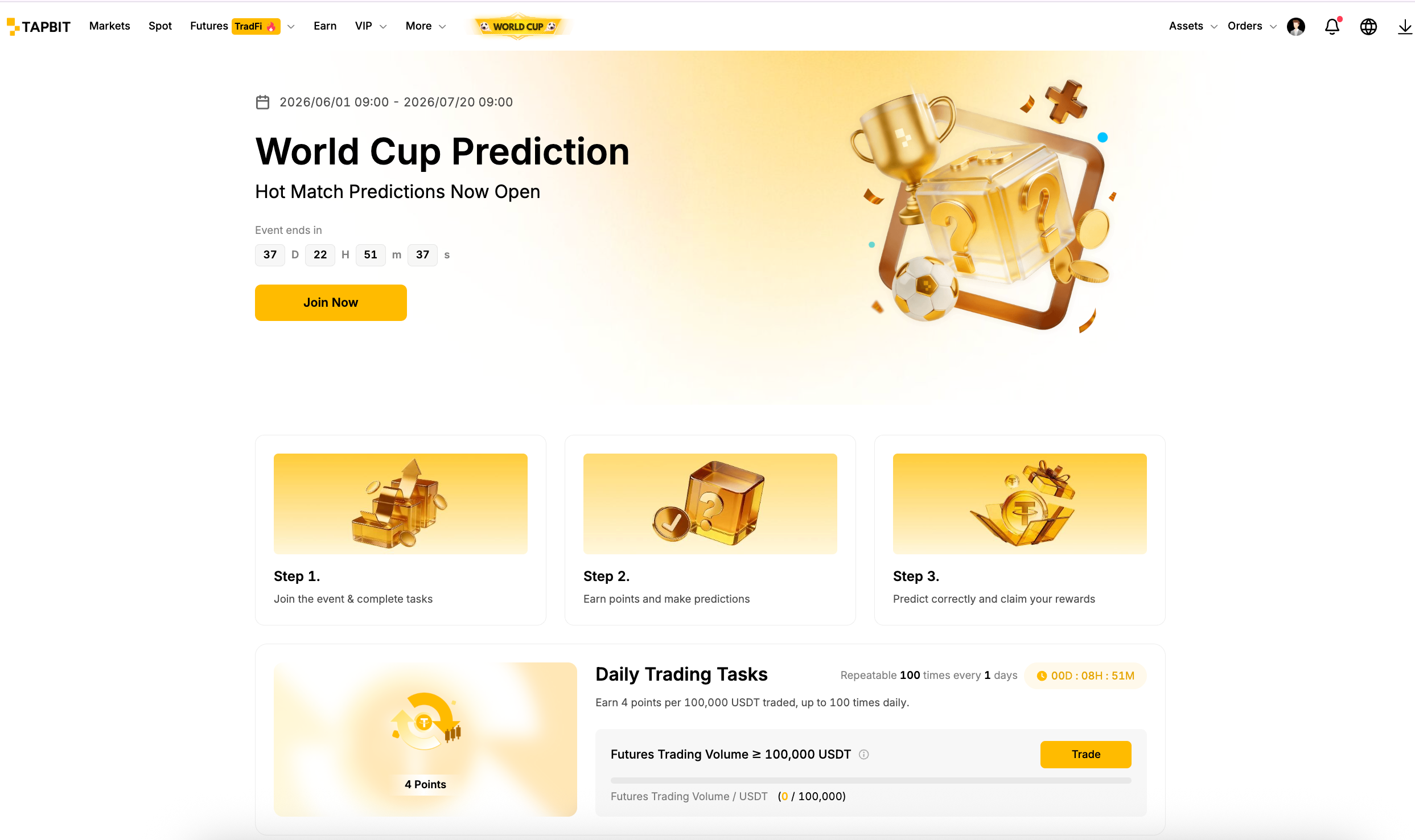
Participation can be understood in four steps:
- Join the event. New users can first create an account and enter the event during its active period.
- Complete contract-volume tasks. Eligible activity generates event points according to the campaign rules.
- Use points for match predictions. Participants allocate earned points to available football predictions.
- Receive eligible rewards. Points from correct predictions convert to USDT at a 1:1 ratio, with rewards distributed within three working days.
The event does not let users buy and sell World Cup outcome shares. Rewards depend on the campaign conditions, completed tasks, and correct predictions. Participation does not assure a profit.
Reading Prediction Markets Alongside Crypto Cycles
Major sports events can attract short bursts of attention toward fan tokens, sports collectibles, prediction applications, and event campaigns. That attention may increase social activity without creating lasting demand.
Crypto traders can compare event-driven momentum with broader market conditions. For example, learning when altcoin season begins helps distinguish a market-wide rotation from a narrow World Cup narrative.
Watch whether activity persists after the opening matches, whether liquidity remains healthy, and whether related tokens have real utility beyond tournament marketing. A headline can trigger attention, but sustainable markets require deeper participation.
Final Outlook
The 2026 FIFA World Cup winner Polymarket trend shows how on-chain markets can transform tournament opinions into changing probability prices. Those prices can summarize crowd expectations, but they remain vulnerable to new information, low liquidity, and emotional trading.
Used carefully, 2026 World Cup prediction markets can provide another lens on the tournament. They should not be treated as certain forecasts, and Tapbit's promotional event should not be confused with a tradable prediction contract.
FAQ
Do Polymarket odds predict who will win the 2026 World Cup?
No. They represent current market-implied probabilities, which change with trading activity and new information.
Can a Polymarket position be sold before the tournament ends?
It may be possible to sell before resolution when sufficient liquidity and platform access are available.
Is the Tapbit World Cup Prediction event a futures product?
No. It is a promotional points activity governed by campaign rules, not a tradable World Cup outcome contract.
Why can prediction-market probabilities change so quickly?
Match results, injuries, bracket changes, large orders, and shifting sentiment can all cause rapid repricing.
Are World Cup prediction markets available worldwide?
No. Access and legal requirements vary by jurisdiction, so users must verify regional eligibility.


