

What Is Crypto Prediction Market?
What is crypto prediction market is a common search because these platforms sit between trading, forecasting, and real-world events. In simple terms, a crypto prediction market is a marketplace where users buy and sell positions linked to a future outcome.
For example, a market may ask: "Will Bitcoin close above a certain price by Friday?" or "Will a team win the World Cup?" Traders then buy outcome shares such as Yes or No. If the outcome resolves correctly, the winning side receives the final payout based on the platform's rules.
This is why prediction markets are often described as information markets. Prices compress thousands of opinions into one live probability-like signal.
How Crypto Prediction Markets Work
Most crypto prediction markets follow the same basic flow:
- A market is created around a clearly defined event.
- Users trade shares linked to possible outcomes.
- Prices move as news, liquidity, and sentiment change.
- The market settles after the event result is verified.
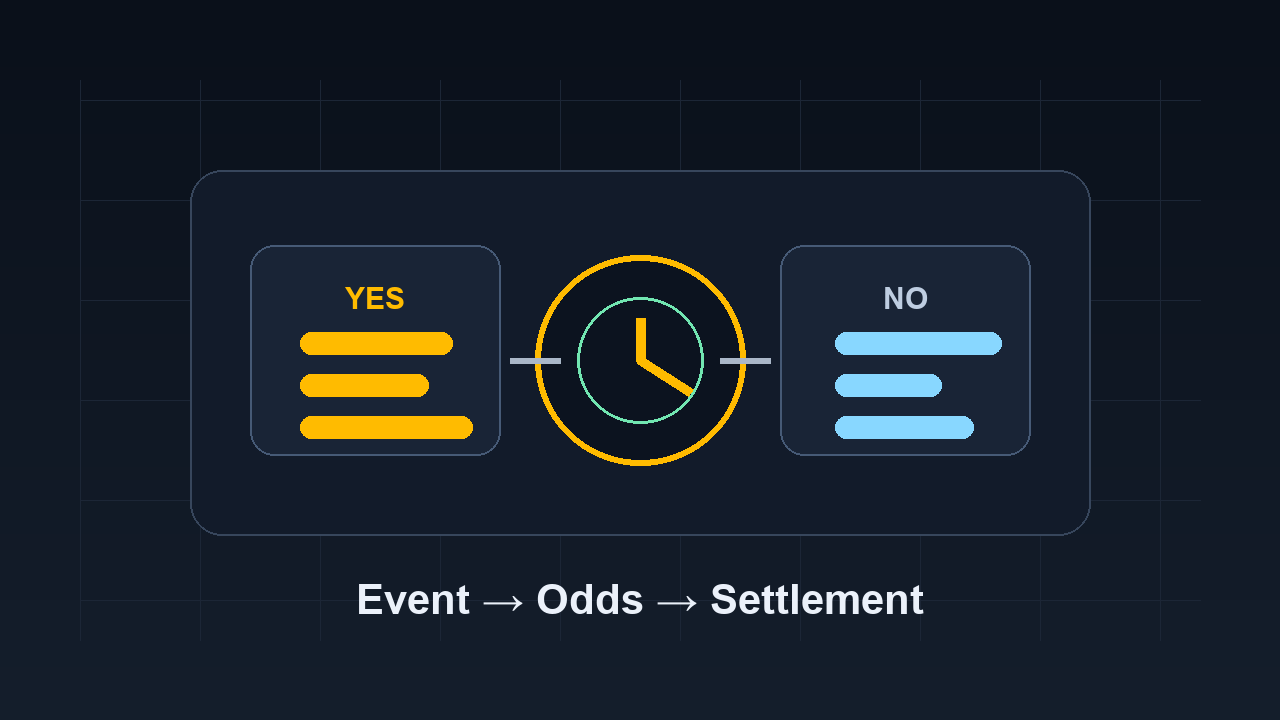
The price is usually the easiest part to understand. If a Yes share trades near $0.65, users often read that as a roughly 65% implied probability. However, this is only a market signal. It can be distorted by thin liquidity, emotional trading, large orders, or unclear settlement rules.
For broader context on crowd sentiment, Tapbit Learn's guide to the crypto fear and greed index explains how quickly market mood can affect crypto decisions.
Decentralized vs. Centralized Prediction Markets
Some prediction markets are crypto-native and decentralized. Others operate more like regulated event-contract exchanges or centralized betting-style platforms.
| Model | How It Usually Works | Main Thing to Check |
|---|---|---|
| Decentralized prediction market | Users trade outcome shares through crypto rails, smart contracts, or stablecoins | Wallet setup, smart contract risk, settlement oracle, regional access |
| Centralized event market | Platform manages accounts, market rules, and settlement | Licensing, eligibility, fees, withdrawals, dispute process |
This difference is important because "prediction market" does not mean one single product type. A user comparing Polymarket, Kalshi, or other event markets should check access, funding method, market rules, and legal status. Tapbit Learn's Polymarket vs Kalshi comparison goes deeper on this platform-level distinction.
Are Prediction Markets Good or Bad?
Prediction markets can be useful because they turn scattered opinions into a tradable signal. They may help users watch how a crowd prices elections, sports, protocol launches, ETF approvals, macro data, or crypto volatility.
But they also have clear limits:
- They can be wrong. A 70% implied probability still means the market sees a 30% chance of failure.
- They can be thin. Low liquidity can make odds jump after a small trade.
- They can be restricted. Regional rules may block access or certain categories.
- They can be emotionally driven. High-profile events may attract hype instead of careful analysis.
So a crypto prediction market is best viewed as a live sentiment tool, not a final answer.
How Crypto Prediction Connects to Trading
Crypto traders watch prediction markets because they can reveal how the crowd is pricing uncertain events. For example, odds around ETF decisions, elections, World Cup winners, or central bank meetings can influence risk appetite.
That does not mean a prediction-market price should be copied into a trade. A better process is to compare it with spot market data, funding, volume, and broader sentiment. Users can view market data on Tapbit to compare crypto prices before making their own judgment.
For event-driven crypto cycles, Tapbit Learn's article on why crypto is up today is also useful because it explains how catalysts and liquidity can move markets together.
How to Evaluate a Crypto Prediction Market
Before using any crypto prediction market, check the basics:
- Market question: Is the event specific and measurable?
- Settlement source: Who decides the final result?
- Liquidity: Can you enter or exit without heavy slippage?
- Fees: Are there trading, withdrawal, or network costs?
- Access: Is the platform allowed in your region?
- Risk controls: Can you afford the possibility of a total loss on a wrong outcome?
For platform transparency habits, users can also review Tapbit's proof of reserves as an example of checking infrastructure before trusting a trading venue. If you want to explore Tapbit's market tools after learning the concept, you can create an account and start with watchlists instead of event contracts.
Conclusion
A crypto prediction market is a trading venue for future outcomes. It can turn event uncertainty into a live price, making it useful for reading crowd expectations. Still, what is crypto prediction market really means more than "betting with crypto." It includes market design, liquidity, settlement, access rules, and the way traders interpret probability.
Used carefully, a crypto prediction market can be a helpful signal. Used blindly, it can become another form of hype.
FAQ
What is crypto prediction?
Crypto prediction means using crypto-based tools, markets, or data to forecast future outcomes. In prediction markets, users trade outcome shares rather than simply publishing opinions.
Are prediction markets good or bad?
They can be useful for reading crowd expectations, but they can also be risky because odds may be wrong, illiquid, or restricted by regulation.
How does a crypto prediction market settle?
Settlement depends on the platform. Some use official data sources, oracles, dispute systems, or predefined resolution rules.
What are the top crypto prediction markets?
Popular names often include Polymarket-style crypto-native markets and regulated event-market platforms. Availability changes by region, so users should verify access and rules directly.
Is a prediction-market price the same as probability?
Not exactly. It can act like implied probability, but liquidity, fees, trader behavior, and market design can make the price imperfect.


