
Blockchain infrastructure is no longer a background feature for crypto exchanges. For many users, it directly affects how quickly they can deposit funds, how much they pay to move assets, and how flexible their trading experience feels.
As crypto adoption grows, users expect more than a trading screen. They expect fast deposits, reliable withdrawals, clear network options, and lower-cost asset transfers. This is why multi-chain support has become an important part of exchange infrastructure.
Tapbit supports the TRON network because TRON has become one of the most widely used blockchain networks for stablecoin transfers, especially USDT through the TRC20 standard. For users who move funds frequently between wallets, exchanges, and trading accounts, TRON can offer a practical balance of speed, cost efficiency, and accessibility.
What Is TRON?
TRON is a public blockchain network designed to support digital assets, decentralized applications, and high-frequency on-chain activity. Its native token is TRX, which is used within the TRON ecosystem for network operations, resource usage, and governance-related activities.
One of the most important parts of the TRON ecosystem is the TRC20 token standard. Similar to how ERC20 tokens operate on Ethereum, TRC20 tokens operate on TRON. This standard allows tokens such as USDT to be issued, transferred, and integrated across wallets, exchanges, and blockchain services that support the TRON network.
For many everyday crypto users, TRON is best known for TRC20 USDT. Because USDT is widely used as a stable trading and transfer asset, the network behind a USDT transfer can make a major difference in speed, fee level, and user convenience.
Why TRON Matters for Crypto Users
The popularity of TRON is closely connected to practical user needs. Many traders do not only buy and sell assets. They also move funds between platforms, transfer stablecoins to other users, rebalance capital, and manage funds across different wallets.
In these situations, three factors matter most: speed, cost, and network availability.
TRON is often chosen for stablecoin transfers because transactions can confirm quickly and network fees are generally lower than on some more congested chains. This makes TRC20 USDT useful for users who make frequent transfers or want to avoid higher transaction costs during busy market periods.
TRON also matters because USDT transfers are a core part of the global crypto trading experience. Stablecoins are commonly used to enter and exit positions, manage volatility, and transfer value between trading venues. Supporting TRON helps give users another practical route for moving stablecoin liquidity.
Why Tapbit Supports TRON
Tapbit supports TRON because exchange infrastructure should match how users actually move assets.
A strong trading platform needs more than spot and futures products. It also needs reliable deposit and withdrawal infrastructure. If a user wants to deposit USDT quickly before entering a trade, or withdraw stablecoins with lower transfer costs, the available blockchain network matters.
By supporting TRON, Tapbit helps users benefit from:
-
More flexible USDT transfer choices
-
Faster deposit and withdrawal experiences
-
Lower-cost transfer options compared with some higher-fee networks
-
Easier movement of assets between wallets and exchanges
-
A more complete multi-chain trading environment
This does not mean one blockchain is always better than another. Ethereum, for example, remains important for DeFi, smart contracts, and deep ecosystem liquidity. Solana may appeal to users looking for high-speed applications. Layer 2 networks such as Arbitrum and Optimism are important for scaling Ethereum-based activity.
The point is choice. Different users have different priorities. Some care most about DeFi access. Some care most about low-cost USDT transfers. Some want speed. Others want ecosystem depth. Tapbit’s role is to provide access to multiple networks so users can select the route that fits their needs.
TRC20 USDT and the Stablecoin Transfer Experience

USDT exists on multiple blockchain networks, including Ethereum and TRON. Although the asset is still USDT, the network selected during a transfer determines where the transaction is processed.
This is why users must always check the correct network before sending funds. ERC20 USDT and TRC20 USDT are not interchangeable during a transfer. Sending assets through the wrong network may cause delays, failed transfers, or difficult recovery situations.
For users who understand the difference, TRC20 USDT can be a practical option. It is commonly used for exchange-to-exchange transfers and wallet-to-exchange deposits because it is designed for efficient value movement on the TRON network.
Tapbit’s support for TRON gives users another way to manage stablecoin transfers while still maintaining access to other blockchain networks.
Tapbit’s Multi-Chain Strategy
Crypto users increasingly operate across more than one blockchain. A single-chain experience is no longer enough for many traders, especially those who move between centralized exchanges, wallets, DeFi protocols, and different ecosystems.
That is why Tapbit continues to support a broader multi-chain infrastructure approach. In addition to TRON, Tapbit’s blockchain support strategy includes major networks such as:
-
Ethereum
-
BNB Smart Chain
-
Arbitrum
-
Optimism
-
Polygon
-
Solana
-
TON
Each network plays a different role. Ethereum remains a foundation for smart contracts and DeFi. BNB Smart Chain is widely used for accessible token transfers and applications. Arbitrum and Optimism help scale Ethereum activity. Polygon supports low-cost Web3 transactions. Solana is known for high-speed blockchain activity. TON brings Web3 closer to social and messaging-based user experiences.
TRON fits into this strategy as a practical network for stablecoin movement, especially for users who value fast and cost-efficient USDT transfers.
CEO Insight
For Tapbit’s leadership, blockchain accessibility is not a small technical detail. It is part of how users evaluate whether an exchange feels complete, reliable, and easy to use.
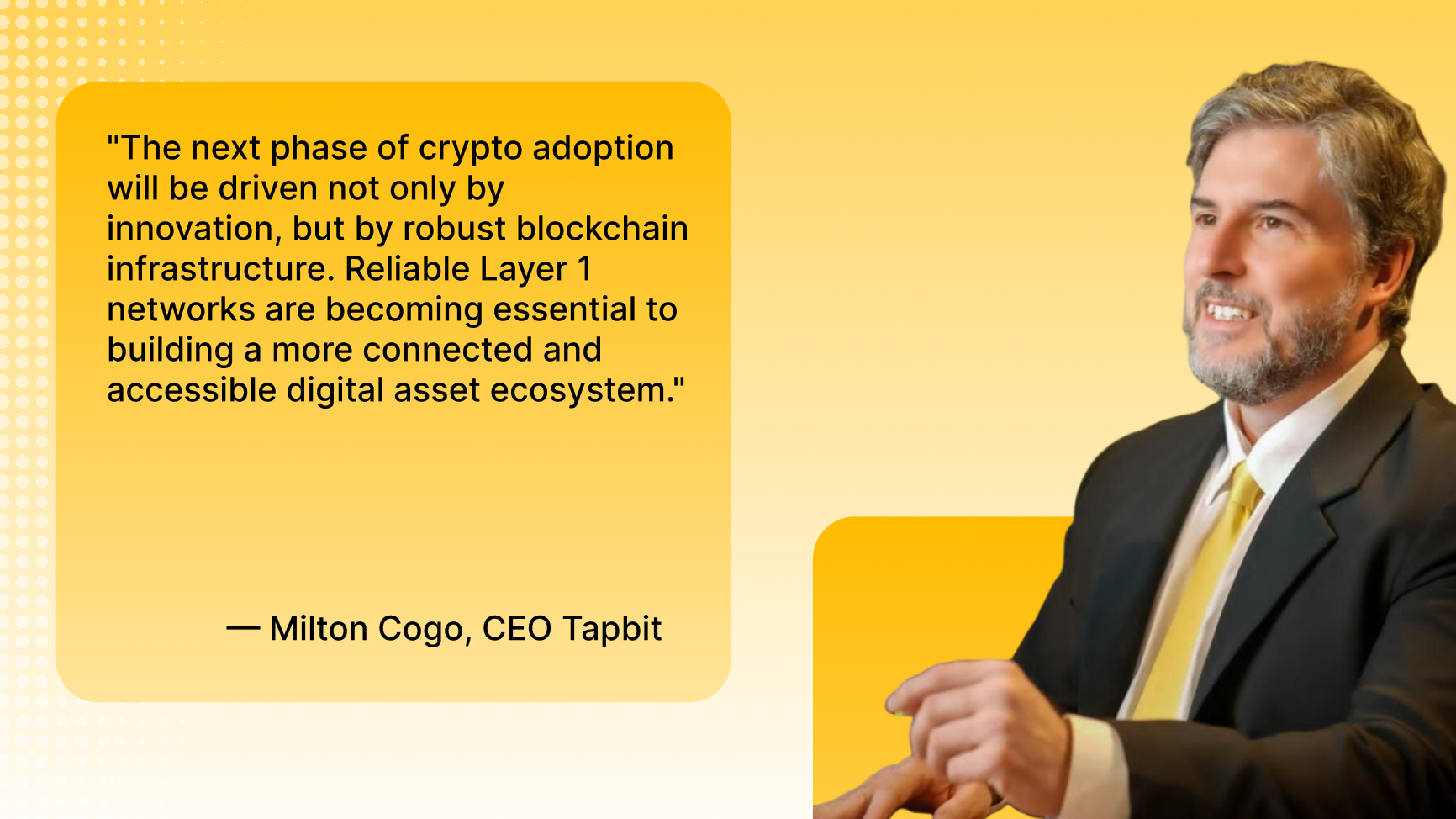
“The next phase of crypto adoption will be driven not only by innovation, but by robust blockchain infrastructure. Reliable Layer 1 networks are becoming essential to building a more connected and accessible digital asset ecosystem.”
— Milton Cogo, CEO of Tapbit
That idea reflects a broader shift in the crypto industry. Exchanges are no longer competing only on trading pairs or market interfaces. They are also competing on infrastructure quality, asset access, transfer efficiency, and user trust.
A user may first come to a platform for trading. But they often stay because deposits are smooth, withdrawals are clear, and the platform supports the networks they use most.
Looking Ahead
As blockchain adoption continues, users will expect exchanges to support more networks, clearer transfer instructions, and better cross-chain asset management.
Tapbit will continue to strengthen its blockchain infrastructure by supporting major networks that improve user choice and transfer flexibility. TRON is an important part of this strategy because it addresses one of the most common user needs in crypto: fast, efficient, and accessible stablecoin transfers.
For traders, multi-chain support is not only about technology. It is about control. The more network choices users have, the easier it becomes to move assets according to their own priorities, whether that means speed, cost, liquidity, or ecosystem access.
Tapbit’s support for TRON reflects this broader commitment: building a more flexible exchange experience for users who need reliable access to crypto markets across multiple blockchain networks.
About Tapbit
Established in 2021, Tapbit is a global digital asset trading platform serving users across more than 190 regions. Offering cryptocurrency derivatives, spot, and copy trading services, Tapbit combines high-performance infrastructure with structured risk management to support efficient trade execution. The platform is committed to fostering a secure, transparent, and user-centric trading ecosystem that aligns with the ongoing maturation of the global digital asset industry.
Connect with Tapbit
For further information about Tapbit and its latest developments, please visit:
-
Official Website: https://www.tapbit.com/
-
X (Twitter): https://x.com/Tapbitglobal
-
Telegram: https://t.me/TapbitGlobalOfficial
-
Instagram: https://www.instagram.com/tapbitofficial
-
LinkedIn: https://www.linkedin.com/company/tapbit/


