

The Martingale trading strategy is one of the most discussed position-sizing methods in trading. It is simple to understand, which is why many beginners notice it early. But that simplicity can be misleading. The strategy is built around increasing trade size after losses, and that can turn a small losing streak into a serious account-risk problem.
In crypto, futures, forex, and other fast-moving markets, Martingale can look attractive because one winning trade may recover several previous losses. The real question is whether the trader has enough capital, margin, discipline, and risk control to survive until that winning trade appears. Many do not.
What Is the Martingale Trading Strategy?
The Martingale trading strategy is a method where a trader increases position size after a losing trade. The goal is to recover prior losses when the next winning trade happens. In its simplest form, the trader doubles the next trade size after each loss.
The idea comes from probability theory, where a repeated bet may eventually produce a favorable outcome. Trading is different. Markets do not follow clean coin-toss logic. Prices can trend for longer than expected, liquidity can change, spreads can widen, and leverage can magnify losses before a reversal arrives.
That is why Martingale should not be treated as a complete trading system. It is mainly a position-sizing framework, and one with very high downside risk if used without strict limits.
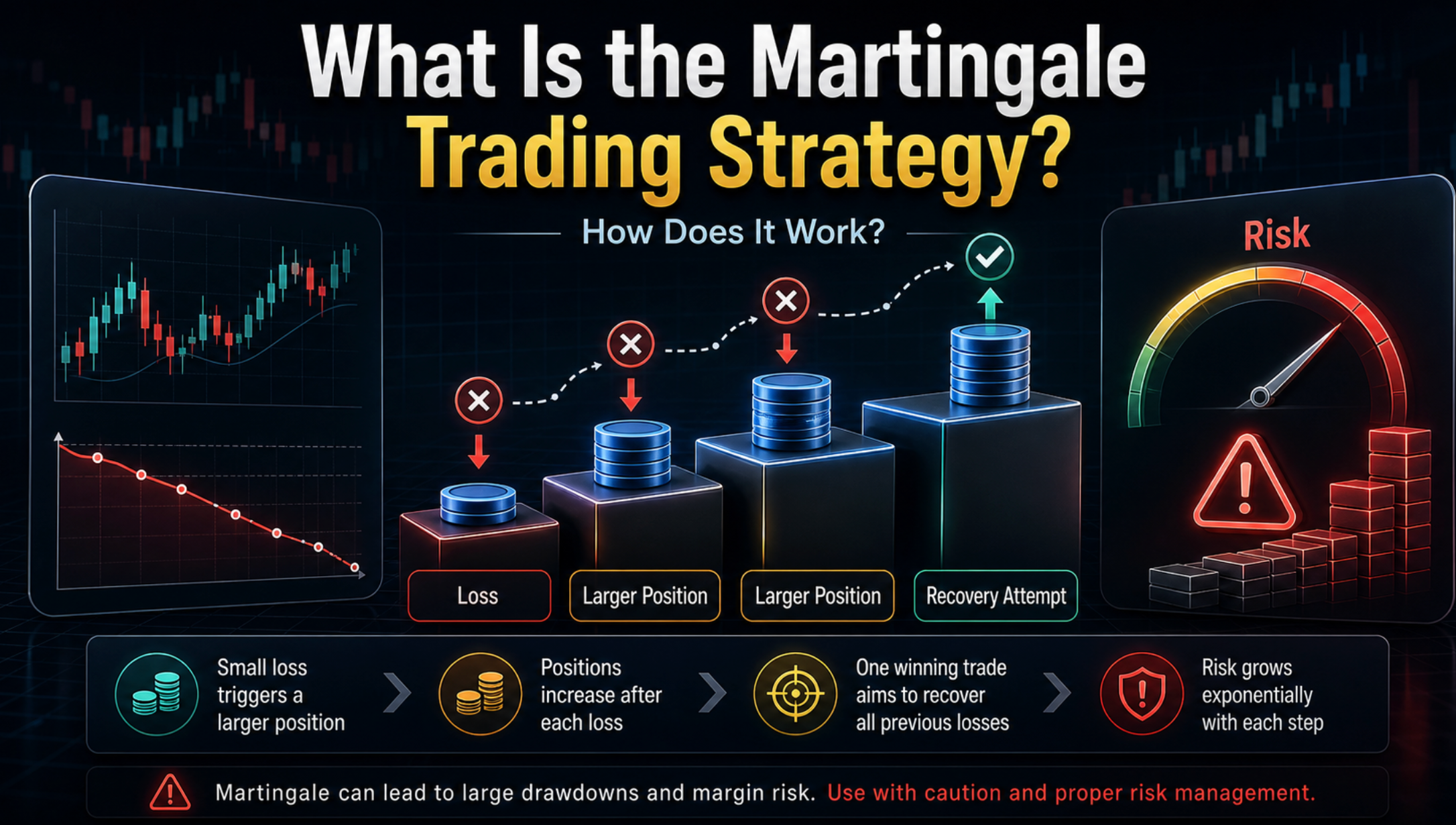
How Does the Martingale Strategy Work in Trading?
A basic Martingale system begins with a small trade. If that trade loses, the trader opens a larger trade in the same direction or under the same trade setup. If the second trade loses, the next position becomes larger again. The strategy keeps increasing exposure until a winning trade recovers the accumulated losses.
| Trade | Result | Example Position Size | Risk Effect |
|---|---|---|---|
| 1 | Loss | $100 | Small initial loss |
| 2 | Loss | $200 | Exposure doubles |
| 3 | Loss | $400 | Drawdown grows faster |
| 4 | Loss | $800 | Margin pressure rises |
| 5 | Win | $1,600 | May recover losses, if capital survives |
The table shows the central problem. Losses do not grow in a straight line; required position size can expand quickly. A trader may be right about a later reversal but still run out of capital before that reversal happens.
Why Traders Use Martingale in Crypto and Futures Markets
Traders use Martingale because it feels logical after a losing trade. If price falls several times, a bounce may seem more likely. If a market is moving sideways, buying lower or selling higher with larger size can sometimes create quick recoveries.
Crypto markets make the strategy especially tempting because sharp rebounds are common. A coin may drop quickly and then bounce within minutes or hours. Futures traders may also use leverage to make recovery trades more powerful.
That is also what makes the method dangerous. Leverage reduces the amount of adverse price movement a trader can survive. A larger recovery position may be liquidated before the market reverses, especially during high volatility.
For users researching platform features beyond active trading, Tapbit’s Earn section provides a place to explore yield-related products and account features. Trading strategies such as Martingale, however, should always be evaluated separately from any passive or yield-focused product because they involve active market risk.
Martingale Trading Strategy Example
Imagine a trader believes Ethereum will rebound from a support zone. The trader opens a long position, but ETH moves lower. Instead of closing the trade, the trader opens a larger long position at a lower price. If ETH rebounds, the average entry price improves and the trader may recover faster.
If ETH keeps falling, the trader now holds a larger losing position. This is the key trade-off. Martingale can reduce the average entry price, but it also increases exposure exactly when the market is proving the original trade idea wrong.
Professional traders may add to positions, but they usually do it with a defined thesis, invalidation level, and maximum risk. Martingale becomes dangerous when it is used mechanically, without a point where the trader accepts that the setup failed.
Main Risks of the Martingale Trading Strategy
The biggest risk is a long losing streak. A trader may believe that several losses in a row are unlikely, but markets can trend aggressively. During a strong move, Martingale keeps increasing exposure against the trend.
The second risk is capital exhaustion. Even if a trader has a high win rate, one extended losing sequence can erase many small wins. This is why Martingale systems often look stable for a while and then fail suddenly.
The third risk is emotional pressure. As trade size grows, every decision becomes harder. Traders may ignore stop-loss levels, add too much margin, or keep increasing size because they feel the next trade must recover everything. That mindset can be costly.
Martingale vs Anti-Martingale Strategy
The anti-Martingale strategy does the opposite. Instead of increasing trade size after losses, it increases size after wins and reduces size after losses. This approach is more aligned with trend-following logic because it adds risk when the trader is performing well and pulls back when conditions are poor.
Martingale tries to recover weakness by adding exposure. Anti-Martingale tries to build on strength while controlling drawdowns. Neither method guarantees profit, but anti-Martingale is often easier to manage for beginners because it does not automatically increase size during losing periods.
Is Martingale a Good Strategy for Beginners?
Martingale is usually not a good strategy for beginners. It requires a strong understanding of probability, margin, volatility, and maximum loss planning. Most new traders focus on the recovery trade and underestimate how fast position size can grow.
A more practical beginner framework is to set a fixed risk per trade, use smaller position sizes, define stop-loss levels before entering, and avoid increasing exposure simply because the previous trade lost. Recovery should come from better trade selection and disciplined risk control, not from forcing a larger next position.
How to Use Martingale More Safely If You Study It
There is no risk-free way to use Martingale. Traders who study it should set a maximum number of adds, a maximum account-risk percentage, and a hard invalidation level before the first trade. Without those limits, the strategy can become an open-ended bet against the market.
It is also important to avoid using high leverage with Martingale. The combination of larger position sizes and leverage can make liquidation risk rise much faster than expected.
Final Verdict
The Martingale trading strategy is easy to explain but difficult to use safely. It increases position size after losses in an attempt to recover with one winning trade. In quiet, range-bound markets, it can appear effective for a while. In trending or volatile markets, it can create severe losses very quickly.
For most traders, Martingale is better studied as a lesson in position sizing and risk control than used as a primary trading system. The strategy’s main weakness is simple: the market can stay unfavorable longer than the trader can stay funded.
FAQ
What is the Martingale trading strategy?
The Martingale trading strategy is a position-sizing method where traders increase trade size after a loss to try to recover previous losses with a future winning trade.
Does Martingale work in crypto trading?
Martingale can work temporarily in range-bound crypto markets, but it is risky because crypto prices can trend sharply and create large losses before a recovery happens.
Why is Martingale risky?
Martingale is risky because position sizes grow quickly during losing streaks. Traders may run out of capital or margin before the next winning trade occurs.
Is Martingale good for beginners?
No. Beginners should usually avoid Martingale because it requires advanced risk control and can lead to large losses if used with leverage or without strict limits.
What is the safest way to use Martingale?
There is no fully safe way to use Martingale. Traders who study it should set strict position limits, define stop-loss rules, avoid high leverage, and never risk more than they can afford to lose.


