
Onyxcoin is popping up in search feeds again. But if you're looking at the chart for a breakout? Not seeing it.
XCN is sitting around $0.0033 right now. CoinGecko and CoinMarketCap have its market cap somewhere between $126M and $131M, with daily volume in the $2.5M–$3.5M range. Oh, and it's still down about 98% from that May 2022 peak.
So what's driving the buzz? Not price action — it's ecosystem stuff. Goliath mainnet went live earlier this year. Onyx Mesh is pitching a new institutional infrastructure story. And the Upbit listing opened the door to Korean won trading. There's also a token unlock coming up, which has people poking around the supply schedule again.
These developments give traders more to discuss, but they do not yet prove that Onyxcoin has achieved broad adoption.
What Is Onyxcoin?
Onyxcoin, identified by the ticker XCN, is the utility and governance token of the Onyx ecosystem. The project began under the Chain brand before the token was renamed Onyxcoin in 2023.
XCN has several proposed uses. Holders can participate in Onyx DAO governance, stake tokens and use XCN to pay for transactions within supported Onyx networks. The token exists on Ethereum and can also operate across other supported networks through bridging infrastructure.
Onyx has gone through several architectural changes. Earlier documentation focused on the Onyx Ledger, a Layer 3 network built around Ethereum and Base. The project has since expanded through Goliath, a separate Layer 1 blockchain where XCN is used as the native token for transaction fees, staking and network security.
That transition is central to the current XCN story. Onyxcoin is no longer being presented only as a governance token attached to a DeFi protocol. The project now wants XCN to support a wider blockchain and financial infrastructure ecosystem.
Goliath Gives XCN a Larger Role
The Goliath mainnet launched in late March 2026 following a public testnet period. It uses proof-of-stake and gives XCN a direct role in consensus, smart contract execution and network transactions.
Validators secure the network by staking XCN. Token holders can also use liquid staking to receive stXCN while keeping exposure to their underlying position.
This gives XCN clearer utility than governance voting alone. If developers, users and financial applications begin using Goliath, demand for network fees and staking could place more XCN inside the ecosystem.
The remaining question is how much activity is genuinely taking place.
A mainnet launch confirms that the infrastructure is available. It does not establish that developers are deploying successful applications or that users are generating meaningful transaction fees. Network usage, validator distribution, active addresses and the amount of non-incentivized liquidity will provide a better view of Goliath’s progress.
The project’s own technical paper also says the Onyx DAO Treasury may proxy-stake XCN to selected nodes during the network’s initial phase. That can help a young network reach consensus, but it makes validator concentration worth monitoring until stake becomes more widely distributed.
What Is Onyx Mesh?
Onyx Mesh was introduced in early July 2026 as part of the project’s push into tokenized finance and institutional blockchain infrastructure.
The design is aimed at organizations that need more control over transactions than a fully public blockchain normally provides. Applications can submit messages to the Onyx network, which timestamps, orders and cryptographically verifies them. Permissioned systems can then use those verified messages while maintaining their own private ledger state and access rules.
The Onyx white paper describes possible applications in regulated financial markets, tokenized assets and central bank digital currencies. The project says this structure could allow institutions to use public consensus while retaining privacy and jurisdiction-specific controls.
That is an interesting technical model, particularly as banks and asset managers explore tokenization. It also places Onyx within a popular market narrative that includes real-world assets, institutional settlement and connections between public and permissioned networks.
What remains missing is verifiable adoption.
Onyx Mesh being technically suitable for banks does not mean banks are already using it. The public material does not yet provide a detailed list of financial institutions processing live transactions through the system, nor does it disclose a meaningful volume of institutional settlements.
For now, Onyx Mesh should be treated as newly launched infrastructure with potential applications. Evidence of customers, recurring transaction volume and commercial revenue would make the institutional story more convincing.
Why Korean Trading Matters for XCN
Upbit added XCN to its KRW and USDT markets on April 27, 2026. The announcement made Onyxcoin directly accessible to South Korean traders through a won-denominated pair.
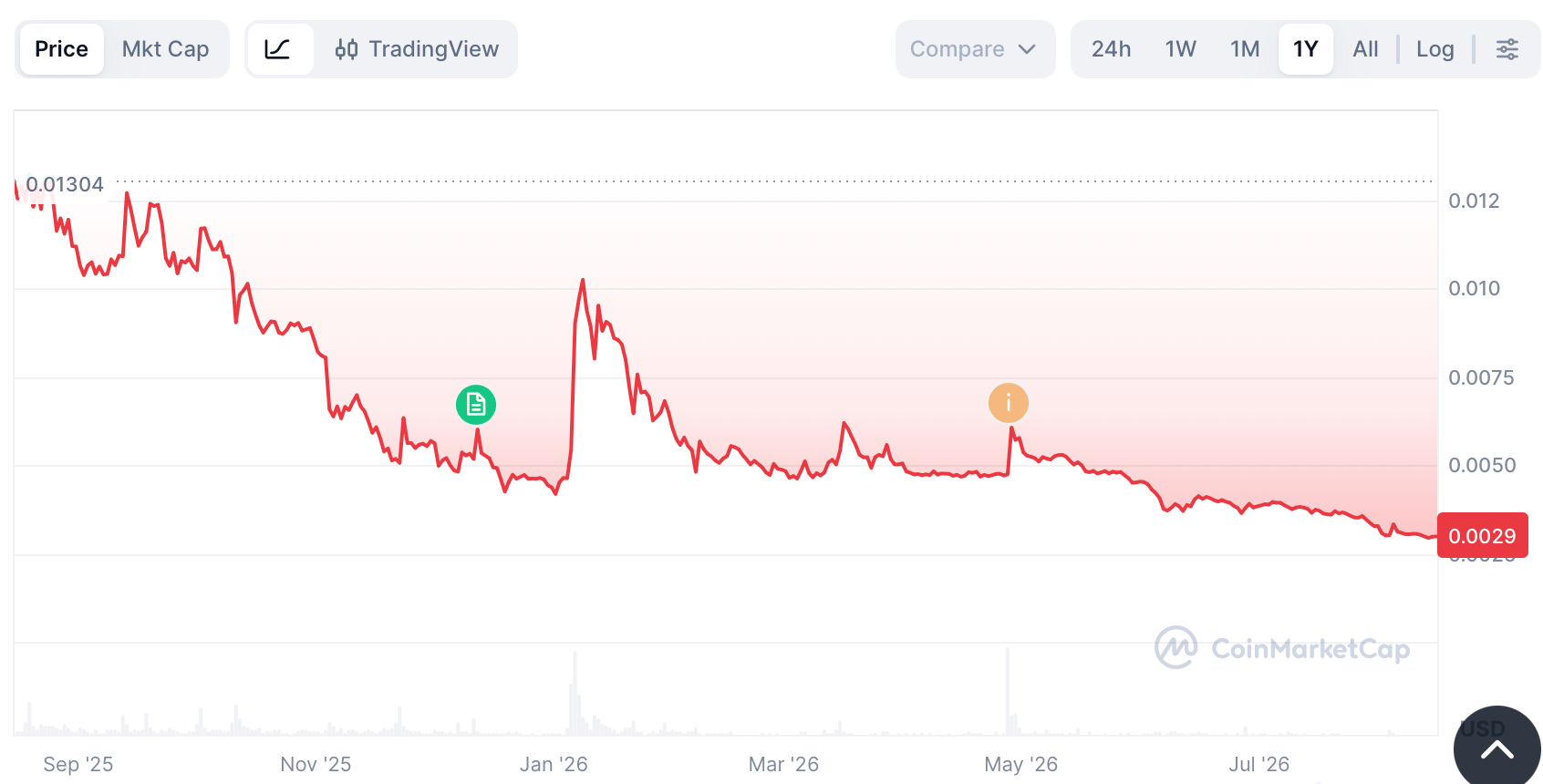
The listing produced an immediate increase in attention and helped XCN reach a three-month price high. It also expanded the token’s liquidity beyond its existing markets on Coinbase, Kraken, Gate and other exchanges.
South Korean listings can have a large effect on smaller cryptocurrencies. KRW pairs reduce the need for local traders to move through stablecoins, while Upbit’s user base can generate substantial activity around newly supported assets.
The effect is not always permanent. A listing changes access, but it does not guarantee sustained demand after the initial announcement. XCN’s current price is well below the level associated with the listing-driven rally, indicating that the early enthusiasm has faded.
Korean trading remains relevant because the KRW market can become an important source of liquidity during another catalyst. Traders should compare prices across exchanges, watch the share of global volume coming from Korea and look for signs of an unusually large regional premium.
A sharp increase in KRW volume without a corresponding project announcement could reflect local speculation rather than a change in Onyxcoin’s fundamentals.
The August Token Unlock
Supply is one of the more immediate issues facing XCN. CoinGecko’s unlock tracker estimated that approximately 296.38 million XCN would be released on August 15, 2026. The amount represented around 0.55% of the reported total supply. Approximately 197.37 million XCN was allocated to the Foundation and 99.01 million XCN to the DAO Treasury.
The unlock is not especially large as a percentage of the total supply. It is more significant when compared with XCN’s daily trading volume. At a price near $0.0033, the unlocked tokens have a market value close to $1 million, while reported daily spot volume has recently remained in the low single-digit millions.
Unlocked tokens are not automatically sold. Foundation and treasury allocations may remain in their existing wallets or be used for development, grants, staking and ecosystem incentives. The release simply removes a restriction that previously prevented the tokens from becoming transferable.
Wallet activity will therefore matter more than the unlock calendar by itself. Transfers to exchanges would suggest potential selling pressure, while movement into staking or long-term treasury contracts would have a different implication.
What Could Support Onyxcoin?
A stronger case for XCN would require evidence that the project’s recent launches are producing economic activity.
Goliath could create demand if it attracts developers, applications and users who need XCN for gas and staking. Onyx Mesh could strengthen the institutional narrative if the team discloses recognizable customers, live deployments or transaction volumes. Continued access to the Korean market could also improve liquidity when new project developments emerge.
Staking may reduce the amount of XCN available for immediate trading, but the quality of that signal depends on where the tokens come from. Tokens staked by independent holders carry a different meaning from treasury-controlled tokens placed with selected validators.
The most useful indicators will be active addresses, transaction fees, application deposits, validator concentration and exchange net flows. These figures can show whether XCN utility is expanding beyond incentive programs and governance announcements.
What Comes Next for XCN?
Onyxcoin has more infrastructure behind it than it did a year ago. Goliath is live, XCN has gained native network utility, Upbit has opened a Korean market, and Onyx Mesh gives the project a place in the institutional tokenization discussion.
The next stage is less about announcements and more about usage. Evidence that developers are building on Goliath, independent validators are securing the network and real organizations are using Onyx Mesh would support the project’s new direction. Without that evidence, XCN may continue to trade mainly around listings, unlocks and narrative-driven speculation.
For traders following XCN, the most important signals are likely to come from network data, Korean trading volume and treasury wallet activity. Those indicators can help distinguish lasting adoption from another temporary rise in attention.
Readers can follow broader cryptocurrency research and market coverage through Tapbit. Existing users can log in here, while new users can create an account.
Frequently Asked Questions
What is Onyxcoin (XCN)?
Onyxcoin is the utility and governance token of the Onyx ecosystem. XCN is used for transaction fees, staking, network security and voting on proposals through the Onyx DAO.
Why is Onyxcoin back in focus?
Recent attention has followed the launch of the Goliath mainnet, the introduction of Onyx Mesh and XCN’s listing on Upbit’s KRW market. Its scheduled token unlock has also renewed discussion about circulating supply and potential selling pressure.
What is the Goliath network?
Goliath is a proof-of-stake Layer 1 blockchain developed within the Onyx ecosystem. XCN serves as its native token and can be used for gas fees, validator staking, smart contract execution and governance.


