
The S&P 500 hit 7,798.99 on August 13, up 0.7% on the day. That brings the year-to-date gain to about 13.9%, and leaves the index less than 3% shy of the 8,000 round number that several strategists have been eyeing.
This latest leg came on the back of cooler inflation data, another solid earnings season, and the ongoing AI capex wave. Falling oil prices also helped, easing some of the supply-side jitters tied to the Middle East.
Still, there's a less comfortable side to the rally. The Fed is still on hold, Treasury yields remain elevated, and earnings growth is still heavily concentrated in a few large tech names.
New record aside, the market has shifted gears. It's no longer pricing in a recovery that might happen. It's pricing in earnings that need to happen. That's a different game.
The S&P 500 Moves Into Its Forecast Range
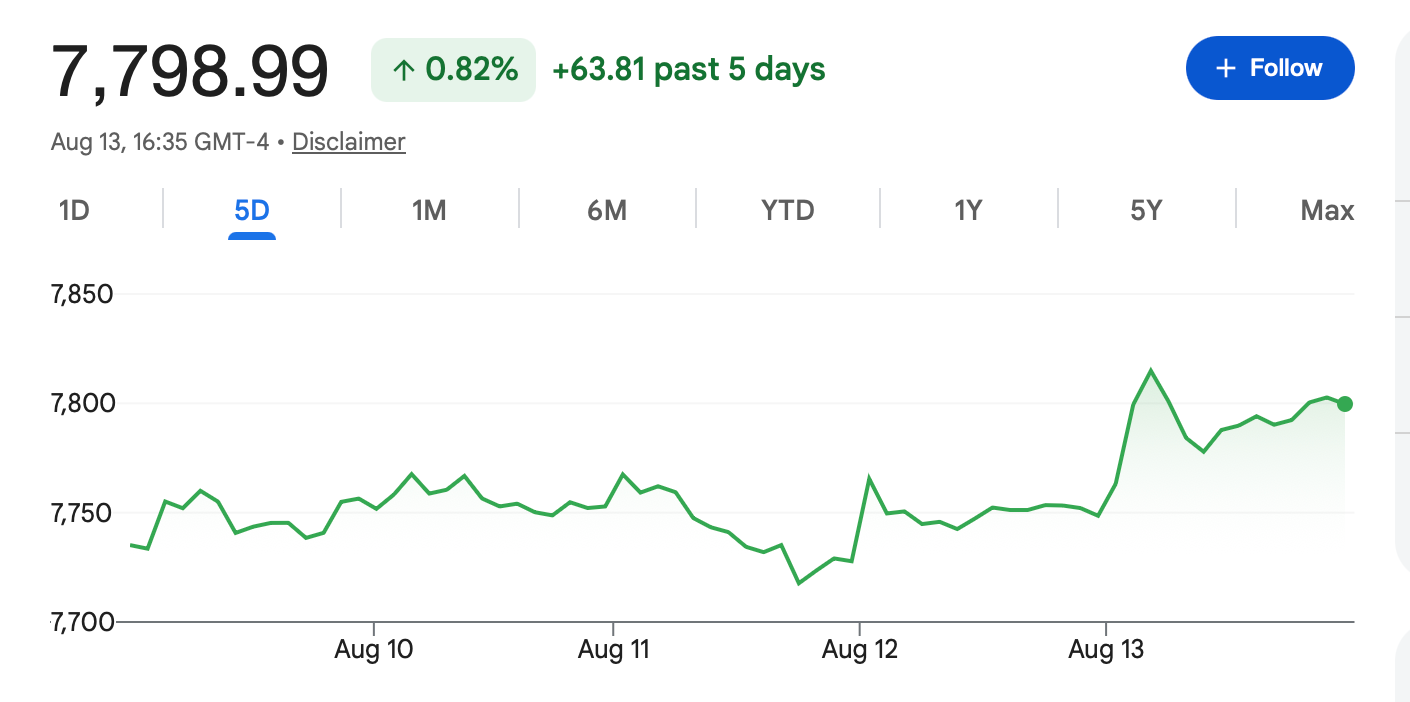
The S&P 500 gained 50.49 points on August 13 to close at 7,798.99, surpassing its previous record. The Nasdaq Composite rose 0.8% to 26,803.03, while the Dow Jones Industrial Average added 0.1%.
The index’s 2026 gain has already carried it into the 7,800 to 8,100 range that many forecasts previously treated as a year-end scenario. Goldman Sachs raised its 2026 target to 8,000 in May, citing stronger earnings and continued AI investment.
At the time, the target implied a return of roughly 6%. From the August 13 close, reaching 8,000 would require a further gain of only about 2.6%.
That changes the discussion around the target. An 8,000 forecast is no longer a particularly aggressive call. It is a nearby level that the market could reach during an ordinary period of volatility. The more important question is whether earnings can support the index after it gets there.
Goldman Sachs Research currently expects corporate profit growth, rather than higher valuation multiples, to provide most of the market’s support.
Inflation Data Gave Stocks Some Breathing Room
July’s inflation reports helped reduce fears that the Federal Reserve would need to raise rates again. The Consumer Price Index increased 0.1% in July after falling 0.4% in June. Over the previous 12 months, headline CPI rose 3.4%, down slightly from 3.5% in June.
Core CPI, which excludes food and energy, increased 0.2% for the month and 2.5% from a year earlier. Shelter costs rose 0.1%, while the energy index fell 1.5%.
The figures point to slower inflation, although they do not show that the problem has disappeared. Energy prices were still 14.7% higher than a year earlier, reflecting the effect of the Middle East conflict and earlier oil price increases.
Producer prices delivered a similar message. The Producer Price Index was unchanged in July after declining 0.1% in June. Its annual increase slowed from 5.5% to 4.7%.
A narrower measure excluding food, energy and trade services rose 0.4% during the month and 4.7% over the year. Headline pressure is easing, but some underlying business costs remain elevated.
The market responded to the direction of the data. Treasury yields declined, and traders reduced the probability they assigned to a September rate increase. That was enough to support equities, even though inflation remains above the Federal Reserve’s target.
The Federal Reserve Has Not Turned Dovish
Falling inflation does not mean the Federal Reserve has moved into an easing cycle. At its July meeting, the Federal Open Market Committee kept the federal funds rate between 3.50% and 3.75%. The decision passed by a 9-to-3 vote, with three officials preferring a quarter-point rate increase.
The statement described economic activity as solid and noted strong productivity growth and capital investment. It also said inflation remained elevated relative to the central bank’s 2% goal, partly because of energy-related supply shocks.
This is a more divided policy environment than a simple “rate cuts are coming” narrative suggests. Softer inflation may allow the Fed to remain on hold, but a renewed increase in oil prices or another acceleration in core inflation could reopen the debate over higher rates.
The market currently benefits from a lower perceived risk of tightening. It does not yet have confirmation of an easier policy.
Corporate Earnings Are Carrying More of the Rally
Another strongest argument for the S&P 500’s record is corporate earnings. By August 11, approximately 88% of index companies had reported second-quarter results. Among those companies, 86% delivered a positive earnings surprise and 76% reported revenue above expectations, according to FactSet data cited by Kiplinger.
Those figures show that the rally is not based solely on higher valuation multiples. Many large companies are producing better financial results than analysts expected.
The headline earnings growth rate still needs context. Earlier FactSet data placed blended second-quarter earnings growth at 37.9%. Excluding an unusually large gain reported by Alphabet, the rate would have been 25.9%. A later calculation found that removing both Alphabet and Amazon would reduce estimated growth from 47.4% to 28.8%.
Underlying earnings growth remains strong after those adjustments. The issue is that index-level figures can be distorted by large non-operating gains at a few companies. Investors should look at revenue, operating margins and forward guidance alongside the headline earnings number.
AI Spending Remains a Major Market Driver

Goldman Sachs estimated that the largest cloud computing companies could spend approximately $670 billion in 2026. That money is moving into semiconductors, servers, data centers, power systems, cooling equipment and networking infrastructure.
The bank also estimated that AI investment could account for roughly 40% of S&P 500 earnings growth during the year. This helps explain why semiconductor and infrastructure companies have had such a large effect on the index.
AI spending is no longer supported only by expectations about future technology. Chipmakers, cloud providers and data center suppliers are reporting real orders and revenue. That gives the theme more financial support than it had during earlier speculative periods.
The harder question is whether customers will eventually earn an adequate return on the money being spent. Hyperscalers cannot raise capital expenditure indefinitely without showing that AI products generate revenue, improve productivity or reduce operating costs.
If those returns become visible, AI could support several more years of earnings growth. If spending grows faster than commercial demand, current estimates may prove too optimistic.
A Record Index Can Still Be a Concentrated Market
The S&P 500 contains approximately 500 leading U.S. companies, but they do not have equal influence. Because the index is weighted by market capitalization, its largest companies have the greatest effect on performance. Research from S&P Dow Jones Indices found that the ten largest constituents represented close to 40% of the index, a concentration level not seen since the mid-1960s.
This concentration has helped the S&P 500 while large technology companies have delivered strong growth. It can work in the opposite direction if earnings disappoint or investors reduce the valuations assigned to AI-related stocks.
A market rally becomes more durable when gains spread across sectors and company sizes. Recent strength in financials, industrials, energy and smaller companies is therefore worth watching. The Russell 2000 was up 23% for the year through August 13, outperforming the S&P 500’s 13.9% gain.
Broader participation would reduce the index’s dependence on a handful of technology leaders.
What Could Take the S&P 500 Above 8,000?
The index does not need a dramatic new catalyst to reach 8,000. It is already close enough that normal market movement could carry it across the level.
Staying above 8,000 would require more. Corporate guidance needs to support current earnings estimates. AI spending must continue producing revenue for chip, cloud and infrastructure companies. Inflation needs to remain controlled without a severe slowdown in economic activity.
It would also help if the rally continued to broaden. Strong performance from financials, industrials, healthcare, consumer companies and smaller stocks would make the market less vulnerable to a correction in a few mega-cap names.
Lower Treasury yields could provide additional support, but that outcome depends on inflation, economic data and Federal Reserve policy.
What Matters After the Record
The S&P 500 has reached a record because several conditions have aligned. Inflation is moving in a more favorable direction, corporate earnings are beating expectations, AI investment remains strong and oil prices have eased from recent highs.
The rally has more fundamental support than a move driven entirely by sentiment. It also carries demanding assumptions about future profits.
At nearly 7,800, the index has already reached the lower end of forecasts once treated as year-end targets. The next phase will depend less on whether strategists raise their targets and more on whether companies deliver the earnings needed to justify them.
Readers can follow global asset markets and access further market coverage through Tapbit. Existing users can log in, while new users can create an account.
Frequently Asked Questions
Why is the S&P 500 at a record high?
The index has been supported by strong corporate earnings, continued AI investment, softer inflation data and lower oil prices. Reduced expectations of an immediate Federal Reserve rate increase also helped market sentiment.
What was the S&P 500’s latest closing level?
The S&P 500 closed at 7,798.99 on August 13, 2026. It gained 0.7% during the session and was up approximately 13.9% for the year.
Can the S&P 500 reach 8,000 in 2026?
It is already less than 3% below that level. Reaching 8,000 is possible, but maintaining it will depend on earnings growth, inflation, interest rates and the performance of large technology companies.


