

Dogecoin can reach $1 mathematically, but the market conditions required would be exceptional. From the supplied DOGE/USDT price of $0.06988, DOGE must rise about 1,331%, equivalent to a 14.3x increase. Its market capitalization would also need to exceed $150 billion based on its approximate circulating supply.
That is achievable only if Dogecoin attracts sustained capital rather than experiencing another temporary social-media rally. Traders can monitor the live market or trade DOGE/USDT on Tapbit, but the $1 target should be treated as a high-end scenario rather than an expected outcome.
What Does the Current DOGE/USDT Chart Show?
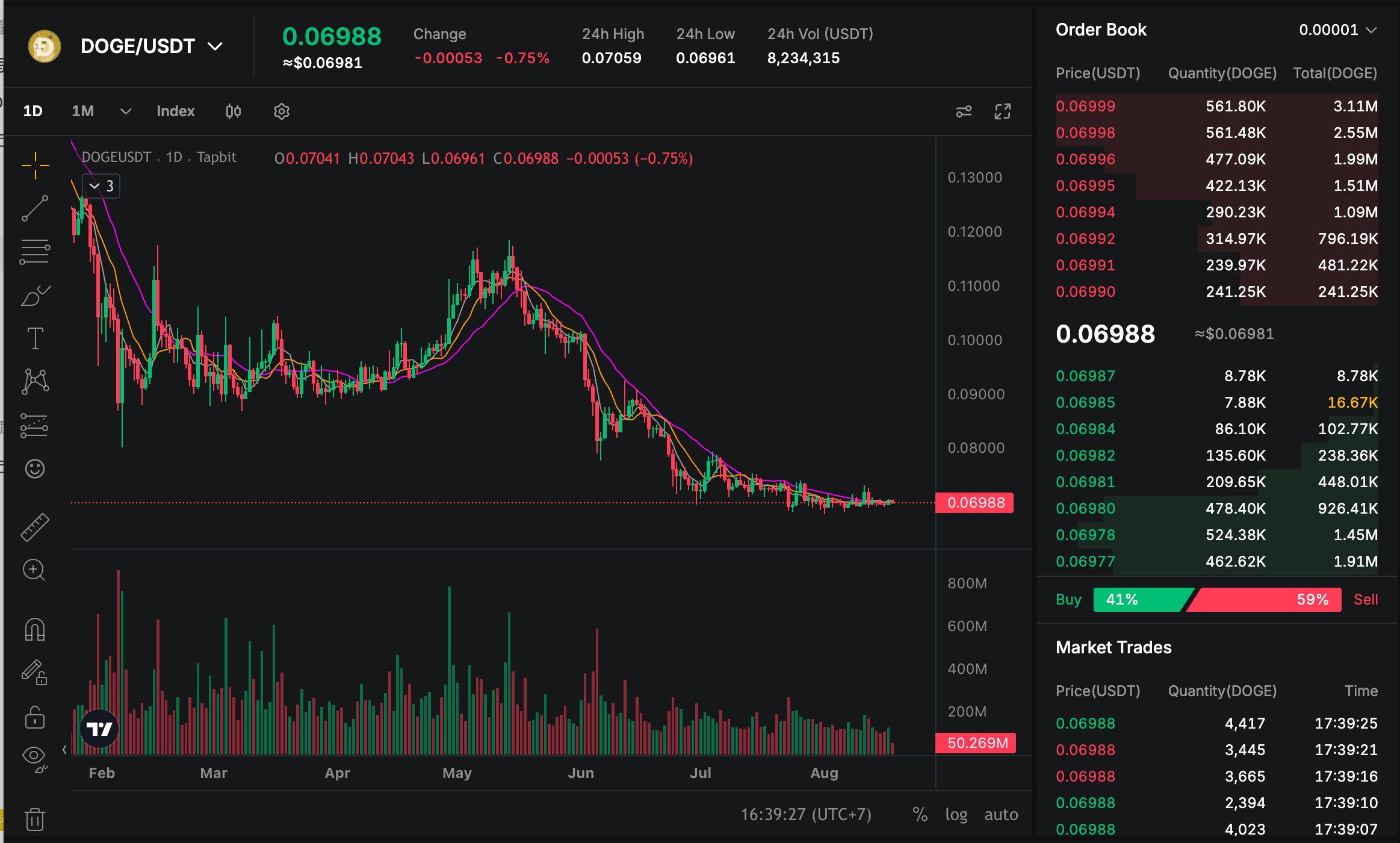
The supplied Tapbit snapshot displays DOGE/USDT at $0.06988. Its visible 24-hour range runs from $0.06961 to $0.07059, while the daily chart shows a broader decline from approximately $0.12.
DOGE attempted several rebounds during the period, including moves toward $0.10–$0.11, but each rally eventually lost momentum. Price later stabilized near $0.07 as volume declined. A stronger recovery would require DOGE to establish higher lows, break above previous resistance, and attract expanding trading volume.
How Much Must Dogecoin Rise to Reach $1?
The calculation is straightforward: $1 ÷ $0.06988 = 14.31. DOGE therefore needs to become approximately 14.31 times more valuable, representing a gain of about 1,331%.
| DOGE Price | Gain From $0.06988 | Price Multiple |
|---|---|---|
| $0.10 | 43% | 1.43x |
| $0.25 | 258% | 3.58x |
| $0.50 | 616% | 7.16x |
| $0.75 | 973% | 10.73x |
| $1.00 | 1,331% | 14.31x |
These intermediate targets provide a more practical framework. DOGE must first reclaim $0.10, then prove that demand can support progressively larger valuations at $0.25 and $0.50.
What Would Dogecoin Be Worth at $1?
Dogecoin does not have a fixed maximum supply. Its mining system issues approximately five billion new DOGE annually. Although the percentage inflation rate declines as the total supply grows, demand must continue absorbing the additional coins.
| DOGE Price | Approximate Market Capitalization |
|---|---|
| $0.10 | Above $15 billion |
| $0.25 | Above $37.5 billion |
| $0.50 | Above $75 billion |
| $1.00 | Above $150 billion |
A market capitalization above $150 billion would place Dogecoin among the world’s largest crypto assets. Maintaining such a valuation would require deep liquidity and lasting demand.
Bull Case: What Could Push DOGE Toward $1?
Dogecoin’s strongest advantage is its brand. During a powerful market cycle, that familiarity can help DOGE capture retail liquidity faster than lesser-known altcoins.
- Bitcoin enters a sustained bull market and lifts overall risk appetite.
- Retail investors return to large meme coins.
- DOGE gains new payment, tipping, or platform integrations.
- Trading volume rises across major spot markets.
- DOGE breaks major resistance without immediately losing the gains.
A gradual rally supported by volume and adoption would create a stronger foundation than a vertical move caused by a few social-media posts.
Base Case: A Recovery That Stops Below $1
Dogecoin does not need to reach $1 to deliver a substantial rally. A move to $0.20 would already represent an increase of about 186%, while $0.30 would require approximately 329%.
A base scenario could see DOGE reclaim $0.10, trade toward $0.20–$0.30 during an altcoin rally, and then consolidate as early buyers take profits. This reflects Dogecoin’s established presence without assuming that it immediately becomes a $150 billion asset.
Bear Case: Why Dogecoin May Not Reach $1
Dogecoin’s popularity does not guarantee permanent demand. Its price remains heavily influenced by sentiment, social narratives, and speculative capital.
- Continued DOGE issuance through mining
- Competition from newer meme coins
- Weak growth in real payment activity
- Large holders selling into rallies
- Declining volume after promotional events
- A prolonged Bitcoin or altcoin bear market
When DOGE rises quickly, short-term holders may rush to realize gains. That selling pressure can prevent the market from holding important levels even after a successful breakout.
DOGE Levels That Matter Before $1
The first important level is $0.10. The next zones are $0.12–$0.13, $0.20–$0.25, $0.50, and $0.75. Volume should expand alongside a breakout. If DOGE rises while volume continues declining, the move may have limited support.
Repeated rejection below $0.10 would weaken the near-term recovery case, while a sustained move below the current consolidation zone would reinforce the broader downtrend.
Conclusion
Dogecoin can reach $1, but it needs far more than a brief meme-coin rally. From $0.06988, the target requires a 14.3x increase and a market capitalization above $150 billion.
The more realistic path would involve first reclaiming $0.10, then proving that demand can support $0.25 and $0.50. The $1 target becomes credible only if those gains are supported by sustained volume, broader crypto-market strength, and stronger reasons to use or hold DOGE.
Frequently Asked Questions
Can Dogecoin realistically reach $1?
Yes, but it would likely require an exceptional crypto bull market, strong retail participation, and sustained demand capable of supporting a valuation above $150 billion.
How much must DOGE rise to reach $1?
From $0.06988, DOGE needs to rise approximately 1,331%, equivalent to a 14.3x increase.
What market cap would Dogecoin have at $1?
With more than approximately 150 billion DOGE in circulation, the market capitalization would exceed $150 billion.
Does Dogecoin have a maximum supply?
No. Dogecoin has no fixed supply cap. Approximately five billion new DOGE are issued through mining each year.
Can DOGE reach $0.25 before $1?
Yes. From the supplied price, $0.25 requires an increase of about 258%, making it a more realistic intermediate target than an immediate move to $1.


